

The Quarantined Jazz Voyager
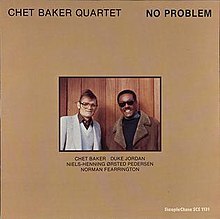
My choice this week is the album No Problem by the Chet Baker Quartet featuring Duke Jordan. The album was produced by Nils Winther, recorded at Sweet Silence Studios, Copenhagen, Denmark on October 2, 1979 and released the following year on the Steeplechase label. The recording engineers were Freddy Hansson and Thomas Brekling, with Tom West holding down the assisting engineer role.
This session came during Baker’s resurgence from losing his embouchure from a beating that broke his tooth, more than likely related to an attempted drug buy, though the story is a bit hazy. After getting dentures he developed a new embouchure in the Seventies and began a more mellow and wavering playing style. There’s always his signature vocals present during this period in his career.
Track List | 51:19 All compositions by Duke Jordan- No Problem ~ 9:45
- Sultry Eve ~ 7:04
- Glad I Met Pat ~ 5:08
- Kiss of Spain ~ 7:15
- The Fuzz ~ 6:05
- My Queen Is Home to Stay ~ 7:13
- Jealous Blues ~ 8:48 (Bonus Track On CD)
- Chet Baker ~ trumpet
- Duke Jordan ~ piano
- Niels-Henning Ørsted Pedersen ~ bass
- Norman Fearrington ~ drums

More Posts: bandleader,history,instrumental,jazz,music,piano,trumpet
Daily Dose Of Jazz…
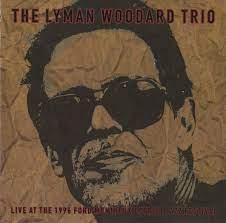
Lyman Woodard was born on March 3, 1942 in Owosso, Michigan. He started his musical career with a trio with drummer Melvin Davis and guitarist Dennis Coffey. They recorded the album Hair And Thangs that was released under Coffey’s name, however a single with It’s Your Thing and River Rouge was released under the name of Dennis Coffey and the Lyman Woodard Trio.
From the late 1960s, Woodard recorded with Motown acts, and served as musical director for Martha and the Vandellas. Establishing the jazz~funk band, the Lyman Woodard Organization in 1975 recorded Saturday Night Special, and in 1979, he recorded Don’t Stop The Groove, for the Corridor label. His 1987 recording, Dedicacion, featured violinist Regina Carter.
In March 2009, Wax Poetics Records reissued a limited pressing of his Saturday Night Special as a double LP on 180-gram vinyl.
Organist Lyman Woodard, who was based in Detroit, Michigan and was known for his ability to fuse Latin and Afro~Cuban inspired rhythms, transitioned on February 25, 2009 in his hometown of Owosso.
More Posts: bandleader,history,instrumental,jazz,music,organ,piano
Daily Dose Of Jazz…
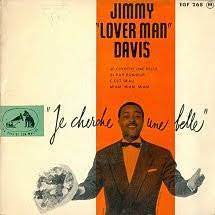
James Edward Davis was born in 1915 in Madison, Georgia. He and his family moved to Gary, Illinois, and then to Englewood, New Jersey, where he completed his high school education. Being musically gifted, he was accepted into the Juilliard School in New York City to study piano and composition, his fees being paid by a benefactress.
In the late 1930s he wrote the song Lover Man (Oh, Where Can You Be?) with Ram Ramirez but could not initially place it, until he offered it to Billie Holiday in 1942. However, due to the 1942–44 musicians’ strike Holiday didn’t record the song until 1944. Although at first it was only a minor hit, it soon achieved widespread success and went on to become a jazz standard.
During the early 1940s Davis struggled to make a living as a songwriter and supplemented his meagre royalties by giving piano lessons. Drafted in 1942, but as a member of the NAACP, refused enlistment into the segregated regiment, was ultimately imprisoned for thirteen days, then inducted into the army, serving three and a half years. By 1945, as a warrant officer, he was sent to France for six months, and learned the language. Back home, upon his discharge he left for Hollywood, joined the Actors’ Laboratory Theatre, however his acting career only offered stereotypical racial roles. At the end of 1947 he emigrated to France.
Warmly welcomed in Paris, in part, due to the fame of the song Lover Man, he styled himself Jimmy “Lover Man” Davis and entered a highly creative period, writing a number of songs and placing them with major French performers, such as Yves Montand, Maurice Chevalier, and Joséphine Baker. His songwriting royalties were still insufficient to live on, so he began singing his own songs in solo performances, touring through France, Italy, Holland, Spain, Switzerland and other countries.
Composer, songwriter, vocalist, pianist and actor Jimmy Davis, whose birth and death dates are currently unknown, and who was a close friend of Langston Hughes, transitioned in Paris, France in 1997. His biography, In Search of Jimmy ‘Lover Man’ Davis, was written by Professor François Grosjean.
More Posts: composer,history,instrumental,jazz,music,piano,songwriter,vocal
Daily Dose Of Jazz…
James Reese Europe was born on February 22, 1881 in Mobile, Alabama and in 1891 his family moved to Washington, D.C. In 1904 he moved to New York City and six years later he organized the Clef Club, a society for Black Americans in the music industry. In 1912, the club, with its 125 members who played in various configurations, made history when they became the first band to play a proto-jazza concert at Carnegie Hall for the benefit of the Colored Music Settlement School.
The importance of this historic concert is that it took place 12 years before the Paul Whiteman and George Gershwin concert at Aeolian Hall, and 26 years before Benny Goodman’s famed concert at Carnegie. The Clef Club’s performances played music written solely by Black composers, including Harry T. Burleigh and Samuel Coleridge-Taylor.
In 1913 and 1914 Jim made a series of phonograph records for the Victor Talking Machine Company. These recordings are some of the best examples of the pre-jazz hot ragtime style of the U.S. Northeast of the 1910s, predating and protecting the idea that the Original Dixieland Jass Band recorded the first jazz pieces in 1917 for Victor.
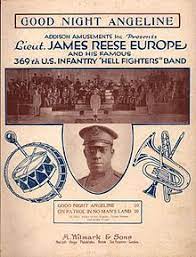
Europe was known for his outspoken personality and unwillingness to bend to musical conventions, particularly in his insistence on playing his own style of music. During World War I, Europe obtained a commission in the New York Army National Guard, where he fought as a lieutenant with the 369th Infantry Regiment otherwise known as the “Harlem Hellfighters” when it was assigned to the French Army. He went on to direct the regimental band to great acclaim. They made their first recordings in France for the Pathé Brothers.
Returning home in 1919 he made more records for Pathé with Noble Sissle and continued to lead his band. During a talk backstage with two of his drummers, Steve and Herbert Wright about their stage behavior, Herbert got agitated and stabbed Europe in the neck with a pen knife. The show went on, Jim went to the hospital but doctors were unable to stem the flow of blood.
Arranger, composer and bandleader Jim Europe, who also played piano and violin, and was the leading ragtime and early jazz figure on the Negro music scene of New York City in the 1910s, transitioned on May 9, 1919.

More Posts: arranger,bandleader,composer,history,instrumental,jazz,music,piano,violin

Requisites
No Blues ~ The Horace Parlan Trio | By Eddie CarterThere’s nothing I enjoy more than listening to a piano trio album and that’s what prompted this morning’s discussion. The Horace Parlan Trio steps into the spotlight with their 1976 album, No Blues (SteepleChase Records SCS-1056). Horace was born in Pittsburgh, Pennsylvania, and was stricken with polio as a child, partially paralyzing his right hand. As a result, he developed a left-hand chord-voicing style and an ability to play with the right hand effectively. Parlan was discovered by Charles Mingus and spent two years with his Jazz Workshop. Over his lengthy career, he recorded with some of the elite musicians in jazz as a leader and sideman. On this date, Horace is joined by a burning rhythm section, Niels-Henning Ørsted Pedersen on double bass, and Tony Inzalaco on drums. The copy used in this report is a friend’s original Danish Stereo release.
Side One gets underway with the trio’s mid~tempo theme on Miles Davis’ No Blues. Horace swings blissfully into the opening solo with flawless execution. Niels-Henning bounces into the second statement with efficient ease, and Tony executes some nifty drumming in a conversation with the piano ahead of the threesome’s reprise and exit. My Foolish Heart by Victor Young and Ned Washington is one of the prettiest jazz standards in The Great American Songbook. Parlan has the solo showcase to himself and applies an equal amount of warmth and tenderness with Pederson and Inzalaco gracefully moving in the background towards a gentle ending. The tempo moves up rapidly for Richard Rodgers and Lorenz Hart’s Have You Met Miss Jones? Tony takes flight first on a brief intro, then Horace kicks off the melody swiftly. Parlan and Inzalaco make it a brightly swinging affair with two energetic readings before the close.
A Theme For Ahmad is Horace’s very moving tribute to Ahmad Jamal. As the song’s only soloist, he gives an elegant performance that’s quite beautiful with Niels-Henning and Tony adding their subtle support into a gorgeous finale. Side Two starts with one of the best-known tunes by Randy Weston, Hi-Fly. Parlan begins with a very pretty introduction segueing into the threesome’s laid-back and tasty opening chorus. Horace takes the lead and swings easily with sprightly notes, then Tony adds a short soulful statement ahead of the ending theme. Up next is a beautiful song by Austin Wells, West of Eden. The rhythm has a bouncing beat and tropical flavor that the ensemble portrays on the melody. Parlan has the only solo spotlight again and gives a delightful interpretation preceding the group’s slow disappearance into nothingness.
The pace picks up for the album’s closer, Holy Land by Cedar Walton. The trio gets into a good groove from the outset of the melody. Horace gives a vivid impression with a fleet lead reading, then Niels-Henning keeps things moving with a joyful excursion into the trio’s reprise and exit. No Blues was produced by Nils Winther and the recording engineer was Freddy Hansson. The sound quality is crystal-clear with superb fidelity that’s audiophile class and the interaction between the trio is exceptional. If you’re a fan of jazz piano or are just discovering Horace’s music for the first time, I invite you to audition No Blues by The Horace Parlan Trio for a spot in your library. It’s an album of beautiful music that’s sure to please your ears with each listen!
~ Darn That Dream, My Foolish Heart, Have You Met Miss Jones? – Source: JazzStandards.com ~ Hi-Fly – Source: Wikipedia.org © 2021 by Edward Thomas Carter

More Posts: choice,classic,collectible,collector,history,instrumental,jazz,music,piano