

Requisites
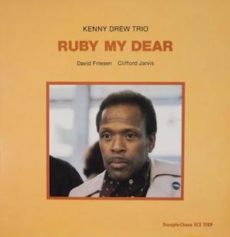
The Kenny Drew Trio steps into the spotlight for this morning’s discussion with their 1980 album, Ruby My Dear (SteepleChase Records SCS 1129). This was Kenny’s fourth release on the Danish label using a trio format, the first three are Dark Beauty (1974), If You Could See Me Now (1975), and Morning (1976). Here, Drew’s working with David Friesen on bass and Clifford Jarvis on drums. My copy used in this report is the US Stereo album sharing the Danish catalog number.
Kenny began playing the piano at age five, and later attended the High School of Music & Art. His first recording was with Howard McGhee. He’s also worked with John Coltrane, Buddy DeFranco, Johnny Griffin, Coleman Hawkins, Charlie Parker, Buddy Rich, Dinah Washington, and Lester Young among others. Drew also led his own groups throughout the fifties and has an extensive discography as a leader and sideman. Bassment, an uptempo original by Kenny launches Side One with an exciting introduction into a spirited melody. The leader’s opening solo sizzles right from the start, then David ends with an effective climax into the threesome’s closing chorus.
Thelonious Monk composed some of the most evocative standards in jazz and Ruby My Dear is one of his most beautiful songs. It’s named for Monk’s first love, Rubie Richardson, and was originally released in 1947, then later reissued on Genius of Modern Music, Volume 1 (1952). The trio starts the melody speaking elegantly, then Drew provides a solo of serene beauty into an intimate coda. Gentle Rain possesses a Bossa Nova flavor as originally intended by its creator, Luis Bonfá who wrote it with Matt Dubey. It premiered in The Gentle Rain that Bonfá scored with Eumir Deodato a year later. The group’s theme is sweet and lovely. Kenny swings softly on the only reading with an enchanting reading.
Side Two starts with Kenny’s Ending. This very pretty ballad opens with a short introduction by the trio preceding an elegant melody. Drew cultivates a very beautiful tone into a memorable interpretation. Friesen delivers the closing performance with easy assurance, ending with a tranquil finale. Sunspots by Austin Wells gets underway with a very pretty introduction of gentle cascades on the piano, gradually growing to a lively frolic on the opening chorus. Kenny starts the solos with a lengthy interpretation that’s a work of art. David steps in next for a rousing statement of effortless artistry. Clifford has an invigorating exchange with the leader and bassist on a breathtaking finale ahead of a soft climax.
Ruby My Dear was produced by SteepleChase Records’ Founder Nils Winther and the man behind the dials is Freddy Hansson. Both men put their talents to great use because the sound quality is astonishing with superb fidelity, placing the trio in your listening room to fill your ears with excellent music. If you’re seeking some outstanding bop for your library, I enthusiastically offer for your consideration, Ruby My Dear by The Kenny Drew Trio. It’s a perfect introduction to Drew’s music for newcomers, and an exceptional companion to his other three albums as well!
~ Dark Beauty (SteepleChase SCS-1016), Genius of Modern Music, Volume 1 (Blue Note BLP 5002), If You Could See Me Now (SteepleChase SCS-1034), Morning (SteepleChase SCS-1048), Ruby My Dear (Blue Note 549) – Source: Discogs.com ~ Kenny Drew, Ruby My Dear – Source: Wikipedia.org © 2021 by Edward Thomas Carter

More Posts: choice,classic,collectible,collector,history,instrumental,jazz,music,piano
Daily Dose Of Jazz…
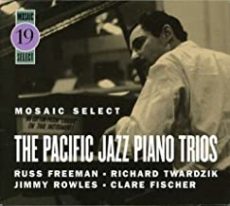
Richard Henryk Twardzik was born on April 30, 1931 in Danvers, Massachusetts and trained in classical piano as a child. He was taught by Margaret Chaloff, the mother of baritone saxophone player Serge Chaloff.
He made his professional debut at the age of fourteen. During his teen years Dick became addicted to heroin, which would eventually be his downfall later in life. Twardzik recorded with Serge Chaloff and Charlie Mariano. He worked with Charlie Parker on several occasions toward the end of Parker’s life. He also played professionally with Lionel Hampton and Chet Baker, recording with the latter and Chaloff in 1954 and 1955.
Pianist Dick Twardzik, who worked in Boston for most of his career, passed away of a heroin overdose while on a European tour with Chet Baker on October 21, 1955 in Paris, France.
More Posts: bandleader,history,instrumental,jazz,music,piano

Daily Dose Of Jazz…
Raymond Fol was born in Paris, France on April 28, 1928 and along with his brother Hubert was raised in a musical household. He began playing piano at five years of age, and both he and his brother played in Claude Abadie’s ensemble after the end of World War II.
The Fol brothers then formed their own group, the Be Bop Minstrels, however, Raymond worked around this time with musicians such as Pierre Braslavsky, Jean-Claude Fohrenbach, Django Reinhardt, Roy Eldridge, and Johnny Hodges. In 1952, he did a European tour in Dizzy Gillespie’s band, and for several years in the middle of the decade was a regular at Paris’s Club Saint-Germain. He also worked in the 1950s with Sidney Bechet, Claude Luter, Guy Lafitte, and Stephane Grappelli.
He worked briefly in Rome, Italy in 1958, then returned to Paris, playing both piano and celesta at the Club Saint-Germain. In the 1960s and 1970s he worked with Kenny Clarke, Duke Ellington, Paul Gonsalves, Cat Anderson, and Gerard Badini. Raymond also recorded a few times on solo piano in the first half of the 1970s.
Pianist Raymond Fol passed away in the City of Lights on May 1, 1979.
More Posts: bandleader,history,instrumental,jazz,music,piano
Daily Dose Of Jazz…
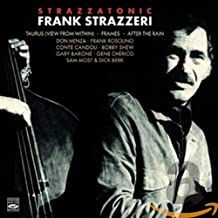
Frank Strazzeri was born on April 24, 1930 in Rochester, New York and he began on tenor saxophone and clarinet at age 12, then switched to piano soon after. He attended the Eastman School of Music, then took a job as a house pianist in a Rochester nightclub in 1952. While there he accompanied visiting musicians such as Roy Eldridge and Billie Holiday.
Moving to New Orleans, Louisiana in 1954, he played with Sharkey Bonano and Al Hirt in a Dixieland jazz setting, but his focus since then was on bebop. He played with Charlie Ventura in 1957–58 and Woody Herman in 1959 before moving to Los Angeles, California in 1960.
During his time there Frank worked extensively as a studio musician on the West Coast jazz scene, and toured with Joe Williams, Maynard Ferguson, Les Brown and Elvis Presley.
He went on to work with Terry Gibbs, Herb Ellis, the Lighthouse All-Stars, Art Pepper, Bud Shank, Cal Tjader, Louie Bellson, Curtis Amy, Harold Land and Chet Baker. In addition he recorded eighteen as a leader.
Pianist Frank Strazzeri passed away on May 9, 2014 at the age of 84.
More Posts: bandleader,history,instrumental,jazz,music,piano
Daily Dose Of Jazz…
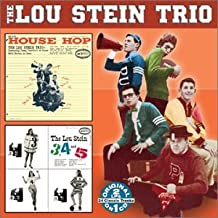
Lou Stein was born on April 22, 1922 in Philadelphia, Pennsylvania and joined Ray McKinley’s band in 1942. He played with Glenn Miller when the latter was stateside during World War II.
After the war he worked with Charlie Ventura from 1946 to 1947 and became a session musician. He performed with the Lawson-Haggart Band, Benny Goodman, Sarah Vaughan, the Sauter-Finegan Orchestra, Louie Bellson, Red Allen, Coleman Hawkins, and Lester Young.
Recording as a bandleader, in 1957 he had a U.S. Top 40 hit with Almost Paradise, as well as a Top 60 hit with his cover version of Got a Match the following year. From 1969 to 1972 he played with Joe Venuti.
Pianist Lou Stein passed away on December 11, 2002.
More Posts: bandleader,history,instrumental,jazz,music,piano