

The Quarantined Jazz Voyager
Remaining hesitant to be in crowds of people without a mask, more and more people are unmasking while we are still in the pandemic. Legislators are speaking unmask rhetoric and otherwise responsible people are listening. This Jazz Voyager is listening to my conscience and protecting myself and those around me.
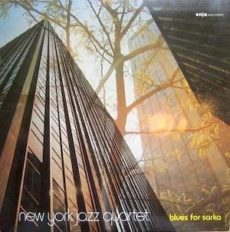
This week I have chosen another quartet recording by the New York Jazz Quartet, founded by pianist Roland Hanna. The first iteration of the group consisted of flautist Hubert Laws, bassist Ron Carter, and drummer Billy Cobham. In 1974 the lineup changed to Frank Wess, bassist George Mraz, and drummer Ben Riley. Drummers Richie Pratt and Grady Tate also were enlisted to contribute their talents to the group at different times through the decade the band was together. The group recorded for the Inner City, Enja, Salvation and Sonet Records from 1972 to 1982
This album is the group’s fourth release, Blues For Sarka, recorded live on May 17, 1978 at The Domicile in Munich, West Germany. It was produced by Horst Weber and Matthias Winckelmann, recorded by Carlos Albrecht and released the same year on Enja Records. The cover photography was taken by Josef Werkmeister and the cover design was by Weber & Winckelmann
Track List | 45:11 All compositions by Roland Hanna except as indicated- All Blues (Miles Davis) ~ 15:29
- Rodney Round Robin ~ 5:44
- I’ll Tell You Tonite (George Mraz) ~ 7:14
- Blues for Sarka (George Mraz) ~ 7:11
- Smelly Jelly Belly ~ 9:33
- Frank Wess ~ flute, tenor saxophone
- Roland Hanna ~ piano
- George Mraz ~ bass
- Grady Tate ~ drums

More Posts: adventure,album,bass,club,drums,flute,genius,jazz,museum,music,piano,preserving,restaurant,saxophone,travel
Three Wishes
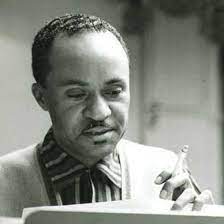
When Ernie Wilkins was approached by Nica and asked what his three wishes would be, he told her:
-
-
“The first would be the ideal jazz club where I could use all the jazz groups I like, and where we’d never go out of business.”
-
“The second would be a recording company the same way, where I’d could use all the musicians I like, and which would never go out of business.”
-
“A million dollars. If I had all these I wouldn’t need to wish for anything for my wife and family, because they’d be covered and it would be Utopia.”
-
*Excerpt from Three Wishes: An Intimate Look at Jazz Greats ~ Compiled and Photographed by Pannonica de Koenigswarter

More Posts: baroness,history,instrumental,jazz,music,pannonica,saxophone,three,wishes
Daily Dose Of Jazz…
Voltaire “Volly” De Faut was born March 14, 1904 in Little Rock, Arkansas but his family moved to Chicago, Illinois when he was six. He started out studying the violin, however, by fourteen switched to the clarinet and saxophone.
At seventeen he had his first professional gig at a summer resort and the next year he was playing with Sig Meyers. During the early 1920s he spent time in the New Orleans Rhythm Kings before joining Art Kassel. He also played with The Bucktown Five.
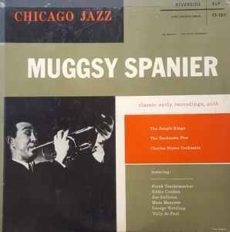
His first recordings were made with Muggsy Spanier in 1924 followed by his recording with Jelly Roll Morton the next year. The late 1920s saw Volly playing with Merritt Brunies and Jean Goldkette, and played for a time in Detroit, Michigan.
Around the end of the decade De Faut held several positions in theater orchestras in Chicago, while working as a studio musician. He started his own dog breeding business but abandoned it to join the military and play in bands there.
He returned to Chicago in the middle of the 1940s, playing with Bud Jacobson and working extensively on the local jazz scene. In the 1950s he moved to Davenport, Iowa but returned to Chicago in 1965. In the last two decades of his life De Faut worked often with Art Hodes, including on many of his recordings for Delmark Records.
Clarinetist and saxophonist Volly De Faut transitioned on May 29, 1973 in Chicago Heights, Illinois.
More Posts: clarinet,history,instrumental,jazz,music,saxophone
Requisites
The Happy Blues ~ Gene Ammons | By Eddie Carter
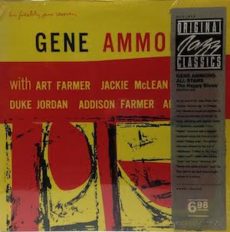
A few nights ago, I was in the mood to hear something bluesy while reading and that’s what prompted this morning’s discussion. I looked through the library and came across one of my favorite albums by tenor saxophonist Gene Ammons. It was originally released as Hi-Fidelity Jam Session (1956) but was reissued a few years later as The Happy Blues (Prestige PR 7039). Ammons is supported on this date by an all-star sextet, Art Farmer on trumpet, Jackie McLean on alto sax, Duke Jordan on piano, Addison Farmer (Art’s twin brother) on bass, Arthur Taylor on drums, and Candido on conga. My copy used in this report is the 1982 US Original Jazz Classics Mono reissue (Prestige OJC-013 – P-7039).
Side One starts with a perfect song for the weekend, The Happy Blues by Art Farmer. Duke opens with a friendly introduction preceding the ensemble’s strut through the melody collectively. Jackie sets the stage with a carefree walk on the opening solo. Art continues making some beautiful music on the second statement, followed by Gene’s stellar contribution aided by Farmer and McLean. Duke provides a good deal of inspiration next, then all three horns engage in a three-way conversation ahead of the ending. The Great Lie by Cab Calloway and Andy Gibson takes the beat to a lively pace on the septet’s swinging melody. Art takes the lead this time and delivers a brisk performance. Jackie and Gene set off some fireworks on the next two solos, then Jordan swings into view on a short statement and Candido takes an impressive reading before the close.
Side Two opens with a show tune from the musical revue, The Little Show (1929) by Paul James and Kay Swift, Can’t We Be Friends? Duke and the rhythm section begin the introduction, then Gene takes the first of two relaxing strolls on the opening chorus and first solo. Art delivers an impeccable laid-back muted performance next. Jackie comes in next with a cleverly executed statement. Duke drives the next interpretation with considerable warmth, then Gene returns for some tuneful blowing. Addison adds a concise comment during the out-chorus. The septet closes with a ferocious trip to Jackie McLean’s Madhouse, flying out of the gate on the fiery theme. The front line chases each other at breathtaking speed on the first of two exchanges. Jackie, Art, Gene, and Duke take one chorus each, then the horns end this vigorous exercise in quick succession ahead of a robust climax.
The Happy Blues was supervised by Bob Weinstock, and Rudy Van Gelder was the man behind the dials. This Prestige Original Jazz Classics reissue has quiet vinyl without any clicks or pops, and an excellent soundstage placing your sweet spot with the musicians surrounding you in your listening room. The Happy Blues is one of the superb albums in Gene Ammons’ extensive discography. If you’re a fan of Hard-Bop, I hope you’ll seek it out on your next vinyl hunt. It’s forty minutes of great music and performances that I not only recommend but is sure to be a welcome addition in your library and on your turntable!
~ Hi-Fidelity Jam Session (Prestige PRLP 7039) – Source: Discogs.com ~ Can’t We Be Friends? – Source: Wikipedia.org © 2022 by Edward Thomas Carter
More Posts: choice,classic,collectible,collector,history,instrumental,jazz,music,saxophone
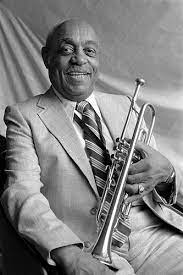
Three Wishes
While hanging out with the Baroness, she asked Benny Carter what his three wishes would be if by some chance he was granted them. His reply is as follows:
-
-
“Three million dollars, tax free.”
-
“Two millions dollars, tax free.”
-
“One million dollars, tax free.”
“But seriously, call me at my hotel when I have had time to think about it, and I will give you the real ones.”
-
-
*Excerpt from Three Wishes: An Intimate Look at Jazz Greats ~ Compiled and Photographed by Pannonica de Koenigswarter
More Posts: baroness,clarinet,history,instrumental,jazz,music,pannonica,saxophone,three,trumpet,wishes