

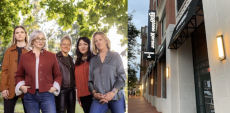
ARTEMIS
ARTEMIS is a powerful ensemble of modern jazz masters, founded in 2017 by pianist and musical director Renee Rosnes. Each musician is a bandleader and composer and every performance encompasses inspired arrangements of classics and originals. Performances across North America and Europe at major venues and festivals have garnered high praise from audiences and critics alike.
It is no wonder that ARTEMIS has been awarded #1 Group of the Year in the Annual Downbeat Readers Poll in 2023, 2024 and 2025! Their third recording “Arboresque” was released February 28, 2025. The album is testament to the group’s evolving musical landscape featuring stellar arrangements and riveting originals contributed by all members of the band. Come hear ARTEMIS perform with joy, passion, and high-wire intensity – there’s no other band like it!
Renee Rosnes – piano & keyboard
Ingrid Jensen – trumpet
Nicole Glover – tenor saxophone
Noriko Ueda – bass
Allison Miller – drums
Tickets: $35.00 ~ $45.00 +fee | Streaming: $15.00 +fee
More Posts: adventure,bandleader,bass,club,drums,genius,instrumental,jazz,music,piano,preserving,saxophone,travel,trumpet
Requisites
Club Date ~ Yusef Lateef | By Eddie Carter
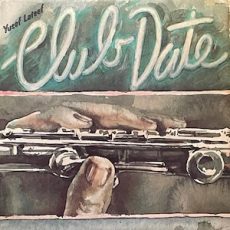
A few nights ago, I spent time with an album I hadn’t listened to in a while and thought it deserved discussing. Club Date (ABC Impulse ASD-9310), by multi-instrumentalist Yusef Lateef, was released in 1976 and showcases his live performance at Pep’s Lounge on June 29, 1964, first heard on Live at Pep’s. My introduction to Lateef’s artistry came through his work on Cannonball Adderley Sextet in New York, Nippon Soul, and Jazz Workshop Revisited. The tracks on Club Date were not available before this release. The group includes Richard Williams on trumpet; Yusef Lateef on flute (tracks B1, B3), oboe (track B1), and tenor saxophone (tracks A1 to A3, B2); Mike Nock on piano; Ernie Farrow on bass; and James Black on drums. The copy I own is the 1976 U.S. Stereo release.
The set opens with Oscarlypso by Oscar Pettiford, a lively tune featuring a Caribbean groove from the start of Ernie’s introduction to the quintet’s theme. Yusef takes the opening solo, as smooth as velvet. Richard follows with a cheerfully festive performance. Mike enters the spotlight last, with a relaxing reading, before both horns share a short exchange leading to the reprise and a vibrant finish. Gee Sam Gee by Yusef Lateef is a slow-moving ballad that begins with the saxophonist stating a hauntingly dreamy theme and opening solo. Williams and Nock follow with two delicately gentle statements preceding Lateef’s return for the closing chorus.
Richard Williams’ Rogi brings the beat way up to end the first side with the group’s collective melody. Yusef steps up first with a spirited performance, then Richard vigorously launches into the following solo. Mike has the last word with an energetic statement ahead of the theme’s return and climax. Brother John, Yusef Lateef’s tribute to John Coltrane, opens the second side with the rhythm section’s trio to Lateef’s switching to oboe for the melody and adventurous opening statement. Williams takes flight next in a scintillating solo. Nock keeps the listener captivated, sailing smoothly until the final note, while Yusef’s flute comments shadow him, before the quintet returns to take the song out.
Yusef Lateef introduces P-Bouk, a speedy original by the saxophonist that the ensemble takes out of the gate at a vigorous pace. Yusef soars upward into the sky on the opening solo with joyful exhilaration. Richard comes in cooking hard next, then Mike meets the challenge with a robust reading, leading to the theme’s restatement and the introduction of Nu-Bouk, also by Yusef Lateef, which he describes as a new blues. He’s back on the flute as he glides over the rhythm section for the soulful melody and lead solo. Williams makes his case in a short statement, returning to the theme and the group’s down-home ending.
Bob Thiele produced the initial session for Club Date, and Esmond Edwards supervised this release, but the identity of the engineer who recorded it remains unknown. The sound quality is very good for a ‘60s live date, with an excellent soundstage that transports the listener to the club’s audience. If you’re new to the music of Yusef Lateef, or are in the mood for a wonderful live album to listen to after a long day or week, I offer for your consideration Club Date by Yusef Lateef. It gives a glimpse into an incredible musician who transcended hard bop through music inspired by exotic locales. While the recording’s live atmosphere adds raw authenticity, it’s the interplay among the players that truly shines, making this record a rewarding listen for both longtime fans and newcomers to Lateef’s work!
~ Cannonball Adderley Sextet in New York (Riverside RLP-404/RLP-9404), Jazz Workshop Revisited (Riverside RM 444/RS 9444), Live at Pep’s (Impulse! A-69/AS-69), Nippon Soul (Riverside RM 477/RS 9477) – Source: JazzStandards.com
© 2026 by Edward Thomas Carter

More Posts: choice,classic,collectible,collector,history,instrumental,jazz,music,saxophone
Daily Dose Of Jazz…
Charles Gayle was born February 28, 1939 in Buffalo, New York and his childhood was influenced by religion, and his musical roots trace to black gospel music. He began his musical education on piano then added tenor and alto saxophone. Much of his history is murky, he spent an apparent homeless period of about twenty years playing saxophone on street corners and subway platforms around New York City.
A multi-instrumentalist playing pianist, bass clarinetist and percussion, his music is spiritual, heavily inspired by the Old and New Testaments, explicitly dedicated several albums to God. Gayle credits among his influences Louis Armstrong, John Coltrane, Albert Ayler, Thelonious Monk and Art Tatum.In 1988, he gained fame through a trio of albums recorded on the Swedish label Silkheart Records. Since then he has become a major figure in free jazz, recording for Black Saint, Knitting Factory, FMP and Clean Feed record labels.
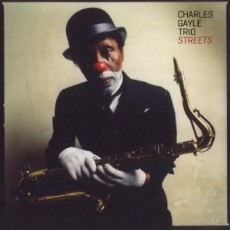
Charles has performed and recorded with Cecil Taylor, William Parker and Rashied Ali with his most celebrated work to date being Touchin’ on Trane with Parker and Ali. He would include lengthy spoken-word addresses in his performances and for a period performed as a mime, “Streets the Clown”. As an educator he taught music at Bennington College.
In 2001, Gayle recorded an album titled Jazz Solo Piano of consisted mostly of straightforward jazz standards in response to critics who charge that free jazz musicians cannot play bebop. In 2006, Gayle followed up with a second album of solo piano originals, and his most recent release in 2012 is titled Streets. His final recording as a leader was The Alto Sessions in 2019.
Suffering from complications of Alzheimer’s disease, saxophonist Charles Gayle, who also played piani, bass clarinet, bass and percussion, died in Brooklyn, New York on September 7, 2023 at the age of 84.
DON ALIQUO
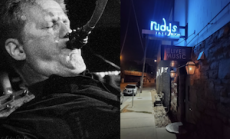
Saxophonist Don Aliquo’s playing has been described as “smooth as silk…with an unfailing feel for breath and phrasing” while extremely supple in the addressing of his axe but always zeroed in on what he’s describing”.
“Growth” his newest release, explores new territory with intriguing compositions and ample solo space for Aliquo’s inspired improvisations. The eight originals are both complex and open, which shows him expanding his boundaries not only as an instrumentalist and improviser, but also as a composer. The music is an electrifying modern outing with one foot in the future and one in the tradition.
Aliquo has released six solo projects and has worked collaboratively or performed as a sideman on many others. His previous solo cd “Sun and Shield” features veteran jazz masters Rufus Reid, Jim McNeely, and the dynamic Obed Calvaire.
Notable collaborations include a duo recording with eclectic pianist Michael Jefry Stevens and quartet recordings with Roger Humphries and the late Beegie Adair. He also has recorded with his mentor, notable Pittsburgh tenor stalwart, Don Aliquo Sr. on the MCG label.
Don has performed in concerts and recordings with many world-class artists including Gary Burton, Greg Osby, Rufus Reid, Roger Humphries, Harold Danko, Adam Nussbaum, Donald Brown, Pete Christlieb, Scott Robinson, and Bobby Shew.
Cover: $20.00 advance/door
More Posts: adventure,bandleader,club,genius,instrumental,jazz,music,preserving,saxophone,travel
Daily Dose Of Jazz…
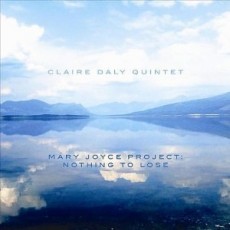
Claire Daly was born on February 26, 1959. At the age of 12 she began playing the saxophone and was soon turned onto jazz by way of a live performance by the Buddy Rich Big Band. She went on to attend Berklee College Of Music and upon graduation she became a full-time professional musician.
In the late 70s and early 80s Claire played with various groups in the jazz and rock arenas, and her powerful tenor saxophone suited the latter perfectly. However, playing more jazz than rock, Daly switched to the baritone saxophone and has worked in New York City since the mid-80s.
>A seven-year association with the all-female big band, Diva, was followed with her working with People Like Us. Daly’s versatility moves between jazz, R&B and Latin, releasing two CDs as a leader for Koch Records and three on her own label DalyBread.
Her influences include Rahsaan Roland Kirk and Sonny Rollins and, on baritone, Serge Chaloff, Ronnie Cuber and Leo Parker. She has performed with Aretha Franklin, James Brown, Joe Williams, and Rosemary Clooney among many others, and her first CD Swing Low resides in the William Jefferson Clinton Library in Little Rock, Arkansas.
Claire Daly, a gifted improviser whose rich tone and emotional depth has earned her a place as a respected member of the baritone saxophone family, continues to lead her own jazz groups and to pass the gift of music on to the next generation.
Diagnosed with head and neck cancer in 2023, baritone saxophonist and composer Claire Daly died at the residence of a friend in Longmont, Colorado, on October 22, 2024, at the age of 66.
More Posts: saxophone