

Daily Dose Of Jazz…
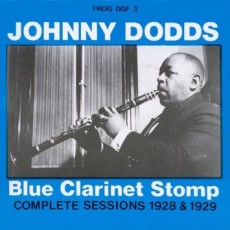
Johnny Dodds (pronounced dots) was born April 12,1892 in Waveland, Mississippi and moved to New Orleans in his youth, and studied clarinet with Loranzo Tio. He played with the bands of Frankie Duson, Kid Ory and Joe “King” Oliver.
Dodds went to Chicago, Illinois to play with Oliver’s Creole Jazz Band, with whom he first recorded in 1923. He also worked frequently with his good friend Natty Dominique during this period, a professional relationship that would last a lifetime.
After the breakup of Oliver’s band in 1924, he replaced Alcide Nunez as the house clarinetist and bandleader of Kelly’s Stable. He recorded with numerous small groups in Chicago, most notably Louis Armstrong’s Hot Five and Fot Seven, Jelly Roll Morton’s Red Hot Peppers and Lovie Austin.
Noted for his professionalism and virtuosity as a musician, and his heartfelt, heavily blues-laden style, Dodds was an important influence on later clarinetists, notably Benny Goodman.
Along with his younger brother drummer Warren “Baby” Dodds, they worked together in the New Orleans Bootblacks in 1926. As a leader he recorded prolifically between 1927 and 1929, recording for Paramount, Brunswick/Vocalion, and Victor. Affected by ill he recorded two more sessions in 1938 and 1940 both for Decca before passing away of a heart attack in Chicgo, Illinois on August 8, 1940. In 1987, clarinetist and alto saxophonist Johnny Dodds was inducted into the Down Beat Jazz Hall of Fame.

Take A Dose On The Road

Daily Dose Of Jazz…
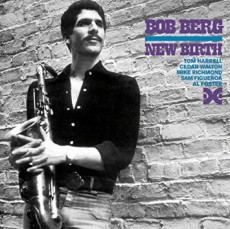
Robert Berg was born on April 7, 1951 in Brooklyn, New York. He started his musical education at the age of six when he began studying classical piano. He began playing the saxophone at the age of thirteen and went on to graduate from Juilliard. He was influenced heavily by the late 1964–67 period of John Coltrane’s music.
A student from the hard bop school, Bob played from 1973 to 1976 with Horace Silver and then from 1977 to 1983 with Cedar Walton. Berg became more widely known through his short period in the Miles Davis band but left the band in 1987 after recording only one album, You’re Under Arrest.
After leaving Davis’s band, Berg released a series of solo albums and performed and recorded frequently in a group co-led with guitarist Mike Stern. On these albums he played a more accessible style of music, mixing funk, jazz and even country music with many other diverse compositional elements to produce albums that were always musical. He often played at the 7th Avenue South NYC club.
He worked with Chick Corea, Steve Gadd and Eddie Gomez in a quartet. Bob’s tenor saxophone sound was a synthesis of rhythm and blues players such as Junior Walker and Arnett Cobb with the lyricism, intellectual freedom and soul of Wayne Shorter, Joe Henderson and Coltrane. Over the course of his short career he recorded a dozen albums as a leader and performed sideman duties on another 30 albums with Randy Brecker, Tom Coster, Kenny Drew, Moncef Genoud, Billy Higgins, Dizzy Gillespie, Sam Jones and Wolfgang Muthspiel.
Saxophonist Bob Berg, who was known for his extremely expressive playing and tone, passed away on December 5, 2002 as a result of a traffic accident. His car was struck by a cement truck that slid on the ice in East Hampton, New York while driving near his home with his wife Arja.
Give A Gift Of Jazz – Share
More Posts: saxophone
Daily Dose Of Jazz…
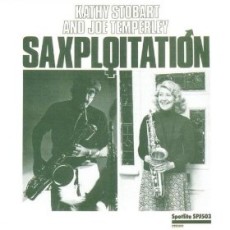
Kathy Stobart was born Florence Kathleen Stobart in the coastal town of South Shields, England on April 1, 1925. She first learned piano and alto saxophone as a child. After picking up her brother’s tenor saxophone and a month’s trial, she first played in Don Rico’s all-girl band at the age of 14 and then locally in Newcastle.
It wasn’t until her joining the Peter Fielding ballroom orchestra that her interest in jazz peaked. She met saxophonists Keith Bird and Derek Neville, who were then stationed at a local RAF camp. They bought her ten jazz records for my 17th birthday and Bird painstakingly took her through various harmonic exercises and saw to it that she succeeded him when he vacated a quartet job in London in late 1942.
Moving to London in the 1940s she began playing with Denis Rose, Ted Heath and Jimmy Skidmore. Later in the decade Stobart played with Art Pepper and Peanuts Hucko. Before the end of the Forties she played with and had a brief marriage with Art Thompson.
She toured with Vic Lewis in 1949 and led her own group in early 1950s, among its members was Derek Humble, Dill Jones and Bert Courtley, whom she married in 1951 until his death in 1969. Throughout the 1950s and 60s Kathy went into semiretirement to raise her family.
Returning to performing, from 1969 to 1977 she played with Humphrey Lyttelton. Following this she led her own groups, with Harry Beckett, John Burch and Lennie Best among others. Aside from this she played with Johnny Griffin, Al Haig, Earl Hines, Buddy Tate, Zoot Sims, Marian McPartland and Dick Hyman.
From 1992 she was paying with Lyttelton again adding flute, clarinet and baritone saxophone to her arsenal of instruments. Tenor saxophonist Kathy Stobart, who held lengthy teaching assignments at City Literature Institute in London, passed away on July 5, 2014.
Uplift Someone’s World
Daily Dose Of Jazz…
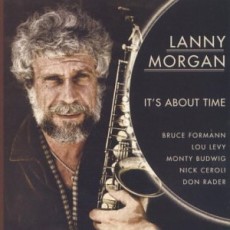
Lanny Morgan was born March 30, 1934 in Des Moines, Iowa and raised in Los Angeles, California. In the 1950s he played with Charlie Barnet, Si Zentner, Terry Gibbs and Bob Florence.
He did a stint in the U.S. military and had to turn down an offer to play in the Stan Kenton orchestra. From 1960-65 he played in Maynard Ferguson’s orchestra after a few years in New York City Morgan returned to Los Angeles in 1969. There he did frequent studio work, performed sessions with Nancy Sinatra and Carmen McRae,
He was a member of Supersax and played in the big bands of Bill Berry, Bob Florence and Bill Holman. Alto saxophonist Lanny Morgan has chiefly been active on the West Coast jazz scene.
Jazz Is Global – Share
More Posts: saxophone
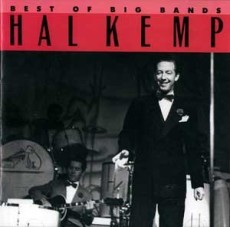
Daily Dose Of Jazz…
James Hal Kemp was born March 27, 1904 in Marion, Alabama. He studied and learned to play the saxophone and clarinet and while at the University of North Carolina at Chapel Hill he formed his own campus jazz group, the Carolina Club Orchestra. They recorded for English Columbia and Perfect/Pathé Records in 1924 and toured Europe that same summer under the sponsorship of bandleader Paul Specht.
Kemp returned to UNC in 1925 and put together a new edition of the Carolina Club Orchestra, featuring classmates and future stars John Scott Trotter, Saxie Dowell and Skinnay Ennis. By 1927 he turned professional and turned over the orchestra to Kay Kyser.
Basing his band in New York City, Hal’s group included Trotter, Dowell, and Ennis, and later joined by trumpeters Bunny Berigan and Jack Purvis. The sound was 1920s collegiate jazz and in the Thirties he toured Europe again and recorded regularly for Brunswick, English Duophone, Okeh and Melotone record labels.
During the height of the Depression in 1932 Kemp changed the orchestra’s style to a dance band. He incorporated an early version of the echo effect using large megaphones for the clarinets, muted trumpets and a double-octave piano. Vocalists with the band during the 1930s included Ennis, Dowell, Bob Allen, Deane Janis, Maxine Gray, Judy Starr, Nan Wynn and Janet Blair.
Hal’s band was one of the most popular bands in the 1930s and was often featured performing on NBC and CBS radio shows. The band also appeared in numerous motion-picture short subjects and was featured in the 1938 RKO film Radio City Revels. He had hits with There’s A Small Hotel, Lamplight, I Got A Date With An Angel, You’re The Top, Lullaby Of Broadway and Where or When.
On December 19, 1940, alto saxophonist, clarinetist, bandleader, composer and arranger Hal Kemp while driving from Los Angeles to a booking in San Francisco, his car collided head-on with a truck. Breaking a leg and several ribs, one of which punctured a lung, he developed pneumonia while in the hospital and died two days later in Madera, California. He was inducted into the Big Band and Jazz hall of Fame in 1992.
Dose A Day-Blues Away