

Daily Dose Of Jazz…
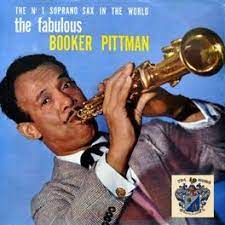
Booker Pittman was born on March 3, 1909 in Fairmount Heights, Maryland, was the son of Portia Pittman and a grandson of Booker T. Washington. He became an accomplished jazz clarinetist and played with greats like Louis Armstrong and Count Basie in the US and Europe in the 1920s and 1930s.
Leaving the States for the first time in 1933, he went with Lucky Millinder’s orchestra to France and stayed there for four years. During that period, he met a Brazilian musician named Romeo Silva, who took him on a tour of Brazil along with other musicians. They sailed to Bahia aboard the Siqueira Campos.
In 1937, Booker moved to Brazil, where he was known by the nickname “Buca“, and continued his musical career there, playing at the Urca Casino. He lived in Copacabana and befriended Jorge Guinle and Pixinguinha. He also played in Argentina and other countries.
He performed and recorded with his singer/actress stepdaughter Eliana Pittman. On October 19, 1969 clarinetist and saxophonist Booker Pittman, sometimes spelled Pitman, transitioned in his home in the São Paulo quarter of Vila Nova Conceição of laryngeal cancer at the age of 60. On behest of his wife Ofélia he was transferred to Rio de Janeiro and there laid to rest at the Cemitério São João Batista in the quarter of Botafogo.

More Posts: clarinet,history,instrumental,jazz,music,saxophone
JESSE JONES JR.
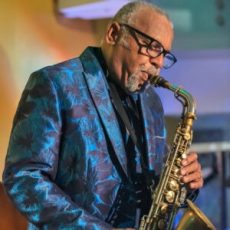
The Miami native is a virtuoso saxophonist who started his first band, the Melt-Jess Jazz Quintet, in high school with trumpeter brother Melton Mustafa, who later left to play with Count Basie. Jones formed his own quartet and remains a longtime fixture in Miami’s jazz scene.
He continues to be at the forefront of a burgeoning jazz renaissance in South Florida. He is renowned for his mastery of the saxophone and captivating vocals, has left an indelible mark on the genre over decades.
More Posts: adventure,concert,genius,jazz,music,preserving,saxophone,travel,vocal
Daily Dose Of Jazz…
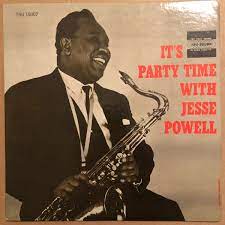
Jesse Powell was born in Smithville, Bastrop County, Texas, on February 27, 1924. He received his formal music training before he began his professional career at age eighteen, when he toured with fellow Texan, Oran “Hot Lips” Page beginning at the age of eighteen during 1942–43.
During the war years he went on to play with Louis Armstrong in 1943–44, then with the Luis Russell Orchestra in 1944–45. He replaced fellow Texas tenorist Illinois Jacquet in the Count Basie Band for a tour of California in 1946. At this time Powell also worked with blues singers Champion Jack Dupree and Brownie McGhee.
1947 saw Jesse joining Curly Russell’s band, and in 1948 he formed his own band in New York City. That same year he performed with trumpeter Howard McGhee at the first international jazz festival in Paris. In 1949–50, he was a member of the Dizzy Gillespie Big Band, with whom he recorded a solo on Tally Ho. In 1953 he once again formed another jump-rhythm band, and in 1964 a Powell quintet played at Birdland in New York City.
Tenor saxophonist Jesse Powell died on October 19, 1982 in New York City.

More Posts: bandleader,history,instrumental,jazz,music,saxophone
Daily Dose Of Jazz…
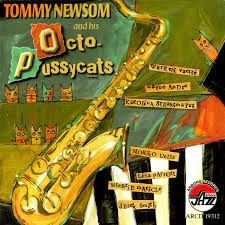
Thomas Penn Newsom was born in Portsmouth, Virginia on February 25, 1929 and earned degrees from the Norfolk Division of the College of William & Mary, the Peabody Conservatory of Music, and Columbia University. He went on to serve in the United States Air Force during the Korean War where he played in the band.
He toured with the Benny Goodman Orchestra and performed with Vincent Lopez in New York. Newsom joined the Tonight Show Band in 1962, and left it when Carson retired in 1992. In addition to Carson’s orchestra, he performed with the orchestra for The Merv Griffin Show.
Well known within the music industry as an arranger as well as a performer, he arranged for groups as varied as the Tonight Show ensemble and the Cincinnati Pops Orchestra, and musicians Skitch Henderson, Woody Herman, Kenny Rogers, Charlie Byrd, John Denver, and opera star Beverly Sills.
He won two Emmy Awards as a music director, one in 1982 with Night of 100 Stars, and in 1986 for the broadcast of the 40th Annual Tony Awards. He also recorded six albums as a bandleader and another four as a sideman.
On April 28, 2007 saxophonist Tommy Newsom, who was nicknamed Mr. Excitement by Johnny Carson and was the band’s substitute director, died of bladder and liver cancer at his home in Portsmouth. He was 78 years old.
More Posts: arranger,bandleader,history,instrumental,jazz,music,music director,saxophone
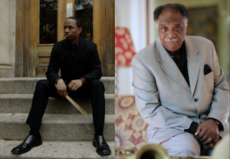
WILLIE JONES TRIO FEATURING HOUSTON PERSON
Willie Jones III:
With an unparalleled style of rhythmic expression, drummer Willie Jones III is one of the world’s leading jazz drummers. In addition to honoring his monumental influences – the late greats Philly Joe Jones, Art Blakey and Billy Higgins – Jones’ bold articulation and constantly innovative sense of swing are results of his life-long musical experience.
Born in Los Angeles, California on June 8, 1968, Jones’ earliest exposure to music was through his father, Willie Jones II, an accomplished and notable jazz pianist, who offered guidance and inspiration to his gifted son. Dedicated to the further development of his skills, the younger Jones spent the next few years working diligently with acclaimed drummers and music instructors and began performing with distinguished musicians by the time he was in his teens. He completed his academic training after receiving a full scholarship to the California Institute of the Arts where he studied under the tutelage of the legendary Albert “Tootie” Heath. Before he was a semifinalist in the 1992 Thelonious Monk Jazz Drum Competition, Jones co-founded jazz band Black Note. Influenced by the rich soulful energy of the West Coast bop movement, Black Note’s hard-swing sound propelled them to first place in the prestigious John Coltrane Young Artist Competition in 1991.
Near the end of 1994, while Jones was reaching for a higher level of drumming dexterity, he gained the privilege of playing sideman to the renowned vibist Milt Jackson, where Jones learned the importance of pacing and sensitivity. Meanwhile, his musical career continued to unfold.
From 1998-2005, Jones was a member of Roy Hargrove’s Quintet and is featured on Roy Hargrove’s CD releases on Verve: Moment To Moment, Hard Groove, Nothing Serious and RH Factor’s Distractions. Jones can be heard on a host of recordings including Kurt Elling’s GRAMMY® nominated Night Moves (Concord) and Eric Reed’s Here (Max Jazz). Jones has worked with Sonny Rollins, Ernestine Anderson, Bobby Hutcherson, Wynton Marsalis, Cedar Walton, Frank Wess, the Dizzy Gillespie All-Star Big Band, Houston Person, Billy Childs, Eric Reed, Ryan Kisor, Eric Alexander, Bill Charlap, Michael Brecker, Herbie Hancock and Hank Jones.
Houston Person:
Houston Person, born in Newberry, South Carolina in 1934, is the natural heir to the Boss Tenor crown worn so long and so well by Gene Ammons. In the more than twenty-five years that he has been a working bandleader, Person has taken his music to most points on the globe. A travelling Jazzman in an era that has found that particular species a veritable rara avis, Person does it all himself. He books his own tours, hunts up the new clubs, has the phone number of every major concert promoter on each continent and produces his own albums: truly the vertically integrated Jazzman.
If, given all this, he played mediocre tenor it would be easy to forgive him. But he doesn’t – he plays damn good tenor and it keeps getting better. One of the last proponents of the big sound, his tone has gotten bigger even as his delivery has mellowed and rounded out. And, of course, with Person you are likely to hear almost anything in terms of repertoire. He has recorded disco and gospel, pop and r&b in addition to his natural Jazz but beyond that he has an enormous and ever changing book. Nothing pedestrian or everyday for Person!
He grew up in Florence, S.C., studied at the state college there, was later named to the school’s Hall of Fame in 1999, and continued his studies at Hartt College of Music in Hartford, CT. Earlier, in the U.S. Air Force, he played with Don Ellis, Eddie Harris, Cedar Walton, and Leo Wright. Contrary to popular belief, he was never married to the late singer Etta Jones, but did spend many years as her musical partner, recording, performing and touring.
Although he has performed in the hard bop and swing genres, he is most experienced in and best known for his work in soul Jazz. Person is also known for his distinctive sassy sound and his expressive style of playing. He received the Eubie Blake Jazz Award in 1982.
He has more than 75 albums under his own name on Prestige, Westbound, Mercury, Savoy, Muse, and is currently with High Note Records. He has recorded with Charles Brown, Charles Earland, Lena Horne, Etta Jones, Lou Rawls, Horace Silver, Dakota Staton, and more.
Houston has deffine ideas about Jazz: “Well, it’s uplifting and important. And a release and a relief. That’s what it is, Jazz, so called Jazz, to me. It’s important that it’s relaxing. Something that when the end of the day comes, after a hard and frustrating day out in the world, that relieves you. Relaxes you and makes you feel good.” Person adds that all he wants is to give people “good solid melodies with some improvisation and plenty of blues feel.” He smiles, “You always want that dance feeling there, that happy, happy feeling.”
More Posts: adventure,club,drums,genius,jazz,music,preserving,saxophone,travel