

Daily Dose Of Jazz…
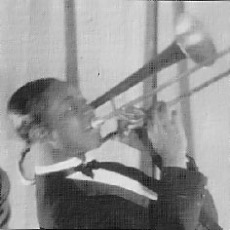
Jimmy Harrison was born on October 17, 1900 in Louisville, Kentucky and began on trombone at age 15, playing locally in the Toledo, Ohio area. He also played semi-pro baseball but chose music over a career in sports when he joined a traveling minstrel show in the late 1910s.
By 1919 Harrison was leading his own jazz ensemble in Atlantic City, New Jersey and played in the bands of Charlie Johnson and Sam Wooding. Moving to Detroit he played with Hank Duncan and Roland Smith. After returning to Toledo, he played gigs with June Clark and James P. Johnson. He followed this period with a stint in New York City with Fess Williams.
Giving leadership of his ensemble to June Clark in 1924, Jimmy continued to play with the group, worked with Duke Ellington during this period and in 1925 was working with Billy Fowler then with Elmer Snowden, Fletcher Henderson and Benny Carter’s Chocolate Dandies. While on tour with Henderson he took ill with a stomach ailment and though he continued to play for several months with Chick Webb. Trombonist Jimmy Harrison passed away on July 23, 1931 in New York City at the age of 30.

Put A Dose In Your Pocket
More Posts: trombone
Daily Dose Of Jazz…
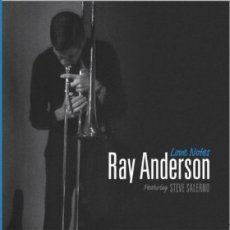
Ray Anderson was born on October 16, 1952 in Chicago, Illinois. An independent jazz trombonist and trumpeter he began training with the Chicago Symphony trombonists then spent time studying in California. By 1973 he was in New York freelancing and four years later joined Anthony Braxton’s group, then with Barry Altschul.
By the late ‘70s his influence was growing, he was leading his own groups, working with George Gruntz’s Concert Jazz Band and over the next twenty years began taking an occasional good-humored vocal singing two notes at the same time.
Anderson also plays the sousaphone, is a master at multiphonics and a supportive sideman has recorded and performed with David Murray, Charlie Haden, Dr. John, Bennie Wallace, Henry Threadgill, John Scofield and Sam Rivers among others. He also received a grant from the National Endowment For The Arts for a series of solo trombone concerts.
While pushing his sound into the future, Anderson has frequently returned to his early love of New Orleans music for inspiration as he continues to perform, record and tour. Since 2003 he has taught and conducted at Stony Brook University.
Give The Gift Of Knowledge
More Posts: sousaphone,trombone,trumpet
Daily Dose Of Jazz…
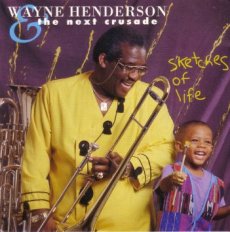
Wayne Henderson was born on September 24, 1939 in Houston, Texas. While studying piano at Texas Southern University the trombonist met Joe Sample and along with several became a part of the Swingsters that became the Modern Jazz Sextet and then the Jazz Crusaders in emulation of one of the leading progressive jazz bands of the day, Art Blakey’s Jazz Messengers.
The soul-jazz and hard bop trombonist and record producer is a very fluent technician who exhibits the influence of lesser apt, yet significant trombonists such as Kid Ory and Jack Teagarden. One can hear his Texas roots in his performances.
He left The Crusaders in 1975 to pursue a career in producing, but revived The Jazz Crusaders in 1995, however, some of his best work is on the mid-1970s Crusaders double album Southern Comfort. Since 2007, he has held a position with the California College of Music in Pasadena, California. Trombonist Wayne Henderson passed away from heart failure on April 5, 2014 at the age of 74 in Culver City, California.
Give The Gift Of Knowledge
More Posts: trombone
Daily Dose Of Jazz…
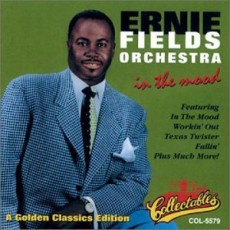
Ernie Fields was born Ernest Lawrence Fields on August 28, 1904 in Nacogdoches, Texas, though raised in Taft, Oklahoma. He attended Tuskegee Institute before moving to Tulsa. From the late 1920s, he led the Royal Entertainers, and eventually began touring more widely from Kansas City, Kansas to Dallas, Texas, and recording. Fields’ band became the first African-American band to play at Tulsa’s landmark Cain’s Ballroom.
A 1939 invite to New York by John Hammond to record for Vocalion. He began touring nationally, never became a star but continued to work steadily, recording for smaller labels, and gradually transforming his sound through a smaller band and a repertoire shift from big band and swing to R&B. During WWII he entertained troops both at home and abroad.
Continuing to straddle these styles into the 1950s, Ernie played swing standards such as “Tuxedo Junction” and “Begin The Beguine” in a rocking R&B style. In the late 1950s he moved to Los Angeles, California and joined the Rendezvous Records and ran the house band In 1959 this band had an international hit with an R&B version of Glenn Miller’s “In The Mood” that reached #4 on the Billboard chart, selling over a million copies. He would go on to record instrumentals under a variety of names including B. Bumble and the Stingers, The Marketts and The Routers.
After Rendezvous Records folded in late 1963, trombonist, pianist, arranger and bandleader Ernie Fields retired and returned to Tulsa. He died on May 11, 1997, at the age of 92.
Put A Dose In Your Pocket
More Posts: arranger,bandleader,piano,trombone
Daily Dose Of Jazz…
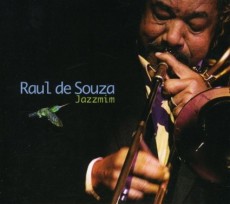
Raul de Souza was born August 23, 1934, in Rio de Janeiro, Brazil. Learning to play to trombone in his youth he went on to perform and record with Sergio Mendes, Flora Purim, Airto Moreira, Milton Nascimento, Sonny Rollins, Cal Tjader, Hermeto Pascoal and the jazz-fusion band Caldera.
Raul’s debut album as a leader came in 1965 with A Vontade Mesmo for RCA Brazil followed up three years later with International Hot on the Equipe label. His American debut release Sweet Lucy, produced by composer and pianist George Duke on the Capitol Records label, also produced his sophomore project, Don’t Ask My Neighbors. Colors, a Milestone recording is now a part of the Original Jazz Classics series from Fantasy Records.
By 1979, de Souza was releasing ‘Til Tomorrow Comes, an Arthur Wright production with many of the top soul session players in Los Angeles. Devoid of any jazz, it was an attempt to jump aboard the disco/funk bandwagon. Since then he has added eight more recordings as a leader to his catalogue and produced a DVD, O Universo Musical de Raul de Souza in 2012.
Trombonist Raul de Souza has appeared at many international jazz festivals and after living and working in the United States for many years, he has returned to live in Brazil where he continues to play and compose.
Give A Gift Of Jazz – Share
More Posts: trombone