

Daily Dose Of Jazz…
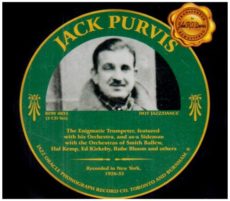
Jack Purvis was born John Purvis on December 11, 1906 in Kokomo, Indiana to Sanford B. Purvis, a real estate agent and Nettie Purvis. His behavior became uncontrollable after his mother’s death in 1912 and as a result of many acts of petty larceny, he was sent to a reform school. While there, he discovered that he had an uncanny musical ability, and soon became proficient enough to play both the trombone and trumpet professionally. This also enabled him to leave the reformatory and continue his high school education, while he was playing paying gigs on the side.
After high school he worked in his home state for a time then went to Lexington, Kentucky where he played with the Original Kentucky Night Hawks. In 1926 he was with Bud Rice touring New England, then with Whitey Kaufman’s Original Pennsylvanians. For a short time he played trumpet with Arnold Johnson’s orchestra, and by July 1928 he traveled to France with George Carhart’s band. In 1929 he joined Hal Kemp’s band and recorded with Kemp, Smith Ballew, Ted Wallace, Rube Bloom, the California Ramblers, and Roy Wilson’s Georgia Crackers. In 1929 Purvis led his own recording groups using Hal Kemp’s rhythm section to produce Copyin’ Louis, and Mental Strain at Dawn.
By 1930, Purvis leading a couple of racially mixed recording sessions including the likes of J.C. Higginbotham, and Adrian Rollini. One of these sessions was organized by Adrian Rollini and OKeh A & R man, Bob Stephens. He went on to work with the Dorsey Brothers and played fourth trumpet with Fletcher Henderson in a rehearsal capacity.
The early Thirties saw him played with a few radio orchestras and worked with Fred Waring, toured the South with Charlie Barnet, worked with the New Orleans Symphony Orchestra, moved to Los Angeles, California and was successful with radio broadcasting work. He worked for the George Stoll Orchestra, Warner Bros. Studios arranging, and composed Legends of Haiti for a one hundred and ten piece orchestra.
Living a checkered life he was in and out of jail, worked outside the musical environment working as a chef, a busker, an aviator in Florida, a carpenter, a radio repairman, a smuggler and a mercenary in South America. Trumpeter and trombonist Jack Purvis gassed himself to death in San Francisco, California on March 30, 1962.


Daily Dose Of Jazz…
Rebecca Coupe Franks was born on November 27, 1961 in San Jose, California. It was natural that she started playing trumpet when she was ten, as her brother, mother, grandfather, and great uncle all were trumpeters.
A professional by the time she was 15, Rebecca moved to New York City saw her attending New York University from 1990 to 1991 and practicing on the roof of the music building overlooking Lower Manhattan.
In the early 1990’s, she made a strong impression with her two albums for the Justice label. Her 1992 release Suit of Armor included appearances by saxophonist Joe Henderson, pianist Kenny Barron and bassist Buster Williams. During the 2000s she self-released several records, including Exhibition: Tribute to Joe Henderson.
Trumpeter Rebecca Coupe Franks continues to compose, record, perform and tour with her Groovemobile, which is a five piece band playing a mix of r&b, jazz and soul.
More Posts: trumpet
Requisites
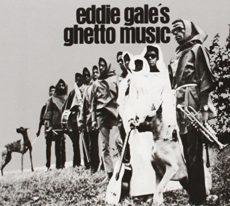
Ghetto Music is the 1968 debut album recorded by trumpeter Eddie Gale and released on the Blue Note label. The album seamlessly blends the new jazz of the ’60s with gospel, soul, and the blues. It was very much representative of the upheaval and turbulence in America at that time, being recorded just five months after the assassination of Martin Luther King Jr.
The Allmusic Guide awarded the album 5 stars and stated “The aesthetic and cultural merits of Eddie Gale’s Ghetto Music cannot be overstated. This is some of the most spiritually engaged, forward-thinking, and finely wrought music of 1968”.
Recorded at Rudy Van Gelder Studio, Englewood Cliffs, New Jersey on September 20, 1968. All five compositions are Gale originals: The Rain, Fulton Street, A Understanding, A Walk With Thee and The Coming of Gwilu.
The Band: Eddie Gale – trumpet, thumb piano, steel drum, bird whistle, Russell Lyle – tenor saxophone, flute, Jo Ann Gale Stevens – guitar, vocals, James “Tokio” Reid, Judah Samuel – bass, Richard Hackett, Thomas Holman – drums, Elaine Beener – lead vocals, Sylvia Bibbs, Barbara Dove, Evelyn Goodwin, Art Jenkins, Fulumi Prince, Edward Walrond, Sondra Walston, Mildred Weston, and Norman Wright – vocals.

More Posts: collectible,trumpet
Daily Dose Of Jazz…
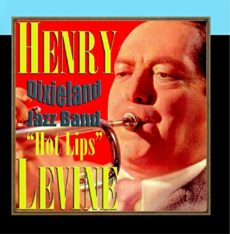
Henry Levine was born on November 26, 1907 in London, England but his family emigrated to the United States in 1908. In 1917, he heard Nick LaRocca with the Original Dixieland Jazz Band and decided to become a musician and learn trumpet.
From 1925 he worked as a professional musician with the Original Dixieland Jazz Band, and from the mid-1920s in various studio bands with Nat Shilkret and Vincent Lopez. From 1927 he performed with the British bandleader Bert Ambrose, and also made recordings with Fred Elizalde in London.
Returning to the States he played with Cass Hagan and Rudy Vallee before working again as a studio musician. He was head of the NBC Chamber Music Society of Lower Basin Street Jazz Group, recording several sessions with them. After the end of the Second World War Levine worked as a director of radio, television and hotel orchestras.
In 1961 he went moved to Las Vegas, Nevada and retired in 1982. He has been lauded by Allmusic as an excellent lead trumpeter and effective soloist. Under his own name, he recorded a single with jazz standards such as Rockin ‘Chair and I’ve Found a New Baby for RCA Victor. British-American trumpeter Henry “Hot Lips” Levine passed away in May 1989.

More Posts: trumpet
Daily Dose Of Jazz…
Colin Ranger Smith was born in London, England on November 20, 1934. Initially joining the Terry Lightfoot band in 1957, he moved on to playing with Cy Laurie, in 1958. He had a long tenure in the Acker Bilk band that began in 1959, taking a break in 1966 to sail across the Atlantic in a 45-foot ketch, rejoining Bilk in 1968. During that period he also worked at the same time in the band with saxophonist Tony Coe and the trombonist John Picard, as well as with Stan Greig’s London Jazz Big Band.
1977 saw Colin together with Picard, Ian “Stu” Stewart, Dick Morrissey and Charlie Watts. He played in the Bob Hall/George Green Boogie Woogie Band, an ad hoc band which would eventually become known as Rocket 88.
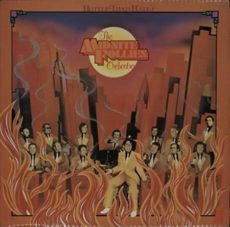
Other big bands he played with included those led by the American clarinettist Bob Wilber, and later the one led by Charlie Watts and the revisionist Midnite Follies Orchestra, Stan Greig’s Boogie Band and Brian Leake’s Sweet and Sour. From 1983 he played with the Pizza Express All Stars and, in 1992, returned to playing with Bilk.
Trumpeter Colin Smith was struck with congenital liver problems that sidelined him during the last years of his life, eventually passing away on March 29, 2004 in London.
More Posts: trumpet