

Daily Dose Of Jazz…
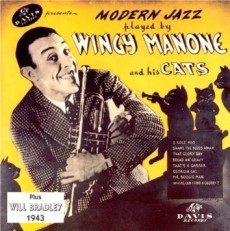
Wingy Manone was born Joseph Matthews Manone on February 13, 1900 in New Orleans, Louisiana. He lost an arm in a streetcar accident, which resulted in his nickname of “Wingy”. He used prosthesis so naturally and unnoticeably that his disability was not apparent to the public.
After playing trumpet and cornet professionally with various bands in his hometown, Manone began to travel across America in the 1920s, working in Chicago, New York City, Texas, Mobile, California, St. Louis and other locations; he continued to travel widely throughout the United States and Canada for decades.
Wingy’s was a frequently recruited musician for recording sessions. He played and recorded with Benny Goodman and recorded fronting various pickup groups under pseudonyms like “The Cellar Boys” and “Barbecue Joe and His Hot Dogs.” His hit records included “Tar Paper Stomp” was later used as the basis for Glenn Miller’s “In The Mood” and a hot 1934 version of a sweet ballad of the time “The Isle of Capri”.
In 1943 he recorded several tunes as “Wingy Manone and His Cats”, performed in Soundies movie musicals and his autobiography, Trumpet on the Wing, was published in 1948. From the 1950s he was based mostly in California and Las Vegas, although he also toured through North America and Europe appearing at jazz festivals. In 1957, he attempted to break into the teenage rock-and-roll market with his version of Party Doll but never rose higher than 56 on the Billboard pop charts.
He composed numerous songs and in 2008, “There’ll Come a Time (Wait and See)” was used in the soundtrack to the Academy Award-nominated movie The Curious Case of Benjamin Button. Trumpeter, vocalist, composer and bandleader Wingy Manone remained active until his passing on July 9, 1982 in Las Vegas at the age of 82.

Give The Gift Of Knowledge
More Posts: trumpet
Daily Dose Of Jazz…
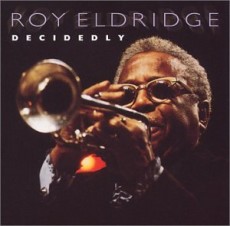
Roy Eldridge was born David Roy Eldridge on January 30, 1911 on the North Side of Pittsburgh, Pennsylvania. His mother was a gifted pianist with a talent for reproducing music by ear, a talent inherited from her. He began playing piano at age five, took up drums at six, played bugle in church and by eleven began seriously honing the instrument, especially the upper register. Though lacking a proficiency at sight-reading, he could replicate melodies by ear effectively.
Eldridge’s early years had him leading and playing in a number of Midwest bands and absorbed the influence of saxophonists Benny Carter and Coleman Hawkins in developing an equivalent trumpet style. Leaving home after expulsion from high school in ninth grade he joined a traveling show at sixteen until it folded in Youngstown, Ohio. He then joined a carnival, returned home and found work in another traveling show. By 20, he led an orchestra, auditioned for Horace Henderson, played in a number of territory bands, formed his own short-lived band once again, moved to Milwaukee and took part in a cutting contest with Cladys “Jabbo” Smith.
Eldridge moved to New York in 1930, playing in Harlem dance bands, and got the nickname “Little Jazz” from Ellington saxophonist Otto Hardwick. He laid down his first recorded solos with Teddy Hill in 1935, led his own band at the reputed Famous Door nightclub and recorded a number of small group sides with singer Billie Holiday. He would join Fletcher Henderson’s band, becoming his featured soloist because of his ability to swing a band. He would move to Chicago to form a band with his older brother, playing saxophone and arranging. In the 40s he joined the Gene Krupa Orchestra, staying until the band broke up after Krupa was jailed for marijuana possession.
Over the course of his career, Little Jazz would play with Anita O’Day, Jazz At The Philharmonic, Coleman Hawkins, Ella Fitzgerald, Earl Hines, Abbey Lincoln, Charles Mingus, Eric Dolphy, Kenny Dorham, Max Roach, Count Basie, Artie Shaw and the list goes on and on. His sophisticated use of harmony, including the use of triton substitutions, his virtuosic solos exhibiting a departure from the smooth and lyrical style of earlier jazz trumpet innovator Louis Armstrong, and his strong impact on Dizzy Gillespie mark him as one of the most influential musicians of the swing era and a precursor of bebop.
In 1971 trumpeter Roy Eldridge was inducted into the Down Beat Jazz Hall of Fame. After suffering a heart attack in 1980, he gave up playing. He died at the age of 78 on February 26, 1989 at the Franklin General Hospital in Valley Stream, New York, three weeks after the death of his wife, Viola.
Give The Gift Of Knowledge
More Posts: trumpet

Daily Dose Of Jazz…
Laura Kahle was born on January 20, 1979 in Michigan but her family moved to Australia as a baby where she lived until 2004. She received her Bachelor of Music in jazz trumpet with the great John Hoffman and a Master of Music Studies in Composition @ the QLD Conservatorium of Music.
Moving to New York in 2004 she found herself working with the Danish Radio Big Band in Copenhagen, arranging the music of Jeff “Tain” Watts and Michael Brecker. She recorded “Downstream” was recorded in 2004 with a ten-piece ensemble from Brisbane, “West End Composers Collective”.
In 2006 she had two arrangements premiered by Wynton Marsalis and the Lincoln Center Jazz Orchestra featuring Jeff “Tain” Watts in Rose Hall, New York City. In 2007 she arranged the music of Gil Evans for the Branford Marsalis Septet, and performed in the Allen Room in New York City. By 2011 she recorded “Circular” and continues to perform and record.
Inspire A Young Mind
More Posts: trumpet
Daily Dose Of Jazz…
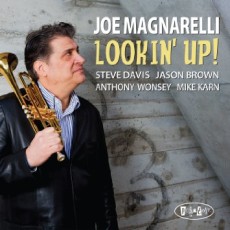
Joe Magnarelli was born in Syracuse, New York on January 19, 1960. He first started playing music at age 12 with guitar and trumpet lessons, but had a knack for picking out songs on the piano by ear. His early performance experience, from elementary through high school, came via playing the trumpet and guitar in church. Later, while attending Onondaga Community College in Syracuse, he was the pianist and choir director at the Central Baptist Church.
Mags, as he was known, went on to get his bachelor’s degree in liberal arts from the State University of New York in Fredonia in 1986, and that year, he moved to New York City to pursue a career in music. Becoming a regular on the New York and international jazz scene, by 1987 he was touring and recording with Lionel Hampton and Brother Jack McDuff, and was soon seen playing with Toshiko Akiyoshi, Glenn Miller Orchestra, Harry Connick Jr. and the Hard Bop Quintet.
In 1990, Joe was a semifinalist at the Thelonious Monk International Trumpet Competition in Washington, DC. He made his debut as a leader on the Cris Cross label in 1994 with “Why Not”. He followed that excellent album with three others on the label, “Always There”, “Mr. Mags” and “Hoop Dreams”. Joe currently has nine records out as a leader, and has played on numerous jazz labels as a sideman.In 2003-2006, Mags performed with the great Latin jazz conguero Ray Barretto’s New Sextet.
Joe recorded on Ray’s “Time Was, Time Is” (O+ Music), which was nominated for a Grammy. His list of sideman gigs is too long to list but a few are the Vanguard Orchestra, Jane Monheit, Jon Hendricks, Jimmy Cobb, Louis Hayes, Alvin Queen, Dado Maroni, Marty Sheller, Tom Harrell Big Band, The Carnegie Hall Orchestra, Don Sebesky, John Pizzarelli, Aretha Franklin, Rosemary Clooney, Joe Williams, Michael Feinstein, and the Lincoln Center Orchestra.
Trumpeter Joe Magnarelli is currently an adjunct professor of music at the Juilliard School of Music and Rutgers University, and he also conducts clinics and master classes around the world.
Give A Gift Of Jazz – Share
More Posts: trumpet
Daily Dose Of Jazz…
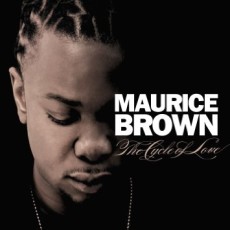
Maurice Brown was born on January 6, 1981 in Harvey, Illinois. Showing a remarkable affinity for the trumpet, he performed with Ramsey Lewis at Chicago’s Symphony Center while matriculating through Hillcrest High School. Following graduation, he received a full scholarship to attend Northern Illinois University, and later continued his studies at Southern University in Baton Rouge, Louisiana, where he worked with famed clarinetist Alvin Batiste.
Relocating to New Orleans shortly thereafter, Maurice began sitting in with numerous jazz veterans, including Clark Terry, Johnny Griffin, Ellis Marsalis and Lonnie Plaxico. He recorded as a sideman with Curtis Fuller, Fred Anderson, Roy Hargrove, Michelle Carr and Ernest Dawkins among others.
In 2001 Brown would win first place in the National Miles Davis Trumpet Competition and in 2003 he released his first album as a bandleader, heading his own quintet for Hip to Bop. The project showed an amazing affinity for bop-inflected jazz, along with a willingness to expand the genre’s lexicon through innovative techniques like playing trumpet solos through a wah-wah pedal.
Trumpeter Maurice Brown continues to live in New Orleans, playing both with his quintet and a hip-hop/funk combo called Soul’d U Out.
Dose A Day – Blues Away
More Posts: trumpet