

The Quarantined Jazz Voyager
The variants are still plaguing society and yet most are taking a casual attitude in dealing with health. Understand it takes a village for all of us to get past this, to coin a phrase. Those of us who have had friends and family pass due to Covid~19 know the loss of loved ones. Stay vigilant people.
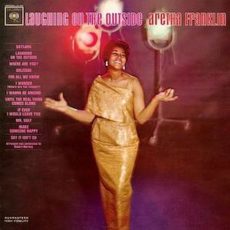
So, for those of you who are not familiar with the jazz side of the Queen Of Soul, allow this to be your introduction to the other side of her interpretive talent. This week I am pulling from the shelves one of her classic albums, Laughing On The Outside. It is the fourth studio album by Aretha Franklin, recorded at Columbia Recording Studios, in New York City on April 17, 1963 and on June 12–14, 1963 in Hollywood, California. It was released on August 12, 1963, by Columbia Records.
These sessions found a 21-year-old Aretha stepping away from her gospel roots and recording jazz and popular music standards, from Johnny Mercer to Betty Comden to Duke Ellington. She is backed by the arrangements of Columbia producer Robert Mersey. One of the most popular songs from the album is her interpretation of the classic Skylark. This was also one of the first times she recorded one of her written compositions, I Wonder (Where Are You Tonight), on an album.
Track Listing | 41:00
Side One
- Skylark (Johnny Mercer, Hoagy Carmichael) ~ 2:49
- For All We Know (Sam M. Lewis, J. Fred Coots) ~ 3:25
- Make Someone Happy (Betty Comden, Adolph Green, Jule Styne) ~ 3:48
- I Wonder (Where Are You Tonight)” (Aretha Franklin, Ted White) ~ 3:16
- Solitude (Duke Ellington, Eddie DeLange, Irving Mills) ~ 3:50
- Laughing on the Outside (Bernie Wayne, Ben Raleigh) ~ 3:14
Side Two
- Say It Isn’t So (Irving Berlin) ~ 3:05
- Until The Real Thing Comes Along (Sammy Cahn, Saul Chaplin, L. E. Freeman) ~ 3:04
- If Ever I Would Leave You” (Alan Jay Lerner, Frederick Loewe) ~ 4:04
- Where Are You? (Harold Adamson, Jimmy McHugh) ~ 3:50
- Mr. Ugly (Norman Mapp) ~ 3:22
- I Wanna Be Around (Johnny Mercer, Sadie Vimmerstedt) ~ 2:25
- Aretha Franklin ~ vocals
- Robert Mersey ~ producer, arranger, conductor
- Earl Van Dyke, Dave Grusin, Andrew Acker, Leon Russell ~ piano
- C. Bosler, Ray Pohlman, Melvin Pollan ~ bass guitar
- Hindel Butts, Hal Blaine ~ drums
- Don Arnome, Tommy Tedesco, Billy Strange ~ guitar
- Jimmy Nottingham ~ trumpet
- Robert Ascher ~ trombone
- Plas Johnson ~ saxophone
- Bernard Eichenbaum, Julius Schacter, Leo Kahn, Berl Senofsky, Felix Gigol, Max Pollikoff, George Ockner, John Rublowsky, Sid Sharp, Tibor Zelig, George Poole, Irving Lipschultz, Irving Weinper, Darrel Terwilliger ~ violin
- R. Dickler, Theodore Israel, Jacob Glick ~ viola
- Jesse Erlich, Anthony Twardowsky, Joseph Tekula ~ cello

More Posts: adventure,album,club,genius,jazz,museum,music,preserving,restaurant,travel,vocal
The Quarantined Jazz Voyager
Do what you desire to or not protect your health but be responsible for the health of your fellow man. This is my request. The children are spreading this far more than adults as I continue to hear reports from friends that they caught Covid from children who have greater exposure.
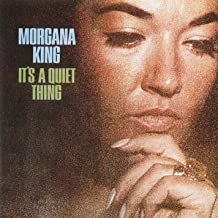
The album It’s A Quiet Thing from vocalist Morgana King is taken from the stacks representing the need for silence and reflection during this time of uneasiness. Produced by Jimmy Bowen, the album was recorded and released on the Reprise label in 1965 with arrangements by Torrie Zito brings us music reflective of the title.
Noise is not required to transport us to destinations that conjure memories. It’s class and sophistication that makes this an elegant compendium of songs. The arrangements and orchestration are equally soft and complimentary to her voice. Her incredible vocal range is backed by a menu of textured strings, guitar, French horn and bossa nova.
Artistry is something one has and when two purveyors connect we become privy to an excellent outcome. This happens to fill that order. So sit back, relax and listen.
Tracks | 31:27- It’s a Quiet Thing (Fred Ebb, John Kander) ~ 3:02
- Dindi (Ray Gilbert, Antonio Carlos Jobim, Aloysio de Oliveira) ~ 4:00
- Useless Landscape (Gilbert, Jobim, de Oliveira) ~ 3:12
- Gone with the Wind (Herbert Magidson, Allie Wrubel) ~ 2:58
- Little Girl Blue (Lorenz Hart, Richard Rodgers) ~ 3:35
- Mountain High, Valley Low (Bernie Hanighen, Raymond Scott) ~ 2:09
- How Insensitive (Norman Gimbel, Jobim, Vinícius de Moraes) ~ 3:14
- Here’s That Rainy Day (Johnny Burke, Jimmy Van Heusen) ~ 2:38
- Deep Song (George Cory, Douglass Cross) ~ 3:38
- If You Should Leave Me (E Se Domani) (Arthur Altman, Giorgio Calabrese, Al Stillman) ~ 3:01
- Morgana King ~ vocals
- Torrie Zito ~ arranger
More Posts: adventure,album,club,genius,jazz,museum,music,preserving,restaurant,travel,vocal

Daily Dose Of Jazz…
Alain Mion was born of French extraction on January 14, 1947 in Casablanca, Morocco but was raised in Paris, France.Influenced by Bobby Timmons, Ray Charles and Les McCann, his style varies between jazz, soul jazz and funky music. By the time he was 19 he formed his own trio and performed at the Blue Note. This subsequently led to him gigging at various festivals with Hank Mobley and Philly Joe Jones.
1974 Alain created the jazz funk group Cortex and recorded a dozen albums before embarking upon a career under his own name in 1982, recording to date eleven albums, such as Pheno-Men, Alain Mion in New York recorded with David Binney and Marc Johnson, and Some Soul Food recorded in Stockholm, Sweden with Patrik Boman and Ronnie Gardiner.
In 2008, he emerged with a new group, Alain Mion FunKey Combo with drums, bass and a saxophone section consisting of Italian and French musicians. He reinvented his new group Alain Mion & The New Cortex with the singer Adeline de Lépinay reprising the role originally performed by Mireille Dalbray on the Troupeau Bleu album.
In the United States, Alain Mion and Cortex’s songs have been sampled by several hip-hop artists including but not limited to Madlib, Fat Joe, DJ Day, MF DOOM, Wiz Khalifa, Curren$y, Mellowhype, Tyler The Creator, Rick Ross, and Lupe Fiasco.
Pianist, composer, arranger, and vocalist Alain Mion continues his exploration of the jazz idiom.
More Posts: arranger,bandleader,composer,history,instrumental,jazz,music,piano,vocal
The Quarantined Jazz Voyager
I can only appeal to your sense of fair play that you quarantine, social distance and wear masks whenever you are out around people during this period of increased variants. It is a responsible person who takes the effort to protect others even when they do not have the desire to protect themselves.
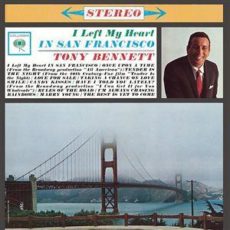
This week I’m pulling from the stacks one of Tony Bennett’s highest selling albums of his career I Left My Heart In San Francisco. Released in 1962 on Columbia Records, it peaked at #5 on the Billboard pop albums chart, and has been certified platinum by the RIAA. Tony Bennett won two 1962 Grammy Awards for the title song: Record of the Year and Best Solo Vocal Performance, Male.
The album was produced by Ernie Altschuler and assembled around unused singles from earlier sessions. The previously released songs included the Cy Coleman/Carolyn Leigh songs The Best Is Yet to Come/Marry Young as well as Close Your Eyes/Rules of the Road, which were A&B sides respectively. Candy Kisses and Have I Told You Lately? were recorded in 1961. Tender Is the Night was later used in the 1962 film, while Charlie Chaplin’s Smile from Modern Times peaked at #73 on the Billboard Hot 100. It was the only other single that charted with San Francisco.
Three additional tracks were taken from sessions spanning 1957 to 1960. Taking a Chance on Love from the musical Cabin in the Sky, Love for Sale from The New Yorkers, and I’m Always Chasing Rainbows” from Oh, Look!. Bennett’s rescue of Once Upon a Time from All American gave him San Francisco instead, his signature song.
Tracks | 32:20
Side 1
- I Left My Heart In SanFrancisco (Douglass Cross, George Cory) ~ 2:52
- Once Upon A Time (Charles Strouse, Lee Adams) ~ 2:57
- Tender Is The NIght ( Sammy Fain, Paul Francis Webster) ~ 2:38
- Smile (Charlie Chaplin, Geoffrey Parsons, John Turner) ~ 2:49
- Love For Sale (Cole Porter) ~ 3:09
- Taking A Chance On Love (Cy Coleman, Carolyn Leigh) ~ 2:28
Side 2
- Candy Kisses (George Coleman) ~ 2:25
- Have I Told You Lately (Harold Rome) ~ 2:39
- Rules Of The Road (Cy Coleman, Carolyn Leigh) ~ 2:42
- Marry Young ((Cy Coleman, Carolyn Leigh) ~ 2:20
- I’m Always Chasing Rainbows (Harry Carroll, Joseph McCarthy) ~ 2:40
- The Best Is Yet To Come ((Cy Coleman, Carolyn Leigh) ~ 2:28
- Tony Bennett ~ vocals
- Ralph Sharon ~ piano; arrangements on Love for Sale
- Candido Camero, Sabu Martinez, Billy Exiner ~ percussion on Love for Sale
- The Count Basie Orchestra ~ instruments and arrangements on Taking A Chance on Love
- Marty Manning ~ arrangements on San Francisco, Once Upon A Time, Tender is the Night, Candy Kisses, Have I Told You Lately?
- Cy Coleman ~ arrangements on Marry Young, The Best Is Yet to Come
- Ralph Burns ~ arrangements on Smile, Rules of the Road
- Frank De Vol ~ arrangements on I’m Always Chasing Rainbows
More Posts: adventure,album,club,genius,jazz,museum,music,preserving,restaurant,travel,vocal
Daily Dose Of Jazz…
Bud Scott was born Arthur Budd Scott on January 11, 1890 in New Orleans, Louisiana. He played guitar and violin as a child and performed professionally from an early age. His first job was with New Orleans dance band leader John Robichaux in 1904 and as a teenager he played with Buddy Bolden. In 1911 he was playing guitar with Freddie Keppard’s Olympia Orchestra. In 1912 he left New Orleans with a large travelling show.
As a violinist he performed with James Reese Europe’s Clef Club Orchestra at a historic 1912 concert at Carnegie Hall, and the following year worked with Europe’s ensemble on the first jazz recordings on the Victor label.He would go on to play on a number of Victor Talking Machine Company ragtime recordings with James Reese Europe’s Society Orchestra in 1913.
A graduate of the Peabody School of Music, he was a notable rhythm guitarist in Chicago, Illinois’s Jazz Age nightclubs of the 1920s. Moving there in 1923, he became a member of King Oliver’s Creole Jazz Band, originating the now traditional shout, Oh, play that thing!, on Oliver’s recording of Dippermouth Blues. He also worked with Johnny Dodds and Jimmy Blythe, Erskine Tate, Jelly Roll Morton’s Red Hot Peppers and Richard M. Jones’ Jazz Wizards.
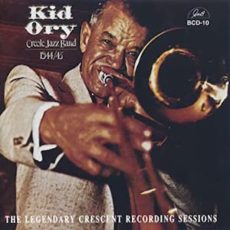
Scott was the first person to use a guitar in a modern dance orchestra, in Dave Peyton’s group accompanying Ethel Waters at Chicago’s Cafe de Paris. After performing and recording with Jimmie Noone’s Apex Club Orchestra in 1928 he moved to California. Making a living as a professional musician through the 1930s, when traditional jazz was eclipsed by big-band swing music, he formed his own trio. In 1944 Scott joined an all-star combination that evolved into Kid Ory’s Creole Jazz Band. This was an important force in reviving interest in New Orleans-style jazz in the 1940s, and he wrote the majority of the band’s arrangements.
In 1944 Bud joined an all-star traditional New Orleans band that was a leader of the West Coast revival, put together for the CBS Radio series The Orson Welles Almanac. He arranged most of the songs for Kid Ory’s band, of which he was a part. His talent for arranging earned him the title of The Master.
A stroke in 1948 forced his retireent from music. Guitarist, banjoist, violinist and vocalist Bud Scott, whose obituary ran on the front page of the Los Angeles Sentinel, transitioned in Los Angeles, California on July 2, 1949, aged 59.
More Posts: arranger,banjo,buitar,history,instrumental,jazz,music,violin,vocal