


Daily Dose Of Jazz…
Born Jeannette Schwager on June 15th in the Netherlands, Jeannette Lambert grew up in Sudbury, Ontario, Canada. Her Dutch and Indonesian parents loved jazz, and she started singing at the age of nine. From the age of 12, she performed with her brother, guitarist Reg Schwager, at coffee houses and music festivals. She did not have to venture far to perform regular jam sessions, which were held at her house when she was a teenager.
Particularly inspired by the older jazz musicians who participated, especially Herbie Spanier, he encouraged her to improvise as freely as possible. While she studied film production at Toronto’s York University during 1984-1986, Lambert also attended the Banff Summer Jazz Workshop in 1985, singing with the Cecil Taylor Workshop Big Band and taking lessons from Jay Clayton, Dave Liebman, and Julian Priester.
After periods living in Paris, New York, and Amsterdam, she settled in Montreal, married drummer Michel Lambert, and co-founded the record label Jazz from Rant with her brother and her husband in 1991. Jeannette’s music is inspired and influenced not only by other jazz singers but by flamenco, fado, and jaipongan. In addition to her singing and recording, she writes music to her own poetry and is an internet filmmaker.
Her several recordings, primarily on the Jazz from Rant label, include free improvisations, collaborations with pianist Paul Bley, and two volumes of Bebop for Babies, jazz versions of children’s melodies. Vocalist, poet, record label owner Jennette Lambert continues to compose, perform and record,

The Quarantined Jazz Voyager
I REMEMBER MILES 6.10.21
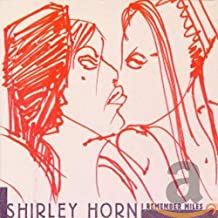
As I continue to be vigilant in my social distancing, masking, and avoiding the unasked that no one is checking I take down off the shelf a favorite vocalist who I used to see perform at the Bohemian Caverns in Washington, DC. This week the album I have selected is the 1998 studio album I Remember Miles by Shirley Horn. It was recorded in tribute to Miles Davis and covers songs that showed the sensitive side of the musicians..
The album’s cover art is a drawing Davis had once done of them both. The album design and artwork was by Chika Azuma, and Ira Gitler wrote the liner notes. Horn’s performance on this album won her the Grammy Award for Best Jazz Vocal Performance at the 41st Grammy Awards.
The production team was composed of producer Richard Seidel, assistant producer Sheila Mathis, production coordination by Camille Tominaro, Dave Baker engineered and mixed the album, and mastering was performed by Duncan Stanbury.
Track List | 52:54
- My Funny Valentine (Lorenz Hart, Richard Rodgers) ~ 5:33
- I Fall in Love Too Easily (Sammy Cahn, Jule Styne) ~ 5:39
- Summertime (George Gershwin, Ira Gershwin, DuBose Heyward) – 4:59
- Baby Won’t You Please Come Home (Charles Warfield, Clarence Williams) ~ 7:21
- This Hotel (Johnny Keating, Richard Quine) ~ 3:37
- I Got Plenty o’ Nuttin’ (Gershwin, Gershwin, Heyward) – 3:39
- Basin Street Blues (Williams) ~ 5:28
- My Man’s Gone Now (Gershwin, Gershwin, Heyward) ~ 10:39
- Blue in Green (Miles Davis, Bill Evans, Al Jarreau) ~ 5:59
- Shirley Horn ~ piano, vocals, producer
- Ron Carter ~ bass guitar
- Roy Hargrove ~ flugelhorn, trumpet
- Toots Thielemans ~ harmonica
- Buck Hill ~ tenor saxophone
- Charles Ables ~ double bass
- Steve Williams ~ drums, percussion
- Al Foster ~ drums

More Posts: adventure,album,club,genius,jazz,museum,music,preserving,restaurant,travel,vocal
The Quarantined Jazz Voyager
TUESDAYS IN CHINATOWN | ANDY BEYPolitics, business and society are taking another foreboding step towards the past normal by allowing people who have been vaccinated to move unmasked. Ther are, however, no checks and balances as no one is checking these people as they come into stores. Thinking this is too early, I remain safe and comfortable in my home.
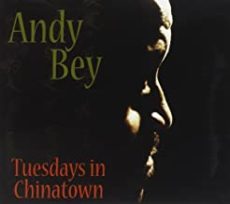
On that note, this week I am listening to another favorite of mine, male baritone vocalist by the name of Andy Bey and I have chosen his 2001 Tuesdays In Chinatown release. The horns were arranged by Geri Allen, engineered and mixed by Dave Kowalski, mastered by Ron McMaster, and produced by Herb Jordan. The photography was taken by Frank Stewart.
Track Listing | 63:01- Tuesdays In Chinatown ~ 6:52
- Fragile (Sting) ~ 4:50
- Bridges (Milton Nascimento) ~ 4:58
- Saidas E. Bandeiras (Fernando Brant / Milton Nascimento) ~ 5:36
- In A Mist (Bix Beiderbecke) ~ 7:06
- I’ll Remeber April (Gene DePaul / Pat Johnston / Patricia Johnston / Don Raye) ~ 5:35
- Invitation (Bronislaw Kaper / Paul Francis Webster) ~ 7:01
- Little Girl Blue (Lorenz Hart / Richard Rodgers) ~ 6:17
- Just Friends (John Klenner / Sam M. Lewis) ~ 2:40
- Feelin’ Lowdown (Big Bill Broonzy) ~ 6:18
- Andy Bey ~ piano, vocal
- Peter Washington, Ron Carter ~ Bass
- Peter Sanders ~ Cello (2)
- Marty Ehrlich ~ Clarinet, Bass Clarinet, Alto Flute
- Victor Lewis ~ Drums
- Earl Gardner, John Sneider ~ Flugelhorn, Trumpet
- Paul Meyers ~ Guitar
- Mino Cinelu ~ Percussion
- Steve Turre ~ Trombone
- Barry Finclair ~ Viola
- Andy Stein ~ Violin, String Arrangements
- Laura Seaton ~ Violin
More Posts: adventure,album,club,genius,jazz,museum,music,preserving,restaurant,travel,vocal
Daily Dose Of Jazz…
Kitty Kallen, born Katie Kallen on May 25, 1921 in Philadelphia, Pennsylvania, was one of seven children. As a child, she won an amateur contest by imitating popular singers. Returning home with her prize camera, her father punished her for stealing it. Only when neighbors subsequently visited to congratulate her did her father realize she had actually won it.
As a young girl, she sang on The Children’s Hour, a radio program sponsored by Horn & Hardart, an automat chain. As a preteen, Kallen had a radio program on Philadelphia’s WCAU and sang with the big bands of Jan Savitt in 1936, Artie Shaw in 1938, and Jack Teagarden in 1939. At twenty she sang the vocals for Moonlight Becomes You with Bobby Sherwood and His Orchestra at the second ever session for what was then still called Liberty Records but would soon be renamed Capitol Records. It was her only session for the label.
She joined the Jimmy Dorsey band when she was twenty-one replacing Helen O’Connell. Her recording with Dorsey, They’re Either Too Young or Too Old, was a favorite of American servicemen. She followed this with Dorsey’s #1 hit Besame Mucho. Singing duets with Bob Eberly, when he left to go into the service in 1943, she joined Harry James’s band.
With James she went on to have many hits in the top twenty with two hitting #1. In 1954 she was voted the most popular female singer in Billboard and Variety polls. She followed up with the song, In the Chapel in the Moonlight, which was another million seller. Kittty performed live at numerous prominent venues, as well as popular television shows like the Tonight Show, American Banstand and The Big Beat.
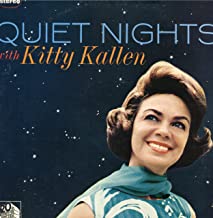
Her final album was Quiet Nights, a bossa nova–flavored release for 20th Century Fox Records. Subsequently, she retired owing to a lung ailment. On February 8, 1960, Kallen received a star on the Hollywood Walk of Fame A compilation of her hits on various labels remains available on the Sony CD set The Kitty Kallen Story. Vocalist Kitty Kallen passed away on January 7, 2016.

More Posts: history,instrumental,jazz,music,vocal
The Quarantined Jazz Voyager
But Beautiful | Jimmy Scott
Society is taking another step towards mingling as governors are relaxing the mask requirement and several major cities are following their lead and people are celebrating. Thinking it too early and comfortable in my home I remain vigilant with my social distancing and trust you are doing the same.
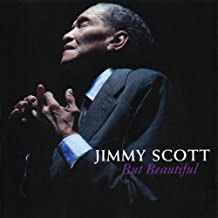
So this week we take a trip down memory lane with Jimmy Scott and his 2002 recording titled But Beautiful. It was recorded at The Studio in New York City on August 16~19, 2001.released on the German label Milestone and was arranged by Freddy Cole (Track 7), Joe Beck (Track 8), Renee Rosnes (Track 1,4,6,7,9) and Robert Sadin (Track 5,10). The album was mixed by Dave Luke at Fantasy Studios in Berkeley, California. It was produced by Todd Barkan and recorded by Katherine Miller. Track Listing | 54:05
- You Don’t Know What Love Is (Gene DePaul/Don Raye) ~ 4:59
- Darn ThatDream (Edddie DeLange/James Van Heusen) ~ 6:35
- It Had To Be You (Isham Jones/Gus Kahn) ~ 4:17
- This Bitter Earth (Clyde Otis) ~ 5:21
- Please Send Me Someone To Love (Percy Mayfield) ~ 5:31
- But Beautiful (Johnny Burke/James Van Heusen) ~ 5:50
- When You Wish Upon A Star (Leigh Harline/Ned Washington) ~ 5:18
- Bye Bye Blackbird (Mort Dixon/Ray Henderson) ~ 5:18
- I’ll Be Seeing You (Sammy Fain/Irving Kahal) ~ 6:01
- Take My Hand, Precious Lord (Rev. Thomas A. Dorsey) ~ 4:37
- Jimmy Scott ~ vocal
- Freddy Cole ~ vocal (track 7)
- Renee Rosnes ~ piano
- George Mraz ~ bass
- Lewis Nash ~ drums
- Joe Beck ~ guitar (track 1,3,5,6, & 8)
- Wynton Marsalis ~trumpet (track 2)
- Lew Soloff ~ trumpet (track 8)
- Eric Alexander ~ tenor saxophone (track 3, 5 & 6)
- Bob Kindred ~ tenor saxophone (track 4 & 9)
More Posts: adventure,album,club,genius,jazz,museum,music,preserving,restaurant,travel,vocal