

Hollywood On 52nd Street
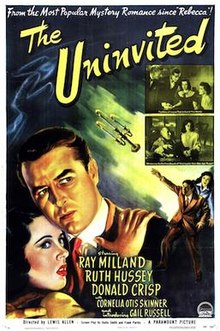
Stella by Starlight is a popular song by Victor Young that was drawn from thematic material composed for the main title and soundtrack of the 1944 Paramount Pictures film, The Uninvited. Appearing in the film’s underscore as well as in source music as an instrumental theme song without lyrics.
It was turned over to Ned Washington, who wrote the lyrics for it two years later in 1946. The title had to be incorporated into the lyrics, which resulted in its unusual placement: the phrase appears about three-quarters of the way through the song, rather than at the beginning or the end.
At one point in the film, the main character, Rick (Ray Milland) tells Stella (Gail Russell) that he is playing a serenade, To Stella by Starlight.
Plot
Rick (Ray Milland) and his sister Pamela (Ruth Hussey) unknowingly buy a seaside home that is haunted by the ghost of Mary Meredith. Meredith’s husband was a painter who had an affair with his gypsy model, Carmel, Meredith discovers the affair, takes Carmel to and leaves her in Paris, where she gives birth to a child, which ultimately Mary took. Subsequently, Carmel returned to England, takes the infant Stella from Windward, and, during the confrontation, pushes Mary off the cliff to her death. So Mary haunts the house and when Stella returns her affinity to the place is cemented. Rick falls for her but wants her to leave. Seances, ghost visitations by both Camel and Mary, and a sanatorium reveal that Carmel, not Mary is Stella’s mother. This frees Carmel’s spirit from Windward House and with Rick confronting Mary’s spirit announcing he is no longer afraid, the spirit also departs.
Recordings
“Stella by Starlight” is one of the most popular standards, its May 1947 recording by Harry James and his orchestra reached 21st place in the pop charts. Two months later, the recording by Frank Sinatra with Axel Stordahl and his orchestra also rose to the 21st position.
Early adaptations of the song were performed and recorded by Charlie Parker, Stan Getz in December 1952, trumpeter Chet Baker, Bud Powell, Stan Kenton, Nat King Cole. Other recordings have been made by Miles Davis, Red Garland, Earl Grant, Joe Pass, Bill Evans, Art Blakey and the Jazz Messengers, Lou Donaldson, Charlie Rouse, Dexter Gordon, Billy Eckstine, Dick Haymes, Ray Charles, Anita O’Day, Helen Reddy, Tony Bennett, Ella Fitzgerald, Mina, Al Hirt, Larry Coryell, among others.

Daily Dose Of Jazz…
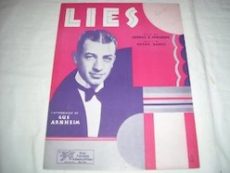
Harry Barris was born on November 24, 1905 in New York City to Jewish parents. Educated in Denver, Colorado. he became a professional pianist at the age of 14. He led a band that toured the Far East at the age of 17.
The same year, he played the piano and occasionally sang in the Paul Ash Orchestra, while Al Rinker and Bing Crosby became members of the Paul Whiteman Orchestra as a singing duo. However, while the duo was appearing at the vast New York Paramount in 1927, sans microphones, they could not be heard by the audience. They were promptly dropped from the bill. However, a band member who knew Barris suggested that they add him to make a trio and The Rhythm Boys was formed in April 1927.
In 1930, The Rhythm Boys left Whiteman and joined Gus Arnheim’s Cocoanut Grove Orchestra. They made one more recording together, Them There Eyes but the boys decided to quit in 1931 agoing their separate ways. Harry however, changed his mind and returned to the Cocoanut Grove to complete his contract. Joining Arnheim’s singing group The Three Ambassadors.
Barris appeared in 57 films between 1931 and 1950, usually as a band member, pianist or singer. Seven of those films had Bing Crosby as the star. In 1932, Barris signed a contract to star in six shorts for Educational Pictures.
During World War II, along with Joe E. Brown, he went overseas to entertain troops. Having a lifelong drinking problem, sustaining a fall that fractured his hip in 1961, and despite a series of operations, he developed a cancerous tumor. Vocalist, pianist, and composer Harry Barris, who was one of the earliest to utilize scat singing in recordings passed away on December 13, 1962 at the age of 57 in Burbank, California.
Share a dose of a New York City composer to inspire inquisitive minds to learn about musicians whose legacy lends their genius to the jazz catalog…
More Posts: composer,history,instrumental,jazz,music,piano,vocal
Daily Dose Of Jazz…
Dara Tucker was born on November 8th in Tulsa, Oklahoma, the third of seven children to music minister and gospel recording artist, Doyle Tucker, and singer Lynda Tucker. Starting out singing harmony at the age of 4 with her brothers and sisters, she began playing the piano at age 8, and traveled the country singing with her family for most of her childhood. The family spent time in Spokane, Washington; Detroit, Michigan; Fayetteville, Arkansas; Pasadena, California; and Baltimore, Maryland. Along with her siblings, they were known as The Tuckers bringing forth their rich harmonies and seamless blend.
Receiving her degree in International Business and German Studies, after graduating, Tucker worked for a few years in the field of International Business. She then moved to Interlaken, Switzerland to study German while aupairing. It was while living in Switzerland in 2003 she began songwriting, and the next year moved to Nashville, Tennessee to pursue a career as a singer/songwriter.
She recorded her debut album All Right Now in 2009 featuring Great American Songbook standards. Two years later she dropped her second album Soul Said Yes blending r&b, jazz, and gospel and featured seven-string guitarist, Charlie Hunter.
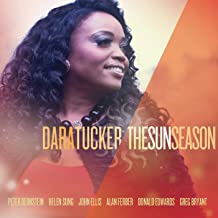
A third release, The Sun Season in 2014 was recorded in Astoria, Queens, New York included ten originals penned by Dara. The session had guitarist Peter Bernstein, pianist Helen Sung, drummer Donald Edwards, John Ellis on saxophone, Alan Ferber on trombone, and bassist Greg Bryant. She would go on to record another studio album and live date.
Vocalist Dara Tucker, named Jazz Vocalist of the Year at the 2016 and 2017 Nashville Industry Music Awards, and cites her influences including her parents as Mel Tormé, James Taylor, Stevie Wonder, and Nancy Wilson, continues to compose, perform and record.
More Posts: bandleader,composer,history,instrumental,jazz,music,vocal

Daily Dose Of Jazz…
Jane Monheit was born November 3, 1977 and grew up in Oakdale, New York on Long Island. Her father played banjo and guitar, her mother sang and played records by vocalists beginning with Ella Fitzgerald. At an early age, she was drawn to jazz and Broadway musicals.
She began singing professionally while attending Connetquot High School in Bohemia, New York. She attended the Usdan Summer Camp for the Arts and at the Manhattan School of Music, studying voice under Peter Eldridge, and graduating in 1999.
She was runner-up to Teri Thornton in the 1998 vocal competition at the Thelonious Monk Institute of Jazz, in Washington, DC. The next year when she was 22, she recorded her debut album, Never Never Land that was released the following year. Jane recorded many songs from the Great American Songbook and after recording for five labels, she started her own, Emerald City Records. The label’s inaugural release was The Songbook Sessions in 2016, an homage to Fitzgerald.
Monheit’s vocals were featured in the 2010 film Never Let Me Go for the titular song, written by Luther Dixon, and credited to the fictional Judy Bridgewater.
She has released eleven albums as a leader and has been a guest vocalist on eight albums recorded by David Benoit, Terence Blanchard, Les Brown, Tom Harrell, Harold Mabern, Mark O’Connor, Frank Vignola, and Joe Ascione. Vocalist Jane Monheit continues to perform and record.
More Posts: bandleader,history,instrumental,jazz,music,vocal
Daily Dose Of Jazz…
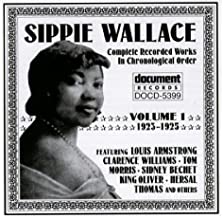
Sippie Wallace was born Beulah Belle Thomas on November 1, 1898 in Plum Bayou, Jefferson County, Arkansas, one of thirteen children. Coming from a musical family, two of her brothers and a niece had prolific music careers. As a child, her family moved to Houston, Texas, and growing up she sang and played the piano in Shiloh Baptist Church but at night she and her siblings would sneak out to tent shows. By her mid-teens, they were playing in those tent shows, performing in various Texas shows, building a solid following as a spirited blues singer.
Along with her brother Hersal, Wallace moved to New Orleans, Louisiana in 1915 and two years later she married Matt Wallace and took his surname. She followed her brothers to Chicago, Illinois in 1923 and worked her way into the city’s bustling jazz scene. Hersal died three years later, but her reputation led to a recording contract with Okeh Records that same year with her first recorded songs, Shorty George and Up the Country Blues, sold well enough to make her a blues star in the early 1920s. Moving to Detroit, Michigan in 1929, she would lose her husband and her brother George in 1936.
For some 40 years, Sippie sang and played the organ at the Leland Baptist Church in Detroit. From 1945 she basically retired from music until launching a comeback in 1966, recording an album, Women Be Wise, on October 31st in Copenhagen, Denmark, with Roosevelt Sykes and Little Brother Montgomery playing the piano. Over the course of her career, she worked with Louis Armstrong, Johnny Dodds, Sidney Bechet, King Oliver, and Clarence Williams.
Singer, songwriter, pianist, and organist Sippie Wallace, who was nominated for a Grammy Award in 1982 and was posthumously inducted into the Michigan Women’s Hall of Fame in 1993, passed away at Sinai Hospital in Detroit, Michigan from complications of a severe stroke suffered post~concert in Germany on November 1, 1986. She was 88.
More Posts: history,instrumental,jazz,music,organ,piano,songwriter,vocal