

Three Wishes
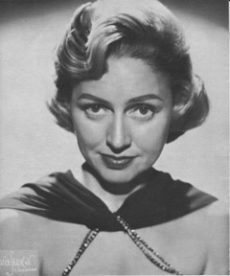
Baroness Pannonica inquired of Anita O’Day what her three wishes would be and she responded with:
- “To find a trio of swinging musicians who care for me enough to play with feeling; correct, musically and technically.”
- To keep all my necessary bills down to a minimum of which I’m sure I can keep them up to date.”
- “With high hopes to have some health. Hoping to have no cancer, which my mother did have. I do hope it does not run in the family. To be active until i die. You know! Up and at ’em, like!”
*Excerpt from Three Wishes: An Intimate Look at Jazz Greats – Compiled and Photographed by Pannonica de Koenigswarter

More Posts: baroness,history,instrumental,jazz,music,pannonica,three,vocal,wishes
Requisites
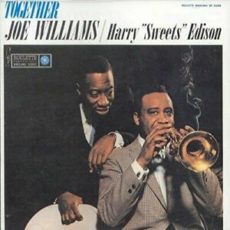
Together is a 1961 album by vocalist Joe Williams and trumpeter Harry “Sweets” Edison which was originally released on the Roulette label. The session was recorded on January 31st and February 1st & 2nd in Los Angeles, California and produced by Teddy Reig.
Track Listing- Winter Weather (Ted Shapiro) – 1:52
- I Don’t Know Why (I Just Do) (Fred E. Ahlert, Roy Turk) – 2:30
- There’s a Small Hotel (Richard Rodgers, Lorenz Hart) – 2:19
- Out of Nowhere (Johnny Green, Edward Heyman) – 2:14
- Aren’t You Glad You’re You (Jimmy Van Heusen, Johnny Burke) – 2:27
- Remember (Irving Berlin) – 1:52
- Together (Buddy DeSylva, Lew Brown) – 2:28
- Deep Purple ([Peter DeRose]], Mitchell Parish) – 2:48
- Always” (Irving Berlin) – 2:37
- Lover Came Back (Victor Herbert, Frederika de Grasec, Harry B. Smith) – 4:05
- By the River Sainte Marie (Edgar Leslie]], Harry Warren) – 1:57
- Alone Together (Arthur Schwartz, Howard Dietz) – 2:30
- Joe Williams – vocals
- Harry “Sweets” Edison – trumpet
- Jimmy Forrest – tenor saxophone
- “Sir” Charles Thompson – piano
- Tommy Potter – bass
- Clarence Johnston – drums
- Unidentified musician – guitar

More Posts: choice,classic,collectible,collector,history,instrumental,jazz,music,vocal

Requisites
Abbey Is Blue is the fourth album by jazz vocalist Abbey Lincoln featuring tracks recorded in the Spring and Fall of 1959 in New York City for the Riverside label. The album was produced by Bill Grauer and Orrin Keepnews, the latter also writing the liner notes The album was mastered by Jack Matthews and the cover photograph was taken by Lawrence N. Shustak. The design of the cover was created by Harris Lewine, Ken Braren and Paul Bacon.
Abbey Lincoln had mastered Billie Holiday’s skill at inhabiting the lyrics of a song and projecting its emotional content outward, and these songs, all of which deal with sorrow, are stark and harrowing accounts of loss and injustice.
Track Listing | 39:19- Afro Blue (Mongo Santamaría) – 3:20
- Lonely House (Langston Hughes, Kurt Weill) – 3:40
- Let Up (Abbey Lincoln) – 5:32
- Thursday’s Child (Elisse Boyd, Murray Grand) – 3:31
- Brother, Where Are You? (Oscar Brown) – 3:10
- Laugh, Clown, Laugh (Ted Fio Rito, Sam M. Lewis, Joe Young) – 5:24
- Come Sunday (Duke Ellington) – 5:13
- Softly, as in a Morning Sunrise (Oscar Hammerstein II, Sigmund Romberg) – 2:46
- Lost in the Stars (Maxwell Anderson, Kurt Weill) – 4:11
- Long as You’re Living” (Oscar Brown, Julian Priester, Tommy Turrentine) – 2:33
- Abbey Lincoln – vocals
- Kenny Dorham (tracks 2, 4 & 7-9), Tommy Turrentine (tracks 1, 3, 6 & 10) – trumpet
- Julian Priester – trombone (tracks 1, 3, 6 & 10)
- Stanley Turrentine – tenor saxophone (tracks 1, 3, 6 & 10)
- Les Spann – guitar (tracks 2, 4 & 7-9), flute (track 5)
- Wynton Kelly (tracks 2, 4, 5), Cedar Walton (tracks 3 & 6), Phil Wright (tracks 7-9) – piano
- Bobby Boswell (tracks 1, 3, 6 & 10), Sam Jones (tracks 2, 4, 5 & 7-9) – bass
- Philly Joe Jones (tracks: 2, 4, 5 & 7-9), Max Roach (tracks: 1, 3, 6 & 10) – drums
More Posts: choice,classic,collectible,collector,history,instrumental,jazz,music,vocal
Requisites
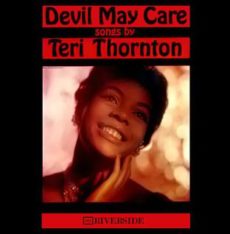
Devil May Care is the debut album released in 1961 by American jazz vocalist Teri Thornton featuring tracks recorded on December 23, 1960 and January 10, 1961 in New York City for the Riverside label.
>Norman Simmons was the arranger for the sessions that elapsed for 39 minutes and 19 seconds and was produced by Orrin Keepnews.
Track Listing- Lullaby Of The Leaves
- Devil May Care
- Detour Ahead
- The Song Is You
- My Old Flame
- What’s Your Story, Morning Glory
- Dancing In The Dark
- Left Alone
- Blue Champagne
- I Feel A Song Coming On
- What’s New
- Blue Skies
- Teri Thornton – vocals
- Clark Terry – flugelhorn, trumpet
- Britt Woodman – trombone
- Earle Warren – alto saxophone
- Seldon Powell – tenor saxophone
- Wynton Kelly – piano
- Freddie Green (tracks 1, 3, 5, 7, 9 & 12) – guitar
- Sam Herman (tracks 2, 4, 6, 8, 10 & 11) – guitar
- Sam Jones – bass
- Jimmy Cobb – drums
More Posts: choice,classic,collectible,collector,history,instrumental,jazz,music,vocal

Requisites
Junjo is the debut album by bassist and vocalist Esperanza Spalding and was recorded on April 6-7, 2005. It wasn’t released until April 2006 on the Spanish label Ayva Music.
The trio features pianist Aruán Ortiz, Francisco Mela on drums and then 22-year-old Spalding on upright bass, providing vocals, often wordless, on all but two tracks. Besides compositions by Jimmy Rowles, Egberto Gismonti and Chick Corea the trio plays originals.
Personnel- Esperanza Spalding – double bass, vocals
- Aruán Ortiz – piano
- Francisco Mela – drums
- “The Peacocks” (Jimmy Rowles) – 7:56
- “Loro” (Egberto Gismonti) – 5:06
- “Humpty Dumpty” (Chick Corea) – 5:51
- “Mompouana” (Aruán Ortiz) – 7:51
- “Perazuán” (Spalding, Ortiz) – 3:38
- “Junjo” (Spalding) – 5:13
- “Cantora de Yala” (G. Leguizamón, M. Castilla) – 4:55
- “Two Bad” (Spalding) – 6:59
- “Perazela” (Francisco Mela, Spalding) – 1:32
More Posts: bass,choice,classic,collectible,collector,history,instrumental,jazz,music,vocal