

Daily Dose Of Jazz…
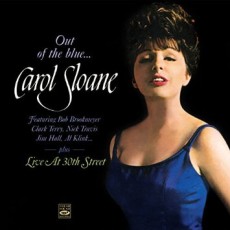
Carol Sloane was born on March 5, 1937 in Providence, Rhode Island. She has been singing professionally since she the age of 14. Between September 1967 and May 1968, she occasionally wrote album reviews for Down Beat and for a time in the 1970s she worked as a legal secretary in Raleigh, North Carolina
One of her early efforts was working with the Les and Larry Elgart orchestra. Later she filled in for Annie Ross of Lambert, Hendricks & Ross. But by 1961, with success at the Newport Jazz Festival Carol landed a multi-album contract with Columbia Records.
In the 70s her career stalled for a time, but Sloane was able to resume live performance and recording by the 1980s. She later signed with Concord Records and found some successes touring Japan.
She has worked with Tim Horner, George Duvivier, Art Davis, Barry Galbraith Clark Terry, Nick Travis, Bob Brookmeyer, Richie Pratt, Art Farmer, Clifford Jordan, Kenny Burrell, Kenny Barron, Rufus Reid, Grady Tate and Ken Peplowski, just to names a few. Vocalist Carol Sloane continues to perform, record and tour.

Uplift Someone’s World
More Posts: vocal
Daily Dose Of Jazz…
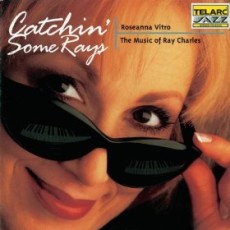
Roseanna Elizabeth Vitro was born in Hot Springs, Arkansas on February 28, 1951 and began singing at an early age, drawing inspiration from various musical genres like gospel from her mother’s side of the family, rock and R&B, theatre and classical. During the 1950s, her father owned a nightclub in Hot Springs called The Flamingo and he loved Dean Martin’s music and opera. . By the 1960s, Vitro was determined to be a rock singer.
She was exposed to jazz and it became her genre of choice after moving to Houston in the 1970s. It was there that Ray Sulienger discovered her and voice coached her and presented her to the Houston Jazz Community. Vitro sang frequently with tenor Arnett Cobb.
She worked for two years in Houston’s Green Room with her group Roseanna with Strings and Things, hosted a radio show on KUHF-FM, featuring guests like Cobb. Many jazz greats stopped in and played with Strings and Things, like Oscar Peterson, Bill Evans, Tommy Flanagan and Keter Betts. Encouraged to dedicate herself to jazz, in 1978 Roseanna moved to New York City with guitarist Scott Hardy and began to study with Professor Gabore Carellia at the Manhattan School of Music.
Vitro started performing with Kenny Werner and Fred Hersch, sat in with and ultimately toured with Lionel Hampton, and appeared at all the major New York jazz clubs. She also appeared with Steve Allen, recorded an album of his compositions and performed and recorded live with Kenny Werner at the John F. Kennedy Center in Washington, DC.
Throughout her career she has collaborated and recorded with Christian McBride, Elvin Jones, Gary Bartz, Kevin Mahogany, and David “Fathead” Newman. She has thirteen albums under her belt and a Grammy nomination for Best Jazz Vocal Album for The Music of Randy Newman. She has been inducted into the Arkansas Jazz Hall of Fame, a U.S. Jazz Ambassador for The John F. Kennedy Center and U.S. State Department, and The Rhythm Road: American Music Abroad featured artist with her band JazzIAm.
As an educator Roseanna Vitro has taught Vocal Jazz at State University of New York at Purchase and currently at New Jersey City University and the New Jersey Performing Arts Center. As a clinician she holds frequent workshops, clinics and master classes.
Give The Gift Of Knowledge
More Posts: vocal
Review: Alex Lattimore | Live
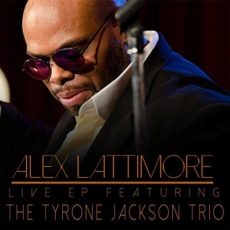
The recorded session has historically been the medium for the listener to fashion a personal venue to partake of an artist’s talent, be it vinyl, cassette or compact disc. But with a live date there is something magical that occurs, and in that space when the artist and the audience connect, an ephemeral relationship is generated. The ordinary becomes exceptional and we remember and carry with us the emotion of the experience. This is just such the case with vocalist Alex Lattimore.
He humbly flaunts a timbre and ease of delivery reminiscent of the spirits of Jon Lucien and Terry Callier, bringing to the fore a small peek into the volume of his talent. With this outing’s arrangements we are privy to two original tunes and also two classic compositions that are songbook standards. His ability to scat is defined right out the gate on Heaven’s Design and justly so closes it out with a winsome whistle that is seldom heard, thus refreshing. Paying homage to Steveland Morris’ My Cherie Amour is a monumental undertaking that he accomplishes with a joie de vivre evident in his inimitable style.
Witnessing a hush fall over the audience exhibits his tenderness with the lyric in his rendition of the Johnny Mercer/Hoagy Carmichael classic Skylark. Alex graciously saves the best for last leaving the audience feeling good and a part of something greater than the individual with Sunlight In My Rain.
But let us be mindful and with the utmost respect to Mr. Lattimore, no man is an island. Understanding that is why he enlisted an exceptional rhythm section comprised of pianist Tyrone Jackson, bassist Brandon Boone, with Henry Conerway and Robert Boone holding down the drum kit. They skillfully apply nuance, reflection and exuberance where and when best needed, griots in their own right. As pleasant an outing as this has been, this band of musicians left the audience wanting more, and thus, we await in anticipation of new treasures that will spring forth.
carl anthony | notorious jazz | february 22, 2016
Give A Gift Of Jazz ~ Share 
#preserving genius
More Posts: bandleader,history,instrumental,jazz,music,review,vocal
Daily Dose Of Jazz…
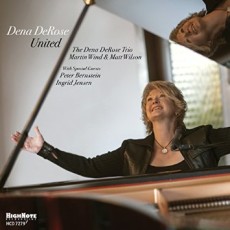
Dena DeRose was born on born February 15, 1966 in Binghamton, New York and began playing the piano at age three and soon became a fan of jazz. As a child she also played the organ and percussion, and played the piano in school bands. By her teenage years, she would to drive to New York City to see jazz musicians like Hank Jones and Mulgrew Miller.
After high school, Dena was offered a scholarship to Concordia College but chose to attend Binghamton University. At 21,she was diagnosed with capel tunnel syndrome and arthritis cusing her suffering severe pain in her right hand. Forced to stop playing the piano for close to a year she became depressed and turned to drugs and alcohol to help her cope. One night she was in a bar listening to Doug Beardsley’s trio when someone suggested that she get up and sing and she started singing regularly with the trio.
After approximately another 18 months, she had two surgeries on her right hand that enabled her to begin playing piano again. She moved to New York City in 1991 to further her career. Her debut album Introducing Dena DeRose came in 1995 on the Amosaya Records label and a year later was renegotiated and leased to the Sharp Nine label. Her sophomore album, Another World, was released in 1998 with a septet of musicians including Steve Davis, Steve Wilson, Ingrid Jensen and Daniel Sadownick, followed by two more releases. Moving to the MaxJazzlabel she released her fifth album with Martin Wind and Matt Wilson.
She has worked with Ray Brown, Clark Terry, Benny Golson, Bill Henderson, Houston Person, Bruce Forman, Judy Neimack, John Clayton, Jeff Hamilton, Steve Turre, Mark Murphy, Gene Bertoncini, Wycliffe Gordon, Marvin Stamm, Jay Clayton, Alex Riel, Billy Hart and Ken Peplowski, to name a few.
As an educator, DeRose has been the Vocal Professor and Head of Jazz Vocals at the University of Music and Dramatic Arts in Graz, Austria, a regular teacher at the Stanford Jazz Workshop, and also teaches periodically at other summer camp and workshop programs including the Litchfield Summer Camp, Taller de Musics in Spain and the Prince Claus Conservatoire in Groningen, Holland.
Discography[edit]
Take A Dose On The Road
Daily Dose Of Jazz…
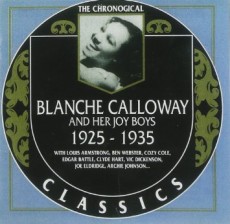
Blanche Calloway was born Blanche Dorothea Jones Calloway on February 9, 1902 in Rochester, New York. Her mother was a music teacher and gave her children a passion for music. The older sister of Cab Calloway, she was a successful singer before her brother.
Influenced as a youth by Florence Mills and Ida Cox, she was encouraged to audition for a local talent scout and dropped out of Morgan College in the early 1920s to pursue her music career. Blanche made her professional debut in Baltimore in 1921 with Eubie Blake and Noble Sissle’s musical Shuffle Along but her big break came two years later on the national tour of Plantation Days. With the tour ending in Chicago, she decided to stayand gained popularity on the town’s jazz scene.
By 1925 she recorded two blues songs accompanied by Louis Armstrong and Richard M. Jones that became the first inception of her Joy Boys orchestra. She would perform with Rueben Reeves and record for Vocalion Records, work with Andy Kirk’s Clouds of Joy, and worte and recorded three songs of which her theme song would emerge, I Need Lovin’. Calloway would go on to form another Joy Boys big band with Ben Webster, Cozy Cole, Andy Kirk, Chick Webb and Zack Whythe, making her the first woman to lead an all-male jazz orchestra.
She struggled in the racially segregated and male-dominated music industry of the period, frequently played to segregated audiences and arrested for using white only restrooms on the road. While sitting in a Mississippi jail a band member stole the group’s money and she had to sell her yellow Cadillac to leave the state. Though an exceptional musician, she received few opportunities outside singer and dancer due to gender roles of the time. By the mid-1930s Calloway began to struggle to find bookings, just as her brother’s own career grew in popularity.
After years of struggling for major success, in 1938 she declared bankruptcy, broke up her orchestra and a couple of yeas later put together a short-lived all-female orchestra during World War II. Struggling once again for bookings she moved to the Philadelphia suburbs and became a socialite, served as a Democratic committeewoman, moved to Washington, DC and managed the Crystal Caverns nightclub. She hired Ruth Brown to perform and gained credit for discovering her and getting her a record deal with Atlantic Records.
In the late 1950s she moved to Florida and became a deejay for WMBM in Miami Beach, then became the program director for twenty years. She became the first Black woman to vote in Florida, was an active member of the NAACP and the Congress of Racial Equality (CORE) and served on the board of the National Urban League.
Vocalist, composer and bandleader Blanche Calloway, whose flamboyant style was a major influence on her brother Cab, eventually moved back to Baltimore, and married her high school sweetheart, passing away on December 16, 1978, from breast cancer, aged 76.
Dose A Day – Blues Away
More Posts: vocal