

From Broadway To 52nd Street
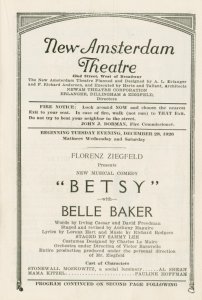
Richard Rodgers and Lorenz Hart wrote the musical Betsy as a vehicle for an actress named Belle Baker. When its producer Flo Ziegfeld decided that the show needed a big hit ballad, he went straight to Irving Berlin and asked him for one and Blue Skies was quickly dropped into the musical and on opening night on December 28, 1926 in the New Amsterdam Theatre, Rodgers and Hart – who never countenanced interpolations into their shows – sat in their house seats, fuming. The show faded away after only thirty-nine performances, however, Blue Skies went on to become part of show business history and a popular standard.
Broadway History: At its height in 1928, Broadway had been reduced to a twelve-block area between 41st and 53rd streets, however it originally encompassed an area stretching from 35th to 54th street, between 6th and 8th avenues. Although the district was comprised of nearly 80 theatres only four theatres are actually located on Broadway, The Marquis at 46th, The Palace at 47th, The Winter Garden at 50th and The Broadway at 53rd Street. The balance of the legitimate houses was located either east or west of this avenue. This however was not always the case. In 1810, if you wandered up Broadway north of the Battery towards the villages of Greenwich or Harlem farther to the north of the common pasture, Sheep’s Meadow; past Wall Street and Maiden Lane, at City Hall Park you would have passed the beautiful Park Theatre on Park Row. A second theatre, The Bowery, was built in 1821 and the migration of “mid-town” towards the north was well underway.
Sponsored By

www.whatissuitetabu.com
More Posts: broadway
From Broadway To 52nd Street
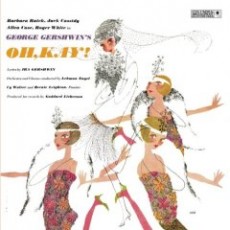
On November 8, 1926 The Imperial hosted the opening night of this new musical “Oh Kay!” starring Gertrude Lawrence, Oscar Shaw and the Fairbanks twins. The show ran for 256 performances and with the assistance of George and Ira Gershwin gave the world a Broadway melody destined to become a jazz standard – Someone To Watch Over Me.
The Story: It is 1926, the Jazz Age and the era of Prohibition. Jimmy Winter is very popular among the young ladies, and in the imaginary town of Beachampton, they are cleaning the living room of his Long Island, New York estate, declaring that “The Woman’s Touch” is exactly what his home needs. Jimmy Winter spends so little time on his Long Island estate, Kay Denham, posing as a cook, helps her rum-running brother, a titled English bootlegger, cache his illegal booze there. When Jimmy returns unexpectedly to get married, he falls in love with Kay. As a result, he helps Kay outmaneuver revenue agents and after renouncing his numerous other promises of marriage, agrees to marry Kay.
Jazz History: West 52nd Street is best known as the “Street of Jazz” or “The Street That Never Sleeps”. It ran east to west from 5th to 6th Avenues and was renowned in its heyday during and after Prohibition from 1925 to 1960. 52nd Street hosted such celebrated establishments as the Hickory House, Jimmy Ryan’s, the Famous Door, the Iron Gate, Leon & Eddie, 21, Tony’s, The Onyx, The Three Deuces, Downbeat, The Yacht Club, The Wing Club and Kelly’s Stable.
From 1935 to 1945 this monochrome of five story brownstone buildings in whose drab and cramped street level interiors – once known as English basements – flourished as speakeasies and jazz clubs and by 1936 it became also known as “Swing Street” and served as the launching pad for more singers, more hit songs and more instrumentalists than Chicago, New Orleans, Memphis or Los Angeles.
Sponsored By
www.whatissuitetabu.com
More Posts: broadway
From Broadway To 52nd Street
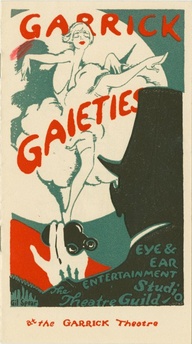
The year was 1926 and much to everyone’s surprise Garrick Gaities was so well received that it was brought back for a regular run. Sterling Holloway appeared in all of the sequels and Edith Meiser appeared in all but the final one. Notable performers included Imogene Coca and Rosalind Russell.
The music and lyrics for this second edition of the Gaieties was written by Rodgers and Hart and introduced their famous song “Mountain Greenery”, which would go on to become a jazz standard.
Jazz History: “The Street”, as it would come to be known, couldn’t have come into existence without the assistance of the New York City Board of Estimate, who on December 10, 1926 passed a resolution lifting residential restrictions on the brownstones between 5th and 6th Avenues. With the new or old owners gaining the ability to command higher rents from the illicit speakeasy owners than ordinary apartment dwellers or even the kept women who occupied many a brownstone apartment, the inevitability of 52nd Street was born.
Sponsored By
www.whatissuitetabu.com
More Posts: broadway