


Daily Dose Of Jazz…
Richard Bona was born Bona Penda Nya Yuma Elolo on October 28, 1967 in Minta, Cameroon. His family of musicians enabled him to start learning music from a young age. His grandfather was a griot and percussionist, as his mother was a singer. When he was four years old he started playing the balafon. At five he began performing at his village church, however, not being wealthy, he made many of his own instruments, flutes and guitars.
He began learning to play the guitar at the age of 11, and in 1980 at 13 he assembled his first ensemble for a French jazz club in Douala, Cameroon. The owner befriended him and helped him discover jazz starting with Jaco Pastorius, which inspired Bona to switch his focus to the electric bass.
Emigrating to Germany at the age of 22 he studied music in Düsseldorf, soon relocating to France, where he furthered his studies in music. While in France, he regularly played in various jazz clubs, sometimes with players such as Manu Dibango, Salif Keita, Jacques Higelin and Didier Lockwood.
He left France and established himself in New York City, playing bass guitar with Joe Zawinul, Larry Coryell, Michael and Randy Brecker, Mike Stern, George Benson, Branford Marsalis, Chaka Khan, Bobby McFerrin, and Steve Gadd, among others. In 1998, Bona was the Musical Director on Harry Belafonte’s European Tour.
His debut solo album, Scenes from My Life, was released in 1999. He has also been prominently featured in Jaco Pastorius Big Band albums. As an educator he held a professorship of jazz music at New York University. For five years beginning in 2015 he owned with restaurateur Laurent d’Antonio, the jazz club Club Bonafide in the city.
Bass guitarist, guitarist, percussionist and vocalist Richard Bona continues to compose, record and perform.

More Posts: bass,guitar,history,instrumental,jazz,music,percussion,vocal
Requisites
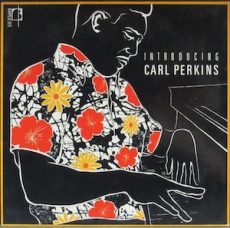
Introducing Carl Perkins ~ Carl Perkins | By Eddie Carter
One of my favorite things to do after a long day is listening to a piano trio album when reading. I first heard Carl Perkins on Harold In The Land of Jazz and You Get More Bounce With Curtis Counce. Introducing Carl Perkins (Dootone Records DL-211) is a 1956 release and his only album as a leader. He began playing professionally with Tiny Bradshaw and Big Jay McNeely in the late forties, then became a unique talent in the fifties. Despite polio afflicting his left arm, he developed a piano technique that was all his own. Leroy Vinnegar joins him on bass, and Lawrence Marable on drums completes the trio. My copy is the 1984 U.K. Mono reissue (Boplicity Records BOP-8).
Side One opens with Way Cross Town, the first of five Carl Perkins originals. The melody’s opening notes give the song a lively bounce. Carl is up first and delivers the lead solo with great spirit. Leroy takes a nice leisurely walk next, and then Lawrence has a short conversation with the pianist ahead of the closing chorus and abrupt stop. You Don’t Know What Love Is by Gene de Paul and Don Raye begins with a lovely solo introduction by Perkins, segueing into the trio’s pretty melody. Carl performs beautifully and sincerely as the song’s only soloist, culminating with a gentle theme reprise and climax.
The Lady Is a Tramp by Richard Rodgers and Lorenz Hart moves the beat to mid-tempo for the trio’s opening chorus. The mood is joyous from the start of the threesome’s theme. Carl delivers the song’s only interpretation with a carefree zest, leading to the theme’s restatement and close. Marblehead by Carl Perkins begins with the trio taking it easy on the opening ensemble. The pianist steps into the spotlight first to dispense a little home cooking. Vinnegar takes his bass for a short walk next, then Perkins returns to make a final comment preceding the ensemble’s theme restatement and ending.
Woody ‘n’ You by Dizzy Gillespie is among his most ageless compositions. The trio begins the jazz standard with a relaxing Latin-flavored melody. Carl has the solo showcase alone and keeps close to the bluesy spirit as his interpretation unfolds, while the rhythm section perfectly complements him into the ending theme and fade-out. Westside by Carl Perkins is a happy little tune that gets underway with the trio’s cheerful theme. The pianist is up first with an attractive reading, and then Vinnegar comes in for a buoyant walk. Marable applies a marvelous touch to the closer before the trio’s out-chorus.
Side Two starts with Just Friends by John Klemmer and Sam M. Lewis. Lawrence introduces the song with a short introduction that segues into the trio’s joyful melody. Carl leads the way and works his magic in the opening solo, then engages in a brief conversation with the drummer, leading to the closing ensemble. It Could Happen To You by Jimmy Van Heusen, and Johnny Burke is a beautiful song from the forties. Perkins’s lovely introduction sets the mood for the trio, showing its sentimental side in a tender melody. The pianist delivers the only solo with great sensitivity and delicacy ahead of the group’s gorgeous finale.
Why Do I Care by Carl Perkins is a much happier song than its title suggests, as exhibited in the trio’s medium groove on the theme. Carl takes the lead and constructs the opening solo effectively. Leroy comes in next to take a short walk, and Leroy returns for the theme’s reprise and close. Lilies In The Rain by Peter DeRose and Mitchell Parish is a lovely ballad that begins with an unaccompanied piano introduction to the trio’s gorgeous melody. In the song’s only solo, Perkins presents a thoughtfully tender presentation matched by the rhythm section’s elegant support until the trio’s return for a gentle ending.
It’s finger-popping time for the album’s final track, Carl’s Blues by Carl Perkins. The trio sets the scene with their easygoing opening chorus. The pianist approaches the first statement more relaxed, and then Leroy briefly walks in a splendid performance. The ensemble reassembles for the closing chorus and a final thought by the leader and bassist into the climax. Dootsie Williams supervised the original session, but it’s unknown who the recording engineer was for the date. The album’s sound quality is quite good, with a solid soundstage that transports the trio to your listening room with stunning fidelity.
Carl Perkins played with some of the elite jazz musicians in a short career but left the jazz world with a void when he died tragically from a drug overdose on March 17, 1958, at age twenty-nine. His untimely death was a loss to the jazz community, a reminder of the fragility of life and the enduring power of his music. If you’re a piano trio fan like me and in the mood for a terrific jazz album, I invite you to consider Introducing Carl Perkins on your next trip to your favorite record store. It’s a feast for the ears and a fascinating album that glimpses a talented pianist who was beginning to make a name for himself but left us far too soon!
~ Harold In The Land of Jazz (Contemporary Records C3550/S7550), You Get More Bounce With Curtis Counce (Contemporary Records C3539/S7539) – Source: Discogs.com
~It Could Happen To You, Just Friends, Woody ‘n’ You, You Don’t Know What Love Is – Source: JazzStandards.com
~Carl Perkins, The Lady Is a Tramp – Source: Wikipedia.org
© 2024 by Edward Thomas Carter

More Posts: choice,classic,collectible,collector,history,instrumental,jazz,music,piano

Daily Dose Of Jazz…
Ivan Jullien was born on October 27, 1934 in Vincennes, France. He found work early on arranging for the Barclay label in the 1960s and later released many of his own big-band albums on Riviera, including his own 1971 fusion-infused take of George Gershwin’s Porgy & Bess.
Jullien played with Claude Bolling and Jacques Denjean early in his career, and was the bandleader for a year with the Paris Jazz All Stars in 1966. He recorded as a leader and also worked as a sideman for Lester Bowie, Maynard Ferguson, and Ben Webster. In the 1980s, he became an arranger for Studio Brussels’ CIM Big Band.
He was a member of several groups, such as 9 Plus, Alix Combelle Et Son Orchestre, Benny Bennet Et Son Orchestre De Musique Latine-Américaine, Big Jullien And His All Star, Grand Orchestre De L’Olympia, Ivan Jullien Big Band, Le Bobby Clark’s Noise, Ivan Jullien Et Son Orchestre, Jacques Denjean Et Son Orchestre, Joey And The Showmen, Les Baroques, Los Cangaceiros, and Synthesis.
Primarily a behind-the-scenes presence, Jullien arranged, played and/or conducted recordings by Charles Aznavour, Henri Salvador, Elton John, Nicoletta, Baden Powell, Didier Lockwood, and many more.
In his later years, the jazz-oriented trumpeter continued to be active, arranging and performing with his big band. His over-50-year career spanned various genres from jazz to pop, and included numerous scores for film and television.
Trumpeter, arranger, composer, conductor and bandleader Ivan Jullien, known as Big Jullien, died of respiratory failure at 80 years old on January 3, 2015.
More Posts: arranger,bandleader,composer,conductor,history,instrumental,jazz,music,trumpet

Daily Dose Of Jazz…
Mark Wagnon was born on October 26, 1956 in Lausanne, Switzerland and his talent as a percussionist was immediately evident. His early musical tastes focused on progressive rock bands like King Crimson, Led Zeppelin, Yes and Genesis. He was impressed with the fusion sounds of Miles Davis and the Mahavishnu Orchestra. However, it was a Gary Burton concert, which helped him focus his desire to become a musician.
He entered the Geneva Conservatory to study classical percussion, including the vibraphone, which would become his instrument of choice. The five years that Wagnon spent at the Geneva Conservatory he also spent a year at the Berklee School of Music in Boston, Massachusetts. While there he met Dave Douglas, and Dave Kikowski, who would become his consistent collaborator.
After his stint at Berklee, Mark moved to New York City where he began a series of projects and really began to develop his own unique style. He formed Dr. Nerve with Kikowski, a band described as Schoenberg meets the Sex Pistols. As a member of Tunnels with bassist Percy Jones and drummer Frank Katz, their album featured a more straight-ahead jazz fusion sound showing his skill on the vibes.
With Dr. Nerve, they released seven albums, and with No No Diet Bang, a collection of Swiss musicans, one cd titled Profan, and kicked off his new music service company, Buckyball, by releasing a collaboration with vocalist and Buckyball co-founder Sarah Pillow titled Paper Cuts, which was a collection of jazz standards. They would go on to release several other Wagnon releases, including a reissue of a late ’80s project, Shadowlines.
Vibraphonist Mark Wagnon has since delved into experimental jazz territory, and is consistently showing off his ever evolving technical mastery.
More Posts: bandleader,history,instrumental,jazz,music,vibraphone
Daily Dose Of Jazz…
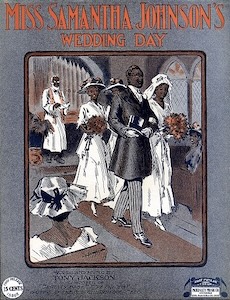
Tony Jackson was born Antonio Junius Jackson an epileptic on October 25, 1882 into a poor Black family of freed slaves in Uptown New Orleans, Louisiana. His twin brother died at fourteen months of age. Showing musical talents at a young age by 10 he constructed a crude properly tuned harpsichord out of junk in his backyard. He played hymns he heard in church and soon the neighborhood was offering the use of their pianos and reed organs to practice on. This led to his first musical job at age 13, when he began playing piano during off hours at a Tonk run by bandleader Adam Olivier.
Jackson became the most popular and sought after entertainer in the red light district Storyville. Able to remember and play any tune he had heard once and was hardly ever stumped by obscure requests. His singing voice was also exceptional, and he was able to sing operatic parts from baritone to soprano range. He became a mentor to Jelly Roll Morton.
Tony wrote many original tunes, a number of which he sold rights to for a few dollars or were simply stolen from him; some of the old time New Orleans musicians said that some well known Tin Pan Alley pop tunes of the era were actually written by Jackson.
Well dressed always with a pearl gray derby, checkered vest, ascot tie with a diamond stickpin, with sleeve garters on his arms to hold up his cuffs as he played. This became a standard outfit for ragtime and barrelhouse pianists.
Moving to Chicago, Illinois hoping to have more of an influence on his career. Jackson was a resident performer at the De Luxe and Pekin Cafes in the city. In his later years his voice and dexterity were impaired by disease, syphilis or cirrhosis of the liver in addition to chronic epilepsy. Pianist, singer, and composer Tony Jackson died on April 20, 1921.
More Posts: bandleader,composer,history,instrumental,jazz,music,piano,vocal