

Jazz Poems
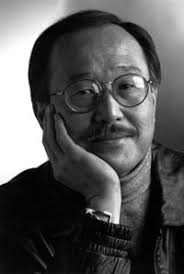
FILLING THE GAP When Bird died, I didn’t mind I had things to do— polish some shoes, practive a high school cha-cha-cha. I didn’t even know Clifford was dead: I must have been lobbing an oblong ball beside the gymnasium. I saw the Lady right before she died— dried, brittle as last year’s gardenia. I let her scratch an autograph. But not Pres. Too bugged to boo, I left as Basie’s brass booted him off the stand in a sick reunion— tottering , saxophone dragging himmlike a stage-hook. When I read Dr. Williams’ poem, “Stormy,” I wrote a letter of love and praise and didn’t mail it. After he died, it burned my desk like a delinquent prescription… I don’t like to mourn the dead: what didn’t, never will. And I sometimes feel foolish staying up late, trying to squeeze some life out of books and records, filling the gaps between words and notes. That is why I rush into our room to find you mumbling and moaning in your incoherent performance. That is why I rub and squeeze you and love to hear your live, alterable cry against my breast Lawson Fusao Inadafrom Jazz Poems ~ Selected and Edited by Kevin Young

More Posts: book,classic,collectible,history,jazz,library,poet
Daily Dose Of Jazz…
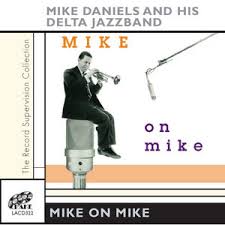
Mike John Brett Daniels was born April 23, 1928 in Norbiton, Kingston-upon-Thames, Surrey, London, England. He had an early interest in jazz at a very young age while studying at Aldenham School from the age of 13 in 1941 as a pupil until 1945. Taking up the trumpet at 16, his family moved to Stanmore, Middlesex, where he organized a new group called the Stanmore Stompers in 1947.
He is probably best known for his work with his own seven piece group, The Delta Jazzmen. He led this group from 1948 to 1974 and again in the 1990s. He moved to Spain briefly in the mid-1960s. He had very little recorded output during his lifetime but he recorded two albums worth of material, one of which was titled Mike on Mike from 1960.
There exists some well recorded performances by the Delta Jazzmen which featured Daniels from 1958 to 1963, along with additional input from trombone player Gordon Blundy and John Barnes on reed instruments. The rhythm section is accompanied on these works by banjo-tuba-drums.
Mike was regarded as an ensemble-orientated player who provided a solid lead combined with laid-back solos. Some of his other bands have featured talents such as Keith Nichols and John Chilton. The British Lake Label produced ‘Limited Edition’ recordings of Daniels’ work.
Trumpeter Mike Daniels, who aspired to reproduce the original styles of King Oliver, Jelly Roll Morton, Louis Armstrong, died on October 18, 2016 at the age of 88
More Posts: bandleader,history,instrumental,jazz,music,trumpet

Daily Dose Of Jazz…
Avery “Kid“ Howard was born on April 22, 1908 in New Orleans, Louisiana and began on drums at about age fourteen, but switched to cornet and then trumpet after playing with Chris Kelly.
In 1920s New Orleans, Howard played with the Eureka Brass Band, Allen’s Brass Band, and the Tuxedo Brass Band. He led his own bands late in the 1920s and early in the 1930s and it was his band which played at the jazz funeral for Buddy Petit. He played in the Palace Theatre pit orchestra from 1938 to 1943.
In 1943, he recorded with George Lewis, considered to be among his best recordings. In 1946, he led the Original Zenith Brass Band, but played only locally for the next few years. 1952 saw the trumpeter returning to playing with Lewis, where he would remain until 1961. Kid’s later recordings with Lewis are uneven because of his battle with alcoholism, which interfered with his abilities as a soloist.
Howard fell ill in 1961 and left Lewis’s band, and upon his recovery he led his own band from 1961 to 1965, and recorded sessions, several of them highly praised.
Trumpeter and bandleader Kid Howard, who was a mainstay on the New Orleans jazz scene, continued to play in New Orleans at Preservation Hall and other venues up until his death of a brain hemorrhage on March 28, 1966 in his hometown.
More Posts: bandleader,history,instrumental,jazz,music,trumpet
Requisites
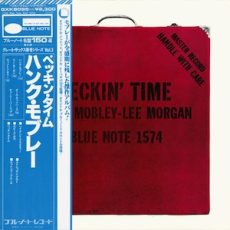
Peckin’ Time ~ Hank Mobley and Lee Morgan | By Eddie Carter
This morning’s record from the library is a perfect description of the term “two heads are better than one.” During the fifties and sixties, tenor saxophonist Hank Mobley and trumpeter Lee Morgan collaborated on several jazz albums. Peckin’ Time (Blue Note BLP 1574/BST 81574) is a 1959 release and one of their earliest dates together. Hank composed four of the five tunes on this album. They are joined by a fabulous rhythm section: Wynton Kelly on piano, Paul Chambers on bass, and Charlie Persip on drums. My copy is the 1978 King Record Company Japanese Mono reissue (Blue Note BLP 1574 – GXK 8095).
Side One takes off with the quintet’s brisk melody to High and Flighty. Hank starts right out of the gate quickly. Lee gets into a robust reading next, and then Wynton gives an enthusiastic statement. Charlie shares the closing solo with both horns in a vigorous conversation until the ensemble’s lively climax. The album’s only standard, Speak Low by Kurt Weill and Ogden Nash comes to life with the rhythm section’s Latin introduction to Lee beginning the theme and Hank completing the melody. Mobley opens with a warm tone in a delicate statement. Wynton enters next with a fine flow of ideas, then Lee eases into the finale before the theme’s restatement and finish.
Peckin’ Time is a catchy original beginning in a medium groove for the quintet’s melody. Wynton breaks the ice with a joyous and carefree solo. Hank approaches the following reading with confidence; then, Lee cooks in the third statement. Paul takes a short walk toward the front line’s final exchange into the closing chorus. Stretchin’ Out raises the temperature to begin Side Two with the ensemble’s fleet theme. Morgan takes flight first with a festive solo. Kelly fuels the second statement with energy, and then Mobley heats things up further before exchanging a few riffs with Persip. The drummer has a short workout until Morgan and Mobley add a few last thoughts to the ending.
Git Go Blues begins with the trio’s introduction leading to the quintet’s easygoing theme, giving way to Hank’s cheery opening statement. Lee continues the good feelings in the following solo. Wynton follows them both with a relaxing performance. Paul adds a concise comment next; then Hank ties it all together until the quintet takes it out after the theme reprise. Alfred Lion produced Peckin’ Time, and Rudy Van Gelder recorded the session. The album’s sound quality is excellent with a superb soundstage in the highs, midrange, and low end that’s sure to stand out on any good mid-fi or high-end audio system.
Hank Mobley and Lee Morgan always worked well together, and they consistently complimented each other’s playing. Lee appeared on seven additional Blue Note LPs with Mobley. Hank appeared on three records with Morgan. If you’re a fan of either musician and in the mood for excellent hard-bop jazz, I highly recommend and offer for your consideration, Peckin’ Time by Hank Mobley and Lee Morgan, the next time you’re out record shopping. It’s an enjoyable and entertaining album that’s sure to please any jazz lover and demonstrates why “two heads are better than one” fits this duo perfectly!
A Caddy For Daddy (Blue Note BLP 4230/BST 84230), A Slice of The Top (Blue Note LT-995), Charisma (Blue Note BST 84312), Cornbread (Blue Note BLP 4222/BST 84222), Dippin’ (Blue Note BLP 4209/BST 84209), Hank Mobley Sextet (Blue Note BLP 1540/BST 81540), No Room For Squares (Blue Note BLP 4149/BST 84149), Straight No Filter (Blue Note BST 84435), The Rajah (Blue Note BST 84426), Third Season (Blue Note LT-1081) – Source: Discogs.com
~ Speak Low – Source: JazzStandards.com © 2024 by Edward Thomas Carter
More Posts: choice,classic,collectible,collector,history,instrumental,jazz,music,saxophone,trumpet
Daily Dose Of Jazz…
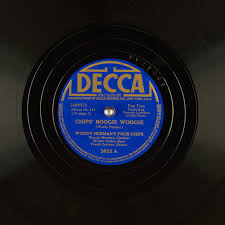
Walt Yoder was born on April 21, 1914 in Hutchinson, Kansas. A piano player from age ten, he switched to bass as a teenager. Early in the 1930s he worked in the bands of Joe Haymes, Tommy Dorsey, and Jimmy Dorsey.
Yoder played with Woody Herman in the Isham Jones band in the middle of the 1930s. After this ensemble dissolved in 1936, Herman formed a new group with five of Jones’s former sidemen, including Walt. He remained with Herman through 1942 and played with him again in 1947-48.
Following his tenure with Herman, Yoder played with Ben Pollack, Russ Morgan, Bob Crosby, and Red Nichols. He did some works as a bandleader and in the studios near Los Angeles later in his life, playing into the 1970s.
Double bassist Walt Yoder, best known for his association with Woody Herman, died on December 2, 1978 in Los Angeles, California.
More Posts: bass,history,instrumental,jazz,music