

Jazz Poems
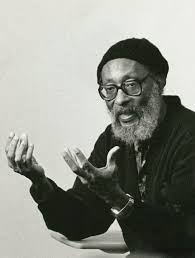
TRANE Propped against the crowded bar he pours into the curved and silver horn his old unhappy longing for a home the dancers twist and turn he leans and wishes he could burn his memories to ashes like some old notorious emperor of rome, but no stars blazed across the sky when he was born no wise men found his hovel, this crowded bar when dancers twist and turn, holds all the fame and recognition he will ever earn on earth or heaven. He learn against the bar and pours his old unhappy longing in the saxophoneKAMAU BRATHWAITE
from Jazz Poems ~ Selected and Edited by Kevin Young

More Posts: book,classic,collectible,history,jazz,library,poet
Daily Dose Of Jazz…
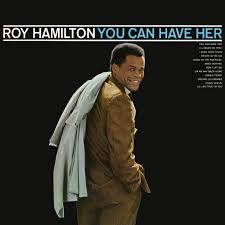
Roy Hamilton was born on April 16, 1929 in Leesburg, Georgia to Evelyn and Albert Hamilton, where he began singing in church choirs at the age of six. The summer of 1943 he was fourteen and the family migrated north to Jersey City, New Jersey in search of a better life. There he sang with the Central Baptist Church Choir, and attended Lincoln High School where he studied commercial art. Being gifted, his paintings were placed with a number of New York City galleries.
In 1947 the seventeen-year-old Hamilton took his first big step into secular music, winning a talent contest at the Apollo Theater. But nothing came of it, so to support himself he worked as an electronics technician during the day, and an amateur heavyweight boxer at night, with a record of six wins and one defeat. The following year he joined the Searchlight Gospel Singers, studied light opera, and continued to perform gospel until 1953 when the group broke up. Then he headed back into pop music with something different to offer.
1953 saw Roy discovered by Bill Cook, the first Black radio disc jockey and television personality on the East Coast. As his manager, Cook made a demo tape, brought it to the attention of Columbia Records and got him signed to Okeh Records. His first session produced Rodgers and Hammerstein’s You’ll Never Walk Alone from the musical Carousel. However Columbia released it on their pop label Epic and it topped the Billboard charts for eight weeks. He would go on to have hits with If I Love You, Ebb Tide and Unchained Melody and in 1955 was named Vocalist of the Year by Down Beat magazine. He would go on to record Great American Songbook singles Without a Song, Cuban Love Song, Everybody’s Got a Home But Me, and Somebody Somewhere.
Hamilton’s last hit record, You Can Have Her, came in 1961, and the Epic label treated him as a major star and issued sixteen albums by him. By the middle of the decade his career declined while recording with MGM and then RCA. In 1969 in Memphis, Tennessee, he made the final recordings of his career.
In early July 1969, he suffered a massive cerebral hemorrhage at his home in New Rochelle, New York. He was taken to New Rochelle General Hospital where he lay in a coma for more than a week. On July 20, 1969 vocalist Roy Hamilton, who was inducted into the Georgia Music Hall of Fame, was Epic Records first star, inspired Sam Cooke, and influenced Elvis Presley and the Righteous Brothers, died after being removed from life support. He was 40 years old.
More Posts: bandleader,history,instrumental,jazz,music,vocal

Daily Dose Of Jazz…
Susanne Alt was born April 15, 1978 in Würzburg, Germany to Hans-Joachim and Maria Alt. Her father is a composer, poet and piano teacher, and mother a guitar teacher. After studying classical piano and guitar with her parents, she began playing the saxophone at thirteen and successfully participated in several saxophone competitions.
While still in high-school she started taking lessons in classical saxophone at the Meistersingerkonservatorium Nuremberg between 1993 and 1995, becoming a full-time student there in the 1995–96 academic year. During this period Susanne began practicing jazz and after winning the Siemens-Jazz-Förderpreis, she moved to the Netherlands to continue her studies at the Hilversums Conservatorium. Returning to Germany for postgraduate studies, she enrolled in the Berlin University of the Arts in 2000.
Forming the Susanne Alt Quartet in 2003, in the following year she released her debut album, Nocturne at Bimhuis, Amsterdam, Netherlands. Five jazz albums later, she released the funk album Saxify in 2016, preceded by the 7-inch single Saxify. The album features 36 musicians, amongst them are Fred Wesley, Michael “Clip” Payne, Michael Hampton, Rodney “Skeet” Curtis, and Roger Smith of Tower Of Power.
Alt has collaborated with a number of notable musicians and ensembles and has also toured worldwide. Saxophonist and composer Susanne Alt is based in Amsterdam, and continues to pursue her desire for new musical experiences.
More Posts: bandleader,composer,history,instrumental,jazz,music,saxophone
Requisites
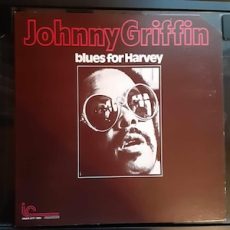
Blues For Harvey ~ Johnny Griffin | By Eddie Carter
It’s been a while since I listened to one of my favorite tenor saxophonists, Johnny Griffin, so I chose an album that became the inspiration for this morning’s discussion. Blues For Harvey (SteepleChase Records SCS-1004) is an excellent 1973 live date, and Johnny’s working with a stellar supporting cast: Kenny Drew on piano, Mads Vinding on bass, and Ed Thigpen on drums. My copy is the 1976 U.S. Stereo reissue (Inner City IC 2004). Johnny began his career in the forties playing the alto sax. He changed to tenor after joining Lionel Hampton’s Orchestra, and he’s played with Art Blakey, Eddie “Lockjaw” Davis, Kenny Clarke-Francy Boland Big Band and Thelonious Monk, to name a few.
The quartet begins the set with a trip to That Party Upstairs, the first of four by Johnny Griffin. The ensemble’s melody begins at an easy swing before stepping aside for Johnny’s lengthy opening statement. Kenny takes an interesting turn next; then Mads finishes with a carefree stroll ahead of the foursome’s theme restatement and close. Alone Again is a pretty ballad that Kenny introduces gently segueing into Johnny’s delicately tasteful theme and opening chorus. The pianist follows with an elegantly stylish interpretation; then, Mads makes a few intimate remarks preceding Griff’s return for a touching theme reprise and finale.
Side Two starts with Soft and Furry. Griff and Mads open with a dialogue over Ed’s soft supplement into the quartet’s haunting theme. Johnny opens the solos with an exceptionally rich tone. Kenny takes an exquisite performance next, and then Mads gives a tender interpretation before the tenor and bass reappear to lead the foursome to a beautiful climax. Blues For Harvey is dedicated to the Montmartre bartender, Harvey Sand. Griff sets the tone in the introduction and the quartet’s melody. Johnny takes the lead in an incredibly fleet interpretation. Kenny adds a bit of fire and drive in the second reading, and Ed has a vigorous exchange with the leader, leading to the ensemble’s brisk conclusion.
Rhythm-A-Ning by Thelonious Monk starts with the foursome’s quirky theme before Johnny takes flight with a speedy interpretation that seamlessly switches to The Theme before the song ends with Griff’s introduction of the quartet. Johnny Griffin and Nils Winther produced Blues For Harvey, and Nils also did double duty behind the dials of the recording. The album’s sound quality is good for a seventies live date, placing the listener in the Montmartre audience, and the quartet’s performance is enjoyable throughout. If you’re a fan of Griff’s playing or in the mood for hard bop, I offer for your consideration, Blues For Harvey by Johnny Griffin. It’s a little-known release in his extensive discography deserving of greater recognition and worthy of checking out for a spot in your library!
© 2024 by Edward Thomas CarterMore Posts: choice,classic,collectible,collector,history,instrumental,jazz,music,saxophone

Daily Dose Of Jazz…
Frank Meester was born in Amsterdam, Netherlands on April 14, 1970 and studied philosophy and general literature at the University of Amsterdam and Erasmus University in Rotterdam, Netherlands. From 2010 to 2016 he was assistant lecturer in Philosophy and Professional Practice at The Hague University of Applied Sciences .
He went on to become the youngest of the writing duo Gebroeders Meester and wrote columns in Filosofie Magazine and de Volkskrant, among others. With Stine Jensen, they also wrote two books together about parenting and toured the country in 2018 and 2019 with the theater performance Het opvoedcircus.
Meester also plays in the Hot Club de Frank, founded in 1990 when he was just 20 years old. Two years later they expanded to a quartet and played in local cafes. In 1994 personnel changes took a turn at vocal swing and became a permanent salon band at the Amstel Hotel and the Amerstadam Bamboo Bar. They dropped their debut cd in 1996, De Heren van het Circus, to critical acclaim, and expanded once again to a quintet. Their sophomore release in 1999 hit success again being broadcast across the radio waves.
Another personnel transition has the band currently consisting of Meester, solo guitarist Harold Berghuis, violinist Jelle van Tongeren and saxophonist Wim Lammen. The band creates a new sound within gypsy jazz with different rhythms, other instruments and special arrangements. They have played festivals and European tours.
Double bassist Frank Meester, who has been published thirteen times, continues to perform with his sons Midas and Gilles in The Maestros.
More Posts: bandleader,bass,guitar,history,instrumental,jazz,music,vocal