

Daily Dose Of Jazz…
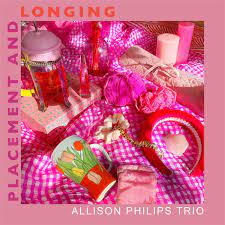
Allison Philips was born on December 8, 1991 in South Orange, New Jersey. She began playing the trumpet at the age of 9 and began performing regularly since she was fourteen. She went on to receive a BFA in Jazz Performance from the New School for Jazz and Contemporary Music of New York City and a Masters in Jazz Performance at The Conservatorium Van Amsterdam in Amsterdam, The Netherlands.
She has studied under several trumpet luminaries including Laurie Frink, Ingrid Jensen, Chris Jaudes, Tatum Greenblatt, Joe Magnarelli, Jimmy Owens, Ruud Breuls and Jan Oosthof.
From the traditional trio setting to genre-bending explorations via electronics, Allison is always searching for new ground. She has created her own trio, co-leads the DeiCont | Philips Collective, and both groups have toured domestically and throughout Europe and Canada.
She has performed with Sara McDonald’s “NY Chillharmonic”, The Chronometer’s Orchestra, Phil’s Music Lab, Charlie Rosen’s Broadway Bigband, the BVR Flamenco Orchestra, Zulema’s Mambo Queens, and many others.
Trumpeter, bandleader and educator Allison Philips continues to perform, record and tour.

More Posts: bandleader,history,instrumental,jazz,music,trumpet
The Jazz Voyager
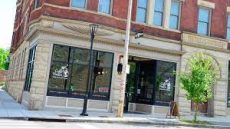
This week the Jazz Voyager is heading out of St. Louis for the Queen City to a coffee house by day and a jazz lounge by night. It’s a place where folks gather, work, socialize and herald the musical art formgather, work, socialize and herald the musical art form. It’s called Caffè Vivace and is nestled in the Walnut Hills neighborhood of Cincinnati, Ohio.
While savoring a glass of wine I’ll be enjoying the vocal talents of Kat Edmonson delivering a holiday menu of swinging music for her Christmas show. A sample of songs I hope to hear are not only the title track to her latest album but also Yule-tide favorites such as I’ve Got My Love To Keep Me Warm, The Christmas Blues, The Chipmunk Song and the classic The Christmas Song! With an equal foothold in jazz and cabaret, and raised on the music and film of the early-to-mid-twentieth century, she is a rare artist who embodies the spirit of the past while remaining resolutely current.
The caffè is located at 975 E. McMillan Street, 45206. Unfortunately for those of you who didn’t purchase early, the evening is sold out. But if you desire more information, you can call 513-601-9897.

More Posts: adventure,club,genius,jazz,music,preserving,travel,vocal
Daily Dose Of Jazz…
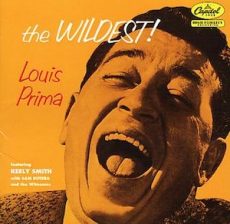
Louis Leo Prima was born December 7, 1910 in New Orleans, Louisiana into a musical Italian American family. His mother, a music lover, made sure that each child played an instrument, assigning him the violin and started out playing at St. Ann’s Parish. His interest in jazz came when he heard black musicians, including Louis Armstrong at a time Italians and Blacks in New Orleans frequently socialized together in the same clubs and bars.
He practiced continuously on his worn-down cornet and formed a band in 1924 with his childhood friends, bassist Candy Candido, Irving Fazola on clarinet and drummer Johnny Viviano. Prima attended Jesuit High School but transferred to Warren Easton High in 1926. There he played with the Eastonites, the school band. The next year he partnered with fellow musician Frank Federico and they played in the French Quarter.
By 1928 his decision was made to become a professional musician. After finishing high school he joined the Ellis Stratako Orchestra in 1929 then the Joseph Cherniavsky Orchestrafollowed by a temporary job playing on the steamship Capital that docked on Canal Street. His first break was when Lou Forbes hired him for daily afternoon and early evening shows at The Saenger.
1934 saw him begin recording for the Brunswick label. He recorded That’s Where the South Begins, Long About Midnight, Jamaica Shout, and StarDust. Prima and his New Orleans Gang featured Frank Pinero playing piano, Jack Ryan bass, Garrett McAdams guitar, and Pee Wee Russell clarinet. at the Famous Door. HIs recordings from 1935 were a combination of Dixieland and swing. He and Russell recorded The Lady in Red, a national jukebox hit. They also recorded Chinatown, Chasing Shadows and Gypsy Tea Room.
Martha Raye played a role in Prima’s professional and personal life and with her got his first national debut on The Fleischman Hour. He recorded Sing, Sing , Sing in 1936, which subsequently became a hit for Benny Goodman. Moving to California he expanded his music, joining the movement for big bands and orchestras. However for him the configuration was not successful.
He returned to New York City in 1937 with his quintet at the Famous Door. Then on to Billy Rose’s Casa Mañana club in 1938, earning nearly a quarter million dollars throughout seven weeks. This led to an East Coast to mid-West tour. During the war years, Louis was experiencing great success regardless of anti-Italian sentiment. He would go on to have several big hits but by the end of the war years, the popularity of big band music was diminishing. By 1947 he was playing more jazzy versions of his music for the next decade and a half.
Trumpeter, singer, entertainer and bandleader Louis Prima suffered a heart attack in 1973. Two years later he was diagnosed with a brain stem tumor, suffered a cerebral hemorrhage, went into a coma following surgery and never recovered. He moved back to New Orleans and transitioned three years later on August 24, 1978 at 67 in his hometown.
More Posts: bandleader,history,instrumental,jazz,music,trumpet
Daily Dose Of Jazz…
Harvie S was born Harvie Swartz on December 6, 1948 in Chelsea, Massachusetts. He learned piano as a child and did not begin playing bass until 1967, when he was nineteen years old. He attended Berklee College of Music and played in and around Boston, Massachusetts with Al Cohn, Zoot Sims, Mose Allison, and Chris Connor.
Moving to New York City in 1972 he worked with Jackie Paris, Thad Jones, Gil Evans, Lee Konitz, Barry Miles, David Friedman, Double Image, David Matthews, Steve Kuhn and Paul Motian. He has recorded extensively as a duet with Sheila Jordan, and has released numerous albums as the leader of his own ensembles, including Urban Earth and the Harvie S Band.
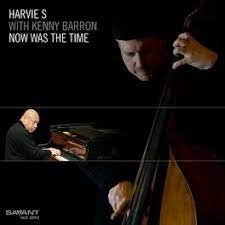
He has recorded fiteen albums as a leader, co-led two sessions with Sheryl Bailey, thirteen as a sideman, and has performed and produced music exclusively as Harvie S since 2001. He has recorded with Alan Broadbent, Sinan Alimanović, Art Farmer, Urbie Green, Jackie and Roy, Eric Kloss, Steve Kuhn, Anders Mogensen and Roseanna Vitro. In 2008, he released a duo album with pianist Kenny Barron, Now Was The Time, on HighNote/Savant Records.
Double bassist Harvie S has been a member of the Westchester Jazz Orchestra since 2007 and continues to produce, compose, arrange and educate.
More Posts: arranger,bandleader,bass,composer,educator,history,instrumental,jazz,music
Jazz Poems
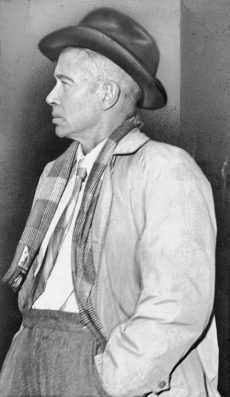
GOD PITY ME WHOM (GOD DISTINCTLY HAS) God pity me whom (god distinctly has) that weightless svelte drifting sexual feather of your shall i say body’s?follows truly through a dribbling moan of jazz whose arched occasional steep youth swallows curvingly the keenness of my hips; or, your first twitch of crisp boy flesh dips my height in a firm fragile stinging weather, (breathless with sharp necessary lips)kid female cracksman of the nifty,ruffian-rogue, laughing body with wise breasts half-grown, lisping flesh quick to thread the fattish drone of I Want a Doll, wispish-agile feet with slid steps parting the tousle of saxophonic brogue. E. E. CUMMINGSfrom Jazz Poems | Selected and edited by Kevin Young

More Posts: book,classic,collectible,history,jazz,library,poet