


Daily Dose Of Jazz…
Alexander von Schlippenbach was born into the Schlippenbach noble family on April 7, 1938 in Berlin, Germany. He started to play piano from the age of eight and went on to study composition at Cologne under Bernd Alois Zimmermann. While studying he started to play with Manfred Schoof.
At the age of 28 he founded the Globe Unity Orchestra. In 1988, he founded the Berlin Contemporary Jazz Orchestra, a big band that has over the years had, among others, Willem Breuker, Paul Lovens, Misha Mengelberg, Evan Parker, Schlippenbach’s wife Aki Takase and Kenny Wheeler.
Alexander has produced various recordings and worked for German radio channels. He played in a free jazz trio with saxophonist Evan Parker and drummer Paul Lovens with many players of the European free jazz community.
In 1994, he was awarded the Albert Mangelsdorff prize. He recorded 43 albums as a leader, eighteen with Globe Unity Orchestra, and another thirty-three with numerous others. Since the 1990s, pianist Alexander Von Schlippenbach has explored the work of more traditional jazz composers such as Jelly Roll Morton or Thelonious Monk, recording the latter’s complete works which were released on CD as Monk’s Casino.
More Posts: bandleader,history,instrumental,jazz,music,piano

Daily Dose Of Jazz…
John Paul Pizzarelli Jr. was born April 6, 1960, in Paterson, New Jersey and started playing guitar when he was six He attended Don Bosco Preparatory High School, an all-boys Catholic school. In his teens, he performed with Benny Goodman, Les Paul, Zoot Sims, Slam Stewart, and Clark Terry.
He played trumpet through his college years, attending the University of Tampa and William Paterson University, but his most important teacher was his father through the Eighties. During that period he established himself as a jazz guitarist and a vocalist and released his debut solo album, I’m Hip (Please Don’t Tell My Father) in 1983.
During the 1990s, Pizzarelli played in a trio with Ray Kennedy and his younger brother Martin. In 1993, the trio opened for Frank Sinatra in Las Vegas, Nevada and four years later, he was starring on Broadway in Dream, a show devoted to the music of Johnny Mercer.
Naming Nat King Cole as the inspiration for his career, he has honored him with the albums Dear Mr. Cole and P.S. Mr. Cole. He has also recorded tribute albums to Frank Sinatra, Duke Ellington, Antônio Carlos Jobim, Richard Rodgers, and Paul McCartney. Along with his father accompanying Annie Ross, they recorded her album To Lady with Love, a tribute to Billie Holiday that Ross recorded when she was eighty-four.
He has hosted a national radio show, Radio Deluxe with John Pizzarelli, and has worked with George Shearing, Rosemary Clooney, Johnny Frigo, Buddy DeFranco, the Clayton-Hamilton Jazz Orchestra, the Boston Pops Orchestra, and the Cincinnati Pops Orchestra.
As a co-producer of the James Taylor album American Standard, he received a Grammy nomination for Best Traditional Pop Vocal Album in 2020. Guitarist and vocalist John Pizzarelli continues to explore and expand his musical vocabulary.
More Posts: bandleader,guitar,history,instrumental,jazz,music,vocal
Three Wishes
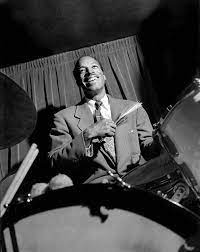
The Baroness inquired of Jo Jones as to what his three wishes would be if granted and he responded with this simple statement:
-
-
“I have only one wish: to play ten more years.”
-

More Posts: baroness,history,instrumental,jazz,music,pannonica,three,wishes
Daily Dose Of Jazz…
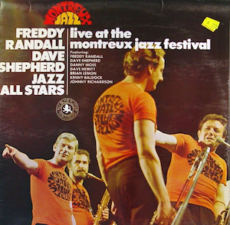
Kenny Baldock, was born on April 5, 1932 in the affluent district of Chiswick in London, England. Having studied both piano and bass, he continued on the instruments at the Guildhall School of Music and Drama in London. By the early ’60s he began showing up on jazz bandstands as a bassist in the company of players such as Peter King and the John Dankworth Orchestra, with whom he continued to be associated into the mid Seventies.
In 1972 he joined pianist Oscar Peterson at the Montreux Jazz Festival, and his performance opened opportunities to collaborate with Freddy Randall’s all-star caravan, and many more engagements with Peterson.
Summer in Montreux presented recording circumstances with guitarist Barney Kessel and the following year Baldock was leading own band projects featuring some of Britain’s heavy hitters. He worked in the Ronnie Scott Quartet that led to backup stints at Scott’s club behind many visiting American jazz performers.
By the early 1980s, Kenny seemed most interested in intimacy and stuck to a small group, often using electric guitarists as sidemen. Throughout his career he performed with among others, the Bobby Wellins Quartet, Freddy Randall~DAve Shepherd Jazz All Stars, Gordon Beck + Two, and the Laurie Holloway Quartet.
Active as an educator, bassist Kenny Baldock, whose composition Kosen Rufu garnered him an Arts Council award in 1983, transitioned from cancer on March 22, 2010.
More Posts: bandleader,bass,history,instrumental,jazz,music
Daily Dose Of Jazz…
Bob Shoffner was born on April 4, 1900 in St. Louis, Missouri. Growing up he played drums and bugle before settling on trumpet at age eleven. Playing trumpet in a military band, he served in the U.S. Army from 1917-1919, and after his discharge he played with Charlie Creath and Tommy Parker in territory bands.
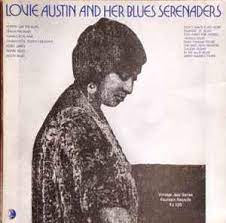
Relocating to Chicago, Illinois in 1921, Bob played with John H. Wickcliffe, Everett Robbins, and Mae Brady. He returned to St. Louis, served briefly under Creath before heading back to Chicago to play with Honore Dutrey. Then, in 1924,he replaced Louis Armstrong in King Oliver’s Creole Jazzband, playing with Oliver until 1927. He went on to spend time with Dave Peyton and Lottie Hightower during this time as well, and recorded with Lovie Austin, Jimmy O’Bryant, Ida Cox, and Luis Russell.
Shoffner suffered a lip ailment in 1927, but returned after a few months to hit with Charles Elgar in 1928, Erskine Tate, Jerome Carrington, McKinney’s Cotton Pickers in 1931, and Frankie Jaxon in ‘32. A move to New York City in 1934, had him with Fess Williams, Fletcher Henderson, and Hot Lips Page towards the end of the decade..
Around 1940 he returned once more to Chicago and took a job working for the state but recorded with Richard M. Jones in the middle of the 1940s. Taking a hiatus from music until 1957he came back to play with Franz Jackson’s Original Jazz All-Stars from 1957 to 1963.
Health concerns forced him into semi-retirement after this time. Trumpeter Bob Shoffner transitioned on March 5, 1983.