

On The Bookshelf
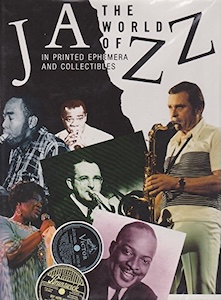
The World of Jazz | Jim Godbolt
This book is exciting and interesting in so many ways. It is filled with amazing pictures from the Jazz Age that make history feel real and alive. The images tell the story of how jazz began in New Orleans and traveled all over the world, growing into the music we know today.
The author, jazz historian Jim Godbolt, clearly loves jazz, and his passion shines through every page. He doesn’t just show photos of musicians and famous places. He also shares colorful artwork from record covers, posters, magazines, and record labels. Some of these designs are legendary, especially posters for Dizzy Gillespie and Jazz at the Philharmonic, as well as jazz magazines like Record Changer.
The story of jazz is told through old newspapers, posters, books, reviews, and rare photographs. Many of these items are hard to find, which makes the book feel like a treasure chest of history. You learn that jazz is not only about music, but also about how it was shared, recorded, advertised, and turned into a business.
The book shows how jazz started with young, self-taught musicians who had very little, and how it slowly became a huge, worldwide industry. It is a book you can read again and again. Every time you look at the pictures, you notice something new—from poor neighborhoods and riverboats to exciting nightclubs and beautiful concert halls around the world.
With its big pages and powerful images, this book is fun to explore, easy to enjoy, and full of inspiration. I highly recommend it.
The World Of Jazz: 1990 | Jim Godbolt

Daily Dose Of Jazz…
Chris Laurence: A Master Bassist Bridging Classical and Jazz Worlds
Born in the heart of London on January 6, 1949, Chris Laurence grew up in a city where musical boundaries have always been meant to be crossed. As a double bassist, he drew inspiration from an eclectic mix of visionaries—Keith Jarrett’s lyrical piano explorations, Miroslav Vitous’s revolutionary bass work, Tony Coe’s clarinet mastery, and Chick Corea’s fusion innovations. These diverse influences would shape Laurence into one of Britain’s most versatile and sought-after bassists.
A Career of Creative Collaborations
Laurence first gained significant recognition during the 1980s through his work in various innovative trios with the adventurous drummer Tony Oxley. In 1984, he expanded his musical palette further by joining the prestigious London Bach Orchestra—a move that showcased his ability to move fluidly between the worlds of jazz improvisation and classical precision.
His collaborative spirit has led him to work with a remarkable roster of British jazz luminaries: the atmospheric saxophonist John Surman, the powerful tenor voice of Alan Skidmore, the poetic pianist John Taylor, the lyrical trumpeter Kenny Wheeler, and the versatile percussionist Frank Ricotti. Each partnership revealed a different facet of Laurence’s musical personality.
An Extraordinary Session Legacy
As a sideman, Laurence’s discography reads like a who’s who of contemporary music. He has appeared on some twenty-one albums alongside artists as varied as Pink Floyd’s David Gilmour, minimalist composer Michael Nyman, pianist Gordon Beck, saxophonist Elton Dean, and classical guitarist John Williams. His bass lines have graced recordings on virtually every major label—EMI, CBS, Turtle, ECM, Vinyl, MN, Virgin Venture, Ogun, Sony Classical, and Columbia—testament to his universal appeal and adaptability.
Stepping into the Spotlight
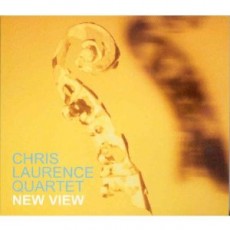
After decades of enriching others’ music, Laurence recently stepped forward as a leader, forming the Chris Laurence Quartet and releasing his debut album “New View.” The title itself seems to acknowledge a career spent supporting others’ visions—now, finally, it’s time for his own perspective to take center stage.
For those who know jazz and classical music in Britain, Chris Laurence’s name represents reliability, creativity, and that rare ability to make every note count—whether behind a bandleader or leading his own ensemble.
More Posts: bass
Daily Dose Of Jazz…
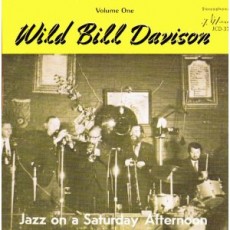
Wild Bill Davison: The Cornetist Who Played by Ear and Lived by Fire
William Edward Davison entered the world on January 5, 1906, in the small town of Defiance, Ohio—a fitting birthplace for a man who would spend his life defying musical conventions. From his earliest days, young Bill displayed both a deep love for music and an uncanny ability to master whatever instrument he touched.
A Musical Prodigy Finds His Voice
His journey began with the mandolin, guitar, and banjo, but Bill had his sights set higher. Ever resourceful, he joined the Boy Scouts specifically to learn the bugle. By age 12, he had graduated to the cornet—the instrument that would become his lifelong companion and voice.
What made Davison truly remarkable wasn’t technical training—his ability to read music remained limited throughout his career. Instead, he possessed something far rarer: a photographic musical ear. After hearing a song just once, he could reproduce its melody with perfect accuracy, then spontaneously weave in complex chord progressions and harmonic improvisations that left audiences spellbound.
From Obscurity to Icon
Though Davison emerged as a fiery jazz cornetist during the roaring 1920s, widespread recognition eluded him for two decades. When it finally arrived in the 1940s, it was explosive. His distinctive sound—marked by tonal distortions, heavy vibrato, and an almost urgent intensity—proved remarkably versatile. Whether playing alongside the mercurial Sidney Bechet or in more traditional settings, Davison’s cornet could adapt while losing none of its power.
His greatest musical partnership came when he joined forces with Eddie Condon. From the mid-1940s through the 1960s, this association produced some of Davison’s finest work, capturing both his hot, powerful attack and his surprisingly delicate melodic sensibility.
The Man Behind the Legend
On the bandstand, Wild Bill cut an unforgettable figure: seated in a chair with legs casually crossed, playing his horn from the side of his mouth with nonchalant mastery. But his colorful nickname didn’t come from his blazing cornet style—it was earned through his equally legendary appetite for whiskey and women, living the jazz life to its fullest and most reckless extent.
Wild Bill Davison brought his distinctive sound to audiences for over six decades before passing away on November 14, 1989, in Santa Barbara, California. He left behind a legacy that proved you don’t need to read music to speak its language fluently—you just need to listen with your whole soul.
More Posts: cornet
Requisites
Afternoon in Paris ~ John Lewis and Sacha Distel | By Eddie Carter
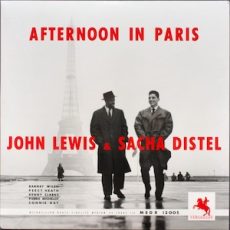
My mother was a big fan of The Modern Jazz Quartet, and today’s selection from the library highlights its founder and musical director, pianist John Lewis, joining French guitarist Sacha Distel on their 1957 collaborative album Afternoon in Paris (Atlantic 1267). It was one of her favorite records to play during our Sunday dinners growing up,and I had almost forgotten how enjoyable this album truly is. The supporting cast is superb: Barney Wilen on tenor saxophone, Pierre Michelot (tracks A1-A3) and Percy Heath (tracks B1-B3) on bass, Connie Kay (tracks A1-A3) and Kenny Clarke (tracks B1-B3) on drums. The copy I own is the 2021 French limited-edition mono audiophile reissue (Versailles MEDX 12005) released by Sam Records.
I Cover The Waterfront by Johnny Green and Edward Heyman, which opens side one, begins with John’s beautiful introduction. Sacha takes over to state the tasteful theme, and leads the way in a gorgeous reading. Barney has the last word in a warm performance that picks up pace until the pianist ends the way he began, softly. Dear Old Stockholm opens with piano, guitar, and tenor sax playing a brief segment of the melody, incorporating Pierre’s bass interlude, until it concludes. The pace picks up significantly for Barney’s swinging opening statement. Sacha delivers straight passion in the following solo, then John builds the third reading with smooth efficiency. All three soloists engage in a short exchange ahead of the pianist’s reprise and gentle ending.
The title tune, Afternoon in Paris by John Lewis, slows the pace to mid-tempo as the group begins the melody. Barney is the first to solo and cooks aggressively. Sacha steps in next to offer a splendid study in soulful improvisation. John makes his entrance with a perfectly locked-in groove. Pierre has the last word, and his sturdy bass lines lead the ensemble into the melody’s restatement. All The Things You Are by Jerome Kern and Oscar Hammerstein II gets side two underway with John’s pretty introduction. Barney launches into a swinging performance, then Sacha takes the reins and gets into a fantastic groove. John follows with a short solo, then he shares a brief word with Kenny before taking the song out softly.
Bags’ Groove by Milt Jackson got its title from the composer’s nickname. It opens with Barney stating the theme, leisurely, alongside Percy and Kenny. Sacha then begins the opening solo. John taps a creative vein next. Barney begins the third reading at ease, but gradually cruises to a satisfying climax. Percy and Kenny share a brief conversation preceding the theme’s reprise and summation. Ann Ronnell’s Willow Weep For Me begins with John’s gentle piano introduction, setting the stage for Sacha’s elegant, understated approach to the melody and his opening statement. The spotlight shifts to Barney, who delivers one of his most memorable solos on the album. John steps in last, providing a gorgeous improvisation that guides the ensemble to a graceful finish.
Although the producer of the original Afternoon in Paris session remains unidentified, Disques Versailles recorded the initial album, and Fred Thomas oversaw this audiophile reissue for Sam Records. The album’s sound quality is exceptional for a 1950s recording, with a warm, airy soundstage that makes you feel as if you’re in the studio with the musicians as they’re performing. It was remastered from the original tapes and pressed on 180-gram vinyl at Optimal Press using the Metal Mothers process from Pallas in Germany. This edition offers a listening experience that truly captures the album’s essence.
This was Sacha Distel’s sole album collaboration with John Lewis, yet both ensembles seamlessly integrate Lewis’s lyrical piano sensibility with Distel’s refined guitar elegance. The musicians’ interaction is both spontaneous and intuitive, culminating in six extraordinary performances. If you’re in the mood for an engaging blend of Bop and Cool Jazz, I cordially invite you to spend an Afternoon in Paris with John Lewis and Sacha Distel on your next record-shopping trip. I’m confident you’ll encounter a memorable album that will leave a lasting impression well beyond the record’s end!
~ All the Things You Are, I Cover The Waterfront, Willow Weep For Me – Source: JazzStandards.com ~Afternoon in Paris, Bags’ Groove, Dear Old Stockholm – Source: Wikipedia.org © 2026 by Edward Thomas Carter

More Posts: choice,classic,collectible,collector,guitar,history,instrumental,jazz,music,piano
Daily Dose Of Jazz…
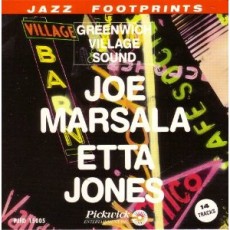
Joe Marsala: A Clarinet Voice That Bridged Two Eras
Born in the vibrant jazz landscape of Chicago on January 4, 1907, Joe Marsala picked up the clarinet as a young boy and never looked back. What emerged was a distinctive voice—one that would help shape the sound of American music across multiple decades.
Beyond Dixieland
While Marsala came of age during the big band era and shared stages with traditional “Dixieland” musicians, his musical vision reached far beyond convention. His playing was richer, more graceful, and decidedly more adventurous than many of his contemporaries—a style he credited largely to the influence of the masterful Jimmy Noone.
As a bandleader, Marsala helmed ensembles with memorable names like “His Chosen Seven” and “His Delta Four.” He had an eye for talent, too: he was among the first leaders to recognize the explosive potential of a young drummer named Buddy Rich. Throughout his career, Marsala collaborated with an impressive roster of musicians including Joe Buskin, Jack Lemaire, Carmen Mastren, and even the legendary Etta James.
A Pioneer for Integration
Beyond his musical contributions, Marsala stood on the right side of history. During the 1940s, he was at the forefront of breaking down racial barriers in jazz, working alongside Dizzy Gillespie and other Black musicians at a time when such collaborations required both courage and conviction.
Reinvention and Resilience
As bebop swept through the jazz world, Marsala faced a harsh reality: clarinetists were increasingly sidelined in the new sound. Work became scarce, both on stage and in the studio. But rather than fade away, Marsala reinvented himself.
He turned his creative energies to songwriting, crafting what we now call classic pop standards. His compositions found their way to two of the era’s biggest voices: Frank Sinatra and Patti Page. Songs like “Don’t Cry, Joe” and “And So To Sleep Again” showcased a different side of his artistry—proof that a true musician can adapt without losing their soul.
Despite battling chronic colitis throughout his later years, Marsala continued contributing to American music until his passing on March 4, 1978, in Santa Barbara, California. His legacy remains a testament to versatility, courage, and the enduring power of a clarinet played with grace and conviction.
More Posts: bandleader,clarinet,history,instrumental,jazz,music