


Daily Dose Of Jazz…
Alex Acuña was born Alejandro Neciosup Acuña on December 12, 1944 in Pativilca, Peru. He played in local bands such as La Orquesta de los Hermanos Neciosup from the age of ten, then followed his brothers and moved to Lima, Peru as a teenager. At the age of eighteen he joined the band of Perez Prado, and in 1965 moved to San Juan, Puerto Rico.
In 1974 he moved to Las Vegas, Nevada and worked with Elvis Presley, The Temptations, and Diana Ross. The following year he joined the jazz-fusion group Weather Report, and while in New York City, Acuña recorded several songs for RCA records. Leaving Weather Report in 1978 he became a session musician in California, recording and playing live with r&b and jazz musicians Ella Fitzgerald, Michael Jackson, Chick Corea, Wayne Shorter, Joe Zawinul, Herbie Hancock, Carlos Santana, Antonio Carlos Jobim, Roberta Flack,Al Jarreau and the list goes on and on.
The Eighties saw Alex recording and touring with the Christian jazz band Koinonia. In 1987 he was summoned back to Perú by producer Ricardo Ghibellini to be the musical producer of Los Hijos del Sol, a group of Peruvians designed to promote Peruvian music worldwide.
Drummer and percussionist Alex Acuña, who has worked as an educator at University of California Los Angeles, and Berklee College of Music, LAMA, Musicians Institute, USC, and CSUN, continues his career of performing and educating.

More Posts: bandleader,drums,history,instrumental,jazz,music,percussion

The Jazz Voyager
The Jazz Voyager is jumping on a plane to return to Magic City on the east coast for some more jazz. The venue is the Miami Beach Bandshell where performances of all genres are held. This historic space was initially erected as the North Shore Community Center, it has undergone several renovations where several television programs were broadcasted. By the 1980s and 90s it became a venue for music.
The Jazz Voyager will be in the audience to witness the vocal talents of Philadelphia native, now Miami’s own Nicole Henry. LOVE: The Greatest Gift is the message for the season. This is her 12th Annual Winter Fundraising Concert is a holiday tradition bringing joy and love for all the music lovers, advocates, and community.
The Miami Beach Bandshell is located at 7275 Collins Avenue, Miami Beach, FL 33141. For more information visit https://miamibeachbandshell.com.
More Posts: adventure,club,ensembles,genius,jazz,music,preserving,travel,vocal

Daily Dose Of Jazz…
Beegie Adair was born Bobbe Gorin Long on December 11, 1937 in Cave City, Kentucky. She began playing the piano at the age of five and graduated from Caverna High School in 1954. She went on to earn a Bachelor of Science degree in music education at Western Kentucky University in 1958.
Relocating to Nashville, Tennessee, in 1961 she worked as a children’s music teacher for three years. There she played in Printer’s Alley and became a member of a jazz band led by Hank Garland. Beegie would go on to accompany Dinah Shore, Peggy Lee, Ray Stevens, Steve Allen, Chet Atkins, Cass Elliot, Vince Gill and Dolly Parton. At various times she played for the Noon Show on WSM-TV, The Johnny Cash Show and other programs.
Partnering with Denis Solee in 1982 they established the Adair–Solee Quartet, which evolved into the sextet Be-Bop Co-Op. She released her debut solo album as a leader in 1988 with Escape to New York, then formed the Beegie Adair Trio, which sold more than 1.5 million albums.
Throughout her 60-year career Beegie appeared on more than 100 recordings. Of these, 35 were recorded by her trio which included bassist Roger Spencer and percussionist Chris Brown. She released a six-CD centennial collection, The Great American Songbook Collection.
Adair was an adjunct professor of jazz studies at Vanderbilt University’s Blair School of Music. She was a faculty and board member of the Nashville Jazz Workshop, where she often performed. She was named a Steinway Artist and was inducted into Western Kentucky University’s Hall of Fame, Cave City’s Hall of Fame and was the inaugural recipient of Nashville Jazz Workshop’s Heritage Award.
Pianist and bandleader Beegie Adair, whose career spanned more than 60 years, died at her home in Franklin, Tennessee on January 23, 2022, at the age of 84.
More Posts: bandleader,history,instrumental,jazz,music,piano

Daily Dose Of Jazz…
Erkki Vilhelm Aho was born December 10, 1918 in Helsinki, Finland. He led the Rytmi orchestra which was formed in 1938. In the orchestra, Olavi Virta and Raija Valtonen acted as soloists, the pianist was Toivo Kärki and another famous member was Pauli Granfelt.
Aho’s orchestra was one of the top Finnish orchestras. During the Continuation War, his orchestra consisted of 14 men before it was taken over in 1945 by drummer Osmo “Ossi” Aalto. In the spring of 1944, the orchestra recorded American evergreens arranged by Kärjen Syväri.
Trombonist, trumpeter and conductor Erkki Aho died on August 19, 2002.
More Posts: bandleader,conductor,history,instrumental,jazz,music,trombone,trumpet
On The Bookshelf
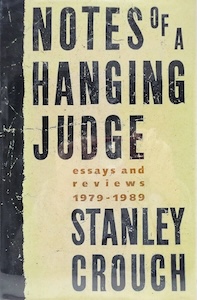
Notes Of A Hanging Judge | Stanley Crouch
Notes Of A Hanging Judge: Essays and Reviews, 1979-1989 is a 1990 collection of essays by Stanley Crouch that critically examines the American Civil Rights Movement, Black culture, and politics, arguing the movement became “loco” and self-defeating despite its initial nobility. The book features sharp, often controversial, critiques of figures like Jesse Jackson and artists like Toni Morrison and Spike Lee, using a blend of insider passion and journalistic rigor to analyze the Black experience in America.
The title refers to Crouch’s role as a harsh judge of the Civil Rights Movement, similar to a pirate-turned-judge who was hard on his former comrades. The book includes essays on race relations, Black middle-class life, the Bernhard Goetz case, Black homosexuality, and profiles of leaders like Jesse Jackson.
Crouch views the Civil Rights Movement as a noble cause that became mired in self-defeating nationalism and a lack of spiritual depth, losing its original majesty. Written with a virtuosic prose style, it balances passionate involvement with a reporter’s rigor, offering unique perspectives on public issues. He covers a wide range of topics, from politics and social issues to art and travel, often focusing on the African-American experience.
Notes Of A Hanging Judge: 1990 | Stanley Crouch
Oxford University Press
