

Daily Dose Of Jazz…
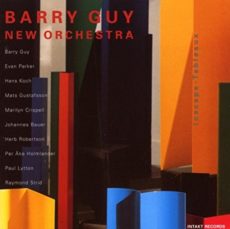
Barry John Guy was born April 22, 1947 in London, England and came to the fore as an improvising bassist as a member of a trio with pianist Howard Riley and drummer Tony Oxley in 1969. He also became an occasional member of John Stevens’ ensembles in the 1960s and 1970s, including the Spontaneous Music Ensemble.
By the early 1970s, he was a member of the influential free improvisation group Iskra 1903 with Derek Bailey and trombonist Paul Rutherford and in the late Seventies was revived with violinist Philipp Wachsmann, replacing Bailey. Guy, saxophonist Evan Parker, and drummer Paul Lytton became one of the best-known and most widely travelled free-improvising trios of the 1980s and 1990s.For a brief time he was a member of the Michael Nyman Band in the 1980s, performing on the soundtrack of The Draughtsman’s Contract.
Guy’s improvisation and formal composition interests led him to the London Jazz Composers Orchestra, originally formed to perform his composition Ode in 1972. The orchestra became one of the great large-scale European improvising ensembles. Though documentation is sketchy early on, in the late 1980s the Swiss label Intakt set out to document the band more thoroughly, resulting in several recordings.
He has also written for other large improvising ensembles, such as the NOW Orchestra and ROVA. Having taught at Guildhall School of Music, double bassist Barry Guy is currently improvising in piano trios with Marilyn Crispell and Agusti Fernandez, recorded several albums for ECM, continues to venture into the pop field with his session work, and along with his wife, run the small label Maya, which releases a variety of records in the genres of free improvisation, baroque music and contemporary composition.
Sponsored By


#preserving genius
More Posts: bass
The Jazz Voyager
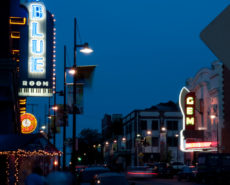
The Jazz Voyager is heading to the airport to catch a plane to the midwest to hang out at The Blue Room situated in the American Jazz Museum and catch a set tomorrow night with Everett Freeman’s band Eclipse with Lisa Henry. Located in the historic 18th & Vine jazz district at 1616 E 18th St, Kansas City, MO 64108 it honors the past and showcases the present best local and national names in jazz.
The Blue Room opened in 1997 and is a happening club that’s determined to keep “Kansas City Jazz” alive and thriving. Welcoming all into an intimate setting it is said you can sit in on the Monday night jam session, big band performances as well as Latin Jazz and Salsa mixed into the varied nights of jazz performances. Open on Monday & Thursday from 5-11pm and Friday 5p-1a and Saturday from 7pm – 1:00am. To discover more visit their site at americanjazzmuseum.org/blueroom or call 816-474-6262 #jazz voyager
Sponsored By

Voices From The Community
#preserving genius
More Posts: adventure,club,genius,jazz,music,preserving,restaurant,travel,voyager
Daily Dose Of Jazz…
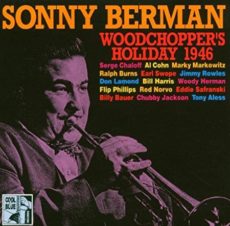
Saul “Sonny” Berman was born on April 21, 1925 in New Haven, Connecticut. He began touring at age sixteen and went on to work with Louis Prima, Harry James and Benny Goodman but is perhaps best known for his later work with Woody Herman.
Berman was distinguished by his passionate and innovative soloing and his versatility of tone, ranging from bold and emotional to sweetly muted. He also had a sense of humor which often made its way into a playfulness and joyfulness found in his solo work.
Trumpeter Sonny Berman died at the age of 21 in New York City from a drug overdose on January 16, 1947.
Sponsored By

#preserving genius
More Posts: trumpet

Atlanta Jazz Festival…2010
The two day jazz festival was once again upon the city of Atlanta and over the course of those days, thousands gathered from around the country and the world once again in Piedmont Park for the May 29th & 30th celebration of jazz. Walking through the entrance to the park at 10th & Charles Allen one felt the excitement of the gathering of fans in attendance.
This year the 31 Days of Jazz was created as a signature program of the Atlanta Jazz Festival and during the month of May, the festival partnered with restaurants and social establishments to celebrate this classic art form. The program implemented the 31 Days Passport Program to provide an interactive method for AJF fans to personally connect with the Festival and its partner venues.
Heralding this festival’s performances were local, national and international favorites Diane Schuur with Jason Marsalis, Groove Project, Hiromi & Stanley Clarke, Hudson on Bass, Jacob Deaton Trio, Jay Norem & Keith White Quartet, Joe Gransden Big Band, Julie Dexter, Kathleen Bertrand, Madoca & Co., Marcus Miller with Christian Scott, Metropolitan Atlanta Youth Wind Ensemble Jazz Band, Non-Movement Movement, Our New Dimensions, Rialto Jazz for Kids All Star Big Band, Spyro Gyra, Steven Charles Band, Swing Streets to Swing Beats with Esperanza Spalding and Raydar Ellis, Trombone Shorty, and William Green & the Magic Dream Band
The sponsors of the jazz festival were American Family Insurance, Anheuser Busch, Atlanta Fulton County Arts Council, Charles Loridans Foundation, Coca-Cola Company, Coca-Cola Enterprises, Fulton County Arts Council, Georgia Lottery, High Museum of Art Access Program, Kendeda Fund, Northern Trust, Publix, Smoothie King, Turner Broadcasting System and the Zeist Foundation. #AJF40
#preserving genius
More Posts: festival,forty,free,history,jazz,music,tradition,years
Daily Dose Of Jazz…
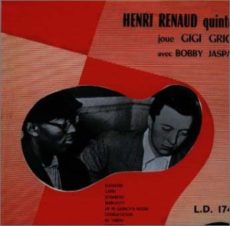
Henri Renaud was born April 20, 1925 in Villedieu-sur-Indre, France. His styles was evolutionary over the decades he was musically active and represented the swing, bebop and cool styles. His international renown came when he served as an ensemble-organizing point-man for visiting jazz performers from the United States.
Moving to Paris in 1946, Renaud established a career as a jazz pianist and joined tenor-saxophonist Jean-Claude Fohrenbach’s combo. During 1949 and 1950 he accompanied Don Byas, James Moody and Roy Eldridge. In 1952 he performed at various times with Lester Young, Sarah Vaughan and Clifford Brown.
Henri would go on to record several times with Brown as well as with Milt Jackson, J. J. Johnson, Al Cohn, Oscar Pettiford, Max Roach, Frank Foster and Bob Brookmeyer. In 1954, he visited the United States and recorded during that time.
He became an executive for French CBS’ jazz division in 1964 and for the most part stopped performing, though he occasionally worked as a film composer. Pianist Henri Renaud passed away in Paris, France on October 17, 2002.
Sponsored By

#preserving genius
More Posts: piano