

Daily Dose Of Jazz…
Glauco Masetti was born on April 19, 1922 in Milan, Italy and was an autodidact on reed instruments as well as a classically trained violinist, attending the Milan and Turin conservatories.
In the late 1940s he worked with Gil Cuppini for the first time, an association that would continue well into the latter part of the 1960s. He worked often as a session musician in the first half of the 1950s, with Gianni Basso and Oscar Valdambrini among others.
He led his own ensemble from 1955, and played with Eraldo Volonté and Chet Baker. In the Sixties, he also played with Giorgio Gaslini during that decade. Clarinetist and alto saxophonist Glauco Masetti passed away on May 27, 2001 in Milan.
Sponsored By


#preserving genius
International Day Of Jazz 2017
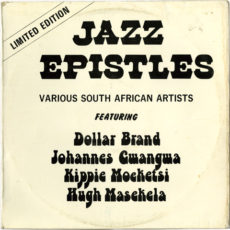
The Jazz Epistles were South Africa’s first important albeit short lived bebop band. Inspired by Art Blakey’s Jazz Messengers, its members included Dollar Brand (later known as Abdullah Ibrahim) on piano, Kippie Moeketsi on alto saxophone, Jonas Gwangwa on trombone, Hugh Masekela on trumpet, Johnny Gertze on bass, and Early Mabuza or Makaya Ntshoko on drums. The group became famous after performing in the jam sessions called Jazz at the Odin in the Odin Theater in Sophiatown.
In 1959 just before breaking up, the Jazz Epistles recorded the first album by a black South African band, Jazz Epistle, Verse 1. That same year, composer Todd Matshikiza’s musical King Kong became a hit in Johannesburg. It used a jazz score to tell the tragic story of South African heavyweight boxer Ezekial “King Kong” Dhlamini. Miriam Makeba, members of the Manhattan Brothers, and the Jazz Epistles musicians were involved in the production.
The 1960 Sharpeville Massacre marked the beginning of an era of vicious apartheid and greater repression of African culture. After Sharpeville, the government imposed a State of Emergency, made mass arrests, issued thousands of bannings, and put activists who challenged apartheid laws on trial. The repression extended to African arts. Jazz was an expressive force seeking musical and social equality. The apartheid system could not tolerate it. Performances were not allowed, jazz was prohibited from radio broadcasts, and prominent musicians were threatened.
When the producers of King Kong received invitations to perform in Europe, the South African government, believing the musical would be helpful propaganda, issued passports to African performers who otherwise would not have had opportunities to leave the country. Members of Jazz Epistles welcomed the opportunity. Most of them found the freedom and the contacts with other musicians in Europe irresistible and chose exile over returning. Thus many of the most adventurous strains in South African music were pursued outside its borders for several decades.
Following a 56-year hiatus, in June 2016 several members played two reunion concerts in Johannesburg. This year, on April 30th at Chastain Park, in honor of the International Day of Jazz and the 40th anniversary celebration of the Atlanta Jazz Festival, the Jazz Epistles will play one of seven reunion concerts schedule for North America and Europe, in remembrance of the 40th anniversary of the Soweto uprising is being celebrated in music. Original Jazz Epistle members Hugh Masekela and Abdullah Ibrahim will be performing along with a host of other performers. Tickets are only $40.00 for this historic reunion. #AJF40
#preserving genius
More Posts: festival,forty,free,history,jazz,music,tradition,years
Daily Dose Of Jazz…
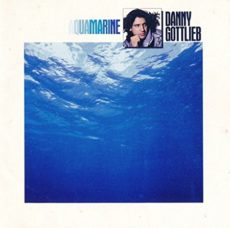
Daniel Richard Gottlieb was born in New York City on April 18, 1953. Taking lessons from Mel Lewis and Joe Morello, he graduated from the University of Miami in 1975. He became a member of the Gary Burton Quartet in 1976 with Pat Metheny, and then was one of the original members of The Pat Metheny Group from 1977–1983. Bassist Mark Egan, who was also in Metheny’s first group, teamed with Gottlieb and formed the band Elements. In 1984 he was a member of the Mahavishnu Orchestra led by guitarist John McLaughlin.
Gottlieb performed or recorded with dozens of musicians not limited to Bill Evans, Branford Marsalis, Jacqui Naylor, Chick Corea, Randy Brecker, Stan Getz, Clark Terry, Ernie Wilkins, Gerry Mulligan, Joanne Brackeen, Herbie Hancock, Hiram Bullock, Booker T and the MG’s, Hubert Laws, Lew Soloff, Jim Hall, Jimmy Haslip, Nnenna Freelon, John Scofield, Bobby McFerrin, Kenny Barron, Larry Coryell, Eddie Gómez, Mark Murphy, Miroslav Vitous, Naná Vasconcelos, Ali Ryerson, Nguyên Lê, Rufus Reid, Sting and Wayne Shorter, as well as the Carnegie Hall Jazz Orchestra, NDR Big Band, Trio, Vanguard Jazz Orchestra, Gil Evans Orchestra and WDR Big Band.
In 2004 he became the drummer for Gary Sinise’s Lt. Dan Band. He has performed on over 400 albums, earned nine Grammy Award nominations and four wins, is on the faculty of the University of North Florida as a full-time Professor of Jazz Studies. Drummer Danny Gottlieb has made over ten instructional DVDs, wrote the textbook The Evolution of Jazz Drumming, and continues to perform and record.

#preserving genius
More Posts: drums

Daily Dose Of Jazz…
Johnny St. Cyr was born on April 17, 1890 in New Orleans, Louisiana. St. He led several bands in the Crescent City beginning around 1905 and performed on the riverboats with Fate Marable. He played for several leading New Orleans bands including A.J. Piron, the Superior, Olympia and Tuxedo bands before moving to Chicago, Illinois in 1923 with King Oliver.
He is most commonly remembered as a member of Louis Armstrong’s Hot Five and Hot Seven bands. He also played and recorded with Jelly Roll Morton’s Red Hot Peppers. St. Cyr also performed with Don Cook’s Dreamland Orchestra. He composed the popular standard Oriental Strut, noted for its adventurous chord sequence.
In 1930 Johnny returned to New Orleans to make a living as a plasterer while still playing with local bands led by Paul Barbarin or Alphonse Picou. In 1955 he moved to Los Angeles, California and returned to music full time. From 1961 until his death in 1966, he was the bandleader of the Young Men from New Orleans that featured Barney Bigard, performers at Disneyland.
Banjoist and guitarist Johnny St. Cyr passed away on June 17, 1966 in Los Angeles, California.
Sponsored By
Voices From The Community
#preserving genius
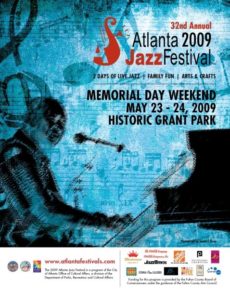
Atlanta Jazz Festival… 2009
It was 2009, the second year of the Piedmont Park Conservancy’s lawn restoration endeavor and it worked. However, the festival was still unable to return for the memorial Day Weekend festivities. The grasses had gone too long and the audiences had taken advantage of the pleasure it had given them over the years. But new rules were in the making for all future festival goers to have a great time. A new dog run was built to accommodate all owners, no charcoal grilling except in the designated park grills or on gas grills. Tents were designated to the hillsides or at the back of the field so everyone could see. Piedmont Park was looking forward to being spectacular and bringing back the festival again.
So on May 23rd and 24th jazz fans and enthusiasts turned their vehicles to Grant Park to enjoy the music. Unfortunately it was music as only Freddy Cole was the national jazz artist representing along with J. C. Young Middle School Jazz Ensemble and Rialto Jazz for Kids All Stars. Booked for the two-day event were other genres of jazz including former Lenny Kravitz drummer Cindy Blackman and her Quartet, Dionne Farris, Hiroshima, Madoca, Mausiki Scales and the Common Ground Collective, Russell Gunn & Elektrik Butterfly and VINX. #AJF40
#preserving genius
More Posts: festival,forty,free,history,jazz,music,tradition,years