

Daily Dose Of Jazz…
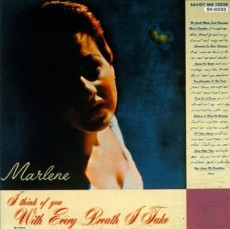
Marlene Ver Planck was born Marlene Paula Pampinella on November 11, 1933 in Newark, New Jersey. She grew up listening to Frank Sinatra and Ella Fitzgerald on the radio and started singing at age 19., working with Tex Beneke and Charlie Spivak in the Fifties, the latter band is where she met her husband, composer, arranger and conductor Billy Ver Planck.
Her first big break came in 1955 at the age of 21 when she teamed up with pianist Hank Jones, flutist Herbie Mann, trumpeter Joe Wilder, bassist Wendell Marshall and drummer Kenny Clarke and recorded I Think Of You With Every Breath I Take for Savoy Records. Singing went on to sing with the Dorsey Brothers Orchestra in New York City and after Tommy’s death pursued studio work with Sinatra, Perry Como, Tony Bennett, Antonio Carlos Jobim, Blood Sweat & Tears and Kiss.
Marlene’s voice was recognizable by millions of people outside the jazz world doing jingles in the ’60s: “Weekends were made for Michelob… Yeah!”, “Winston tastes good like a cigarette should!” and “Mmm good, mm-mm good, that’s what Campbell’s Soups are/mm mm good.” After thousands of commercial jingles and hours and hours of studio session work in New York, she decided to settle down with her husband in their house in Clifton, New Jersey and began performing and recording together.
They would go on to work with composer Loonis McGlohon, Alec Wilder, Mel Torme, Eileen Farrell, Glenn Miller Orchestra, George Shearing and Marian McPartland among others. Over the course of her career she recorded two-dozen albums and appeared on several television shows.

Take A Dose On The Road
More Posts: vocal

Daily Dose Of Jazz…
Andrew Charles Cyrille was born on November 10, 1939 in Brooklyn, New York into a Haitian family. He began studying science at St. John’s University but was already playing jazz in the evenings and soon switched his studies to the Juilliard School. His first drum teachers were fellow Brooklyn-based drummers Willie Jones and Lenny McBrown. Through them, he met Max Roach, nonetheless he became a disciple of Philly Joe Jones.
His first professional engagement was as an accompanist of singer Nellie Lutcher, had an early recording session with Coleman Hawkins and trumpeter Ted Curson introduced him to pianist Cecil Taylor when he was 18. He joined the Taylor unit in 1964 and stayed for about 10 years and eventually performed drum duos with Milford Graves.
In addition to recording a dozen albums as a bandleader, he has recorded and/or performed with David Murray, Irene Schweizer, Marilyn Crispell, Carla Bley, Butch Morris, Reggie Workman, Oliver Lake, Geri Allen, Ahmad Abdul-Malik, Billy Bang, Anthony Braxton, Marion Brown, Walt Dickerson, Charlie Haden, David Murray, Horace Tapscott and the list goes on.
Avant-garde drummer Andrew Cyrille is currently a member of the group, Trio 3, with Oliver Lake and Reggie Workman.
Give The Gift Of Knowledge
More Posts: drums
Daily Dose Of Jazz…
Lynn Baker was born Malcolm Lynn Baker on November 9, 1955 in Salem, Oregon. When he was seven he started taking piano lessons and by the fifth grade was in band class and in sixth grade his mother bought him a tenor saxophone but didn’t practice much until he got in junior high. It was there that he soon took first chair and held it throughout his high school years.
By 1973 Baker was attending Oregon College of Education but in his sophomore year transferred to the University of Oregon seeking a better jazz program without success. However it offered him the opportunity to play with a young John Zorn, which would have a powerful impact on his music aesthetic. Eventually he would transfer to Western Oregon University, Mt. Hood Community College and finally transferring back to and graduating from Oregon College of Education.
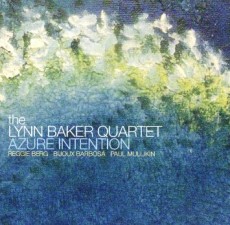
He joined a local Top 40 band led by Ricky Santos for a while, then moved to Eugene, Oregon and joined the Experimental Jazz Ensemble followed by gigs playing with dance bands and a rock/Latin fusion band. An award winning composer, performer and educator Lynn released his debut album Azure Intention in 2010 on the Origin Records label. His sophomore project LectroCoustic followed three years later.
As an educator Baker has taught at Indian University and Carleton College and is currently the director of jazz studies and Commercial Music Program at the Lamont School of Music, University of Denver, directs the Lamont Jazz Orchestra, coaches combos and teaches jazz improvisation and composition, jazz history and jazz technique. Tenor saxophonist Lynn Baker continues to perform in between his teaching duties.
Put A Dose In Your Pocket
More Posts: saxophone
Daily Dose Of Jazz…
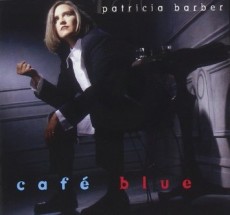
Patricia Barber was born on November 8, 1955 in Chicago, Illinois to professional musician parents and raised in South Sioux City, Iowa. She began playing classical piano at age six and by the time she graduated high school jazz was completely in her blood.
She enrolled in the University of Iowa with a double major of classical music and psychology but the jazz voice in her head grew louder. In 1984 she returned to Chicago and landed a five night week gig at the Gold Star Sandine Bar and since the mid-90s performs regularly at the Green Mill.
Starting her professional career as a pianist, as Barber’s stock rose, she then began to add vocals to her repertoire, centered in a fairly low register and a traditional blues-jazz style. Mixing original compositions and standards with classic rock covers, she has recorded and released a dozen compact discs, including a three CD box set covering her 1994-2007 years. She has released a classic Cole Porter collection of his songbook in her unique way of interpretation.
Vocalist, pianist and songwriter Patricia Barber has been awarded a Guggenheim Fellowship and teaches master classes worldwide in between her performing, touring and recording.
Jazz Is Global – Share
Daily Dose Of Jazz…
Kitty Margolis was born November 7, 1955 in San Mateo, California. As a child she listened to underground radio to hear the sounds of Ramsey Lewis, Beach Boys, John Lee Hooker and Santana, and Tower of Power was a local band playing at her high school dances. She would go to the Fillmore and Winterland and hear Miles Davis, Grateful Dead, Otis Redding, Janis Joplin, Jimi Hendrix, John McLaughlin, Charles Lloyd to name a few. But an outing with her uncle to the Village Vanguard and it was a Rahsaan Roland Kirk performance that changed her life.
She went on to San Francisco State and studied jazz and recording studio arts and was soon gigging with her teachers John Handy and Hal Stein. Hanging out at Todd Barkan’s Keystone Korner she met all the heavyweights, Dexter Gordon, Art Blakey, McCoy Tyner, Betty Carter, Cedar Walton, Freddie Hubbard, Flora Purim, Airto, Horace Silver, Red Garland and many more. She even had the oppoertunity to sing Charlie Parker’s solo on Billie’s Bounce and got thumbs up from her idol Eddie Jefferson. In 1989, she made her well-received debut at the legendary Monterey Jazz Festival.
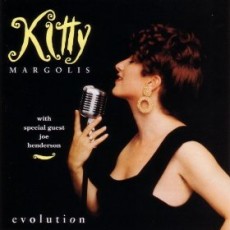
She released her debut studio album Evolution in 1993 and with guest performers Joe Henderson and Joe Louis Walker made a name for herself in the jazz community. On the heels of this album release Kitty won honor of Talent Deserving Wider Recognition in that year’s Down Beat critics’ poll, which she would repeat in 1995 and 1997. Her sophomore album, 1997’s Straight Up With a Twist, was her most eclectic outing yet, featuring quirky interpretations of standards, plus guest appearances by Roy Hargrove and Charles Brown.
Recording in between continuous performance and touring vocalist and record producer Kitty Margolis has taken time to co-found her own record label Mad Kat with Madeline Eastman. She has subsequently released five albums with a couple of live dates in San Francisco among them.
Give A Gift Of Jazz – Share
More Posts: vocal