
Daily Dose Of Jazz…
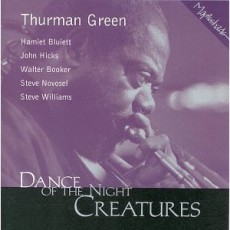
Thurman Green was born on August 12, 1940 in Texas. A jazz trombonist, who primary performed in the bebop orientation, spent time playing in Los Angeles with swinging big bands, such as, the Clayton-Hamilton Jazz Orchestra. He an occasional member of the Horace Tapscott Quintet, one of many groups headed by the late pianist that no one bothered to record. Thurman was open-eared enough to play quite credibly in free settings now and then.
Thurman recorded as a sideman with Willie Bobo, Donald Byrd and Bobby Hutcherson on the Blue Note label. In 1962, Green and baritone saxophonist Hamiet Bluiett were jamming buddies at the Navy School of Music in Washington D.C. They soon went their separate ways but hoped to team up again some day.
It was thirty-two years later, in 1994, that Bluiett was able to give his old friend his first opportunity to lead his own record date with Dance of the Night Creatures that had pianist John Hicks, bassist Walter Booker or Steve Novosel and drummer Steve Williams. It is a shame that it took over four years for the music to finally come out because Green suddenly died at age 57 on June 19, 1997.
More Posts: trombone

Daily Dose Of Jazz…
Russell Procope was born on August 11, 1908 in New York City and grew up in San Juan Hill, attending school with Benny Carter. His first instrument was the violin, but he switched to clarinet and alto saxophone. He began his professional career in 1926 as a member of Billy Freeman’s orchestra. At the age of twenty he recorded with Jelly Roll Morton and went on to play with bands led by Benny Carter, Chick Webb, Fletcher Henderson, Tiny Bradshaw, Teddy Hill, King Oliver and Willie Bryant by the mid-Thirties.
Procope would play with Roy Eldridge, Bill Coleman, Frank Newton, Dizzy Gillespie, Dickie Wells and Chu Berry. He made his first trip to Europe in 1937 as part of Teddy Hill’s band with “The Cotton Club Revue,” an all-Black show, which during its European tour appeared at the London Palladium.
In 1938 Russell replaced Pete Brown in John Kirby’s sextet and made a name for himself until 1945 with a three-year interruption in the Armed Services during World War II. He joined the reed section of the Ellington orchestra in ’46 as an alto saxophonist but made his name and reputation as a clarinetist. During the summer of 1950 the band returned to Europe bringing him back once again as a member and he stayed until the bandleader’s death in 1974,
Playing alto saxophone he recorded the 1956 album “The Persuasive Sax of Russ Procope” under the London Records label. Although his early playing reflected the influence of Benny Carter, alto saxophonist and clarinetist Russell Procope, most highly regarded for his woody, understated clarinet solos, lyrical approach and forceful swinging attack, passed away on January 21, 1981.
More Posts: saxophone
Daily Dose Of Jazz…
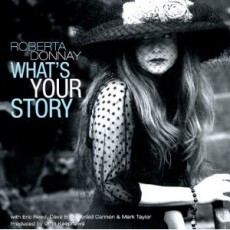
Roberta Donnay was born on August 10, 1966 in Washington, DC and began singing professionally at sixteen, knapsack wandering through Europe and borrowing guitars. Moving to San Francisco and sang with different bands, studied Latin and vocal jazz along with guitar and released her first indie album Catch The Wave in the Bay area.
She sat on the Board of Governors of the San Francisco chapter of the National Academy of Recording Arts and Sciences alongside Orrin Keepnews, produced the temp track for the documentary Journey of the Universe, and her songs have been featured on such television shows as The Unit, Nash Bridges, The Young and the Restless, One Life To live, All My Children and That’s Life.
She has appeared with Ernestine Anderson, Booker T, Peter Coyote, Johnny Lange, Tommy Castro, Eddie Money, Neil Young and Huey Lewis among others. Her song “One World” was selected as the theme for the 2003 World Aids Day in South Africa. An avid activist she composes about the human condition, not limited to women’s issues, racial injustice, government and environmental destruction. With seven albums as a leader or collaborator, vocalist Roberta Donnay continues to perform, record and tour.
More Posts: vocal

Daily Dose Of Jazz…
The Savoy Ballroom was a medium sized ballroom created for music and public dancing located between 140th and 141st Streets on Lenox Avenue in Harlem, New York City. Owned by Jewish gangster Moe Paddon, who some say it was a front for Al Capone, it was in operation from March 12, 1926 to July 10, 1958. It is estimated that the ballroom generated $250,000 in annual profit during its peak years with an admission fee being 30 to 85 cents per person.
As the Savoy was a popular dance venue many dances such as the Lindy Hop became famous here. It was known downtown as the “Home of Happy Feet” but uptown, in Harlem, as “the Track”. Unlike the ‘whites only’ policy of the Cotton Club, the Savoy Ballroom was integrated, and white and black Americans danced together. Virtuosic dancers, however, excluded others from the northeast corner of the dance floor, now referred to as the “Cat’s Corner,” although the term was not used at the time.
The ballroom was 10,000 square feet in size, on the second floor and a block long. It could hold up to 4,000 people. Generally, the clientele was 85% black and 15% white. The ballroom had a double bandstand that held one large and one medium sized band running against its east wall. Music was continuous as the alternative band was always in position and ready to pick up the beat when the previous one had completed its set. The interior was painted pink and the walls were mirrored. The floor had to be replaced every 3 years due to its constant use. The Savoy was unique in having the constant presence of a skilled elite of the best Lindy Hoppers.
Chick Webb was the leader of the best-known Savoy house band during the mid-1930s and a teenage Ella Fitzgerald, fresh from a talent show win at the Apollo Theatre in 1934, became its vocalist. 1934’s big band classic, “Stompin’ at the Savoy” was named after the ballroom.
A famous “Battle of the Bands” or “cutting contest” happened when the Benny Goodman Orchestra challenged Chick Webb in 1937. Webb and his band were declared the winners of that contest. And in 1938 the Count Basie Band did the same. While Webb was officially declared the winner, there was a lack of consensus on who actually won that night. The Savoy participated in the 1939 New York World’s Fair, presenting “The Evolution of Negro Dance”.
Despite to save it, the Savoy and the nearby Cotton Club were demolished for the construction of a housing complex, Bethune Towers/Delano Village. On 26 May 2002, Frankie Manning and Norma Miller, surviving members of Whitey’s Lindy Hoppers, unveiled a commemorative plaque for the Savoy Ballroom on Lenox Avenue between 140th and 141st Streets.
More Posts: ballroom
Daily Dose Of Jazz…
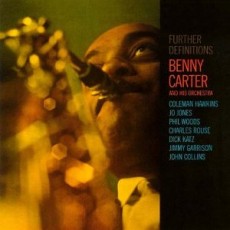
Benny Carter was born Bennett Lester Carter on August 8, 1907 in New York City. He received his first piano lessons from his mother but was largely self-taught. Growing up in Harlem under the influence of trumpeter Bubber Miley and was inspired to buy his own. Unable to play like Miley, he switched to saxophone.
By age fifteen he was sitting in at Harlem night spots and from 1924 to 1928, Carter gained valuable professional experience as a sideman in some of New York’s top bands. For the next two years he played with such jazz greats as cornetist Rex Stewart, Sidney Bechet, Earl Hines, Willie “The Lion” Smith, Fats Waller, James P. Johnson, Duke Ellington and others.
His first recordings of a prolific catalogue were made in 1928 with the Charlie Johnson’s Orchestra and he formed his first big band the following year. In the early 30s he played with Fletcher Henderson, led the McKinney’s Cotton Pickers in Detroit, then returned to New York to once again lead his own band. He would work with Sid Catlett, Chu Berry, Teddy Wilson and Dicky Wells.
Benny’s name first appeared on records with a 1932 Crown label, then on Columbia, Okeh and Vocalion. In 1935 he moved to Europe to play trumpet with Willie Lewis’s orchestra, became staff arranger for the BBC dance orchestra, made several records, returned home in 1938, formed another orchestra and spent much of 1939 and 1940 at Harlem’s Savoy Ballroom. He relocated to Los Angeles in 1943, moved increasingly into studio work and arrange for dozens of feature films and television productions, influencing and mentoring Quincy Jones, as well as arranging for Billie Holiday, Sarah Vaughan, Billy Eckstine, Pearl Bailey, Ray Charles, Peggy Lee, Lou Rawls, Louis Armstrong and Mel Torme among others over the course of his career.
Carter has been honored as a jazz master by the National Endowment for the Arts, received the National Medal of Arts from President Clinton, was a Kennedy Center honoree, was awarded the Grammy Lifetime Achievement Award, won six Grammy Awards, has a star on the Hollywood Walk of Fame and was inducted into the Downbeat Jazz Hall of Fame.
Alto saxophonist, clarinetist, trumpeter, composer, arranger and bandleader Benny Carter, who was a major figure known as “King” in the jazz community and the only musician to record in eight different decades, passed away on July 12, 2003 in Los Angeles, California at age 95.
More Posts: saxophone