

Daily Dose Of Jazz…
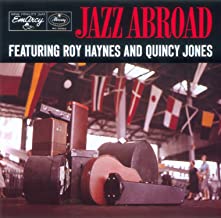
Simon Brehm was born on December 31, 1921 in Sweden and learned to play the double~bass. He recorded three albums with Quincy Jones. Later in life, he became a record producer and owner of Karusell Records.
Very little is known or written about this musician, but he managed singer Lill-Babs and was the leader of the orchestra that played in the TV show Hylands hörna from 1962.
Double~bassist, composer, and record producer Simon Brehm passed away on February 11, 1967 at the age of 45
More Posts: bandleader,bass,composer,history,instrumental,jazz,music,record producer
Daily Dose Of Jazz…
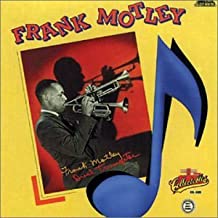
Frank Motley, Jr. was born December 30, 1923 in Cheraw, South Carolina and took trumpet lessons when he was young from Dizzy Gillespie, who was from the same town. He developed a technique of playing two trumpets at the same time, becoming known as “Dual Trumpet” and “Two Horn” Motley. Getting a degree in mechanical engineering at South Carolina State College, before joining the military, he performed in the Navy Band entertaining troops in the Pacific. After the end of the war he played in nightclubs in New York City before settling in Washington, D.C. and forming his own band in 1949.
He recorded extensively for Lillian Claiborne’s DC Records from 1951, and many of his recordings were licensed to other labels including RCA Victor and Specialty. His band, the Motley Crew, included singer and keyboardist Curley Bridges, drummer Thomas E. “TNT” Tribble, and vocalist Elsie “Angel Face” Kenley.
From 1952, he played mainly in Canada, marrying and moving to Toronto in 1955. However, he continued to perform and record in the United States. His biggest commercial success came in 1963, when his version of William Bell’s song Any Other Way, recorded with vocalist Jackie Shane for a small Boston label.
Disbanded the Motley Crew in 1966 he formed a new band in Toronto, the Hitch-Hikers, at first with Shane and then with singer Earle The Mighty Pope Heedram. The band broke up in 1970 but he continued to perform with another new band, the Bridge Crossings, until the mid 1980s. With his health declining he retired to Durham, North Carolina, where he continued to play in local dance bands. Trumpeter Frank Motley, who also sang, passed awayin Durham in 1998, aged 74.
More Posts: bandleader,history,instrumental,jazz,music,trumpet
Daily Dose Of Jazz…
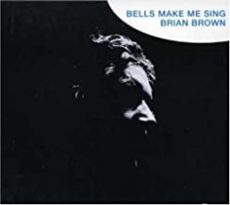
Brian Ernest Austin Brown was born on December 29, 1933 in Melbourne, Australia and was a self-taught player and emerged in the 1950s, a leading figure in Australia. He performed as a soloist and with his own ensembles since the mid-1950s throughout Australia and in Scandinavia, United States, Japan, United Kingdom, Italy, Spain, the Netherlands, Brunei and Germany.
In early 1956 Brown returned to Melbourne from Europe and formed the Brian Brown Quintet with drummer Stewie Speer, trumpeter Keith Hounslow, schoolboy pianist Dave Martin and bassist Barry Buckley. The new hard bop band was a regular from 1955 to 1960 at Horst Liepolt’s Jazz Centre 44 in St Kilda, Victoria, Australia. They introduced bop to Melburnians, a musical style largely unheard in Australia.
He made eight albums over an 18-year period heading various groups. Touring Europe with his Australian Jazz Ensemble in 1978, Brian also led groups doing experimental and original classical pieces from 1980 to 1986.
As an educator, he founded the Improvisation Studies course at the Victorian College of the Arts, where he taught from 1978 until his retirement in 1998. He appeared at the World Saxophone Congress in Tokyo in 1988, with Tony Gould. In June 1993 he was awarded the Order of Australia for service to the performing arts.
Soprano and tenor saxophonist, flutist, synthesizer, panpiper, leather bowhorn, composer, and educator Brian Brown passed away on January 28, 2013.
More Posts: composer,educator,flute,history,instrumental,jazz,leather bowhorn,music,panpipes,saxophone,synthesizer
Daily Dose Of Jazz…
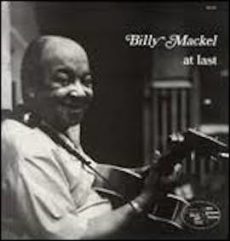
Billy Mackel was born John William Mackel on December 28, 1912 in Baltimore, Maryland and played banjo early in his career, but like many banjoists of his time he switched to guitar.
He led a band early in the 1940s, then joined Lionel Hampton in 1944 and spent the next thirty years with him. In the 1940s he also recorded with Milt Buckner, Arnett Cobb, Herbie Fields, and others, and worked with Billy Williams in the 1960s.
Guitarist Billy Mackel, who played left~handed and recorded as a leader, passed away on May 5, 1986.
More Posts: bandleader,guitar,history,instrumental,jazz,music
Daily Dose Of Jazz…
William Orval Crow was born December 27, 1927 in Othello, Washington but spent his childhood growing up in Kirkland, Washington, taking up the trumpet in fourth grade. When he joined the Army in 1946, he started to play brass instruments, remaining in the army until 1949. After leaving the Army, he played drums and trombone while a student at the University of Washington.
In 1950, Bill moved to New York City and within two years as a double bassist, he played with Teddy Charles and was with Stan Getz from October 1952 to the following April. He was part of Gerry Mulligan’s groups during the mid to late 1950s.
Crow joined the house band at Eddie Condon’s club in 1965 and then played with Walter Norris’s small group, which was one of the house bands at the Playboy Club in New York City in the mid~Sixties to early Seventies. From 1975 into the late 1990s he worked in theater orchestras on Broadway, where he sometimes played the tuba.
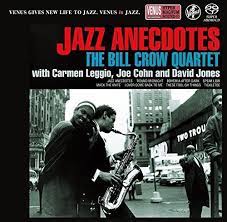
He authored a book called Jazz Anecdotes that was published by Oxford University Press in 1991. His autobiography, From Birdland to Broadway, was released by the same publisher two years later. Both were also the titles of his two albums as a leader.
As a sideman, he recorded 70 albums with Gerry Mulligan, Stan Getz, Zoot Sims, Bob Brookmeyer, Al Cohn, Clark Terry, Marian McPartland, J. J. Johnson, Al Haig, Jimmy Cleveland, Milt Jackson, Benny Goodman, Mose Allison, Jimmy Raney, Sal Salvador, Don Elliott, Teddy Charles, Manny Albam, Joe Morello, Bob Wilber, Eddie Bert, Jay McShann, Bob Dorough, Barbara Lea, Dick Sudhalter, Phil Woods, Dick Sudhalter, Ronnell Bright, Art Simmons, Rich Pearle, Spike Robinson, Claude Williamson, and Michelle Leblanc. Bassist Bill Crow continues to perform at the age of 92.