

Daily Dose Of Jazz…
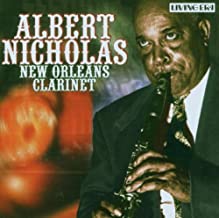
Albert Nicholas was born on May 27, 1900 in New Orleans, Louisiana and his primary instrument was the clarinet, which he studied with Lorenzo Tio in his hometown of New Orleans. Late in the 1910s he played with Buddy Petit, King Oliver, and Manuel Perez.
Spending three years in the Merchant Marines, he then joined Oliver in Chicago, Illinois from 1925 to 1927. After time in East Asia and Egypt, he returned to New York City in 1928 and played with Luis Russell until 1933. During this time in the city Albert played with Red Allen, Charlie Holmes, and J. C. Higginbotham. He would later play with Chick Webb, and Louis Armstrong with Russell and Jelly Roll Morton.
The Dixieland jazz revival of the late 1940s reinvigorated his career, playing with Art Hodes, Bunk Johnson, and Kid Ory. Nicholas had a regular gig with Ralph Sutton in 1948. In 1953 he moved to France and except for recording sessions in the U.S. in 1959-60, he remained there for the rest of his life.
Clarinetist Albert Nicholas, who was active from his teen years until his death, passed away on September 3, 1973 in Base, Switzerland.

More Posts: clarinet,history,intrumental,jazz,music
Daily Dose Of Jazz…
Born May 18, 1894 in North Buxton, Ontario, Canada, Louis Stanley Hooper was raised in Ypsilanti, Michigan. He attended the Detroit Conservatory, where he played locally in dance orchestras in the 1910s. He then moved to New York City around 1920, recorded with Elmer Snowden and Bob Fuller frequently in the middle of the decade, and performed with both of them in Harlem as well as with other ensembles.
Hooper served for some time as the house pianist for Ajax Records and accompanied many blues singers on record, including Martha Copeland, Rosa Henderson, Lizzie Miles, Monette Moore, and Ethel Waters. He participated in the Blackbirds Revue of 1928.
In 1932 returning to Canada he played in Mynie Sutton’s dance band, the Canadian Ambassadors. Lou did local work solo and in ensembles for the next two decades, then was brought back into the limelight by the Montreal Vintage Music Society in 1962. He released an LP of ragtime piano tunes in 1973 entitled Lou Hooper, Piano.
As an educator he taught at the University of Prince Edward Island late in his life and appeared regularly on CBC television in Halifax. His papers, which include unpublished compositions and an autobiography, are now held at the National Library of Canada in Ottawa, Ontario. Pianist Lou Hooper passed away on September 17, 1977, Charlottetown, Prince Edward Island.
More Posts: bandleader,composer,history,instrumental,jazz,music,piano
Daily Dose Of Jazz…
Theodore “Wingy” Carpenter was born on April 15, 1898 in St. Louis, Missour. Losing his left arm as the result of an accident during his early teens, the amputation was performed by a noted surgeon who was an uncle of jazz musician Doc Cheatham. Sometime later, he took up the trumpet and by 1920 he was working in traveling carnival shows. In 1921 he toured with Herbert’s Minstrel Band.
By 1926 he had settled in Cincinnati, Ohio, where he worked with Wes Helvey, Clarence Paige, Zack Whyte, and Speed Webb. In 1927, he played in Buffalo, New York, with Eugene Primus. Off and on from late 1926 through 1928, he was featured on the Whitman Sisters’ Show with pianist Troy Snapp’s band.
During the early 1930s, Wingy was featured with Smiling Boy Steward’s Celery City Serenaders and another Florida band led by Bill Lacey. In the mid-1930s, he began regular touring with bandleaders including Jack Ellis, Dick Bunch, and Jesse Stone. In the late 1930s, he settled in New York City, where he worked with Skeets Tolbert and Fitz Weston.
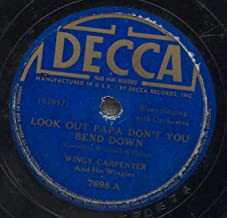
From 1939 on working as the leader of his own band, Carpenter had periods at well-known clubs such as The Black Cat, The New Capitol, Tony Pastor’s The Yeah Man, and other venues. He continued to lead his band through the 1960s, playing occasional dance dates. Several of his works are still accessible as MP3 downloads, including Look Out Papa Don’t You Bend Down, Preachin’ Trumpet Blues, Put Me Back in the Alley, Rhythm of The Dishes and Pans, and Team Up.
Trumpeter, vocalist and bandleader Wingy Carpenter, one of several one-armed trumpeters who worked in the music business, passed away on July 21, 1975, in New York City.
More Posts: bandleader,history,instrumental,jazz,music,trumpet,vocal
Daily Dose Of Jazz…
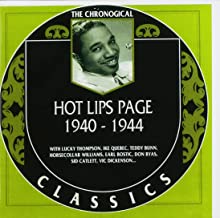
Ernest “Bass” Hill was born on March 14, 1900, Pittsburgh, Pennsylvania. He played from 1924 with Claude Hopkins, and remained with him on a tour of Europe with Josephine Baker the following year. He collaborated with Hopkins numerous times over the next few years and again in the 1940s. In 1928 he played with Leroy Smith & His Orchestra and Bill Brown & His Brownies, and the following year worked in the Eugene Kennedy Orchestra.
The 1930s saw Bass playing with Willie Bryant, Bobby Martin’s Cotton Club Serenaders, Benny Carter, Chick Webb, and Rex Stewart. He was in Europe late in the decade when World War II broke out and he fled to Switzerland. There he played with Mac Strittmacher before returning to the United States in 1940.
In that year, he recorded with violinist Eddie South and trumpeter Hot Lips Page. Following this, he played with Maurice Hubbard, Hopkins again, Zutty Singleton, Louis Armstrong, Cliff Jackson, Herbie Cowens, and Minto Kato throughout the decade. In 1949 he returned to Europe, where he played in Switzerland and Italy with Bill Coleman and then in Germany with Big Boy Goudie until 1952.
Upon his return to the States he worked in New York City with Happy Caldwell, Henry Morrison, and Wesley Fagan. Double bassist Ernest “Bass” Hill, who worked in the musicians’ union in the last decade of his life, passed away on September 16, 1964 in New York City.

More Posts: bass,history,instrumental,jazz,music
Daily Dose Of Jazz…
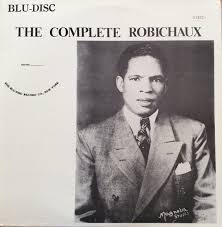
Joseph Robichaux was born on March 8, 1900 in New Orleans, Louisiana and played piano from a young age and studied at New Orleans University. After working in the O.J. Beatty Carnival, he played with Tig Chambers briefly in 1918, then returned to New Orleans where he played with Oscar Celestin, Earl Humphrey, Lee Collins, and The Black Eagles.
Arranging for the Jones-Collins Astoria Hot Eight in 1929, Joe also recorded with them. He accompanied Christina Gray on record that year. In 1931 he formed his own ensemble, which featured Eugene Ware on trumpet, Alfred Guichard on clarinet and alto saxophone, Gene Porter on tenor sax, and Ward Crosby on drums.
The group journeyed to New York City to record for Vocalion in August 1933, laying down twenty-two mostly stomping, uptempo sides and two alternate takes in a marathon five day recording schedule which included Rene Hall on tenor banjo. Vocalion issued ten records over the next year and two tracks with Chick Bullock vocals were issued under his name on Banner, Domino, Oriole, Perfect, and Romeo.
Working and recording during the height of Jim Crow, problems arose with the musicians’ union in New York that prevented the group from playing live there, so they returned to New Orleans not long after recording. Robichaux expanded the size of his ensemble over the course of the 1930s, with Earl Bostic was among those who joined its ranks.
Touring Cuba in the mid-1930s, the band also recorded for Decca Records in 1936, recording 4 sides in New Orleans, but unfortunately they were all rejected. By 1939 Robichaux’s ensemble disbanded and he found work as a solo performer, mostly in New Orleans. During the 1950s he recorded on R&B recordings and played with Lizzie Miles.
From the late 1950s to the mid Sixties he played with George Lewis, Peter Bocage; and performed at Preservation Hall. Pianist Joe Robichaux passed away of a heart attack at the age of 64 on January 17, 1965 in his hometown.
More Posts: bandleader,history,instrumental,jazz,music,piano