


Daily Dose Of Jazz
Sid Phillips was born Isador Simon Phillips on June 14, 1907 in London, England into a Jewish family. He learned violin and piano as a child, and played reeds in his teens as a member of his brother’s European band. He got his start in the music business as a publisher and director for Edison Bell.
In 1930, Phillips began writing arrangements for Bert Ambrose, and joined Ambrose’s ensemble in 1933, remaining there until 1937. Towards the end of the decade he was playing in the United States on radio and freelancing in clubs.
During World War II, Sid served in the Royal Air Force, then put together his own quartet in 1946 and wrote several pieces for the BBC Symphony Orchestra. He led a Dixieland jazz band of his own formation from 1949, and his sidemen variously included George Shearing, Colin Bailey, Tommy Whittle, and Kenny Ball.
Phillips’s first recordings under his own name were made in 1928. In 1937 through 1938, a number of his recordings were issued in the United States, through a contract he signed with Irving Mills and issued on Mills’ Variety label, as well as Vocalion, Brunswick and Columbia labels, though most of his recordings were made in England.
Clarinetist, arranger and bandleader Sid Phillips, who continued to record as a leader well into the 1970s, passed away on May 23, 1973 at aged 65 in Chertsey, Surrey, England.
More Posts: arranger,bandleader,clarinet,history,instrumental,jazz,music
Daily Dose Of Jazz…
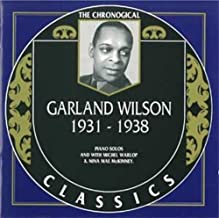
Born Garland Lorenzo Wilson on June 13, 1909 in Martinsburg, West Virginia. He attended Howard University in Washington, D.C. and in the 1930s worked in New York City nightclubs.
In 1932 the pianist joined Nina Mae McKinney on a European tour, worked extensively in England with local groups, and recorded with trumpeter Nat Gonella.
In the liner notes of the CD box l’intégrale Django Reinhardt ~ Vol 2 he is quoted as being accompanist of French singer Jean Sablon together with guitarist Django Reinhardt on two sides recorded on November 1, 1935 in Paris, France.
Returning to the United States in 1939, he remained there until 1951, when he moved to Paris, France. Pianist Garland Wilson remained in Paris until he passed away on May 31, 1954.
More Posts: bandleader,history,instrumental,jazz,music,piano
Daily Dose Of Jazz…
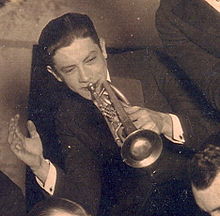
Emmett Louis Hardy was born in Gretna, Louisiana on June 12, 1903 and lived much of his life in the Algiers neighborhood on the west bank of New Orleans, Louisiana. A child prodigy, he was playing marvelously in his early teens. A musical highlight was a 1919 cutting contest where, after long and intense struggle, he succeeded in outplaying Louis Armstrong.
In his early teens he was a member of the Papa Jack Laine band, then worked in the Carlisle Evans Band and Norman Brownlee’s Orchestra of New Orleans. He belonged to a small band that worked with singer Bee Palmer. After moving to Chicago, Illinois he became a member of the New Orleans Rhythm Kings. After returning to New Orleans he led his own band and played in the band of Norman Brownlee.
Hardy did not appear on any of the Rhythm Kings recording sessions, and never made any commercial recordings before his early death. He did metal work, made his own mouthpieces for his horn, and modified his cornet to add an additional spit-valve. When advancing tuberculosis started to make his breathing difficult, Hardy taught himself banjo so he could continue playing music.
Hardy and some of his musician friends made some home recordings on wax phonograph cylinders for their own amusement. As Hardy’s tuberculosis worsened and his death seemed inevitable, the friends decided to preserve the cylinders as a memento of Hardy’s playing. At least one cylinder survived to the start of the 1950s, however when Tulane University’s Jazz Archive was established in the late 1950s, however, a diligent search failed to turn up any of these recordings, which are, alas, presumed lost forever.
After returning to New Orleans he led his own band and played in the band of Norman Brownlee. Though he never recorded with Brownlee, he was a big influence on his replacement, Sharkey Bonano. Cornetist Emmett Hardy passed away from tuberculosis in New Orleans, just four days after his 22nd birthday on June 16, 1925. He was buried in Gretna.
More Posts: bandleader,cornet,history,instrumental,jazz,music
Daily Dose Of Jazz…
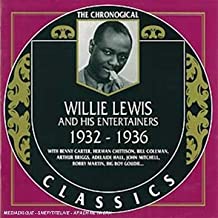
William T. Lewis, born Willie Meria Tawlton Lewis on June 10, 1905 in Cleburne, Texas. Growing up in Dallas, Texas and played in variety shows as a teen. He attended the New England Conservatory of Music, then played in Will Marion Cook’s orchestra. When Cook’s band was taken over by Sam Wooding, he traveled with him on his tours of Europe, South America, and North Africa, remaining until Wooding disbanded the orchestra in 1931.
Following this he put together his own band, Willie Lewis and His Entertainers. They featured some of Wooding’s old players and played to great success in Europe. Among those who played in his band were Herman Chittison, Benny Carter, Bill Coleman, Garnet Clark, Bobby Martin, and June Cole. His Entertainers recorded for French label Disques Swing.
In 1941 Willie disbanded the Entertainers and returned to New York City. He played sparsely after this but found some work as an actor, but took up bartending as his fortunes declined.
Clarinetist and bandleader Willie Lewis passed away on January 13, 1971 in New York City, at age 65.
More Posts: bandleader,clarinet,history,instrumental,music
Daily Dose Of Jazz…
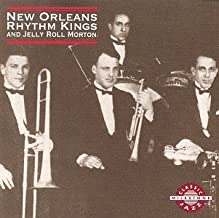
Louis Thomas Black was born on June 8, 1901 in Rock Island, Illinois and began playing banjo during early childhood. He became a professional musician in 1917.
By 1921 he had joined the famous New Orleans Rhythm Kings at Friar’s Inn in Chicago, Illinois. With this band, he participated to the first-ever interracial recording session with pianist Jelly Roll Morton.
Leaving the band in 1923, Lou went on to play with other bands. From 1925 until 1931, he was a staff musician for radio station WHO in Des Moines, Iowa. He left music in the early 1930s, but came back and began playing in 1961. He sat in with several bands during a brief stay in New York City, then played gigs in Moline, Illinois from the fall of 1963.
An automobile accident landed him in a Rock Island hospital and while recovering from his injuries, he suffered a fatal heart attack. Lou Black, who often went by Lew or Louie and was one of the foremost banjo players of the Jazz Era, passed away on November 18, 1965.
More Posts: banjo,history,instrumental,jazz,music