

Daily Dose Of Jazz…
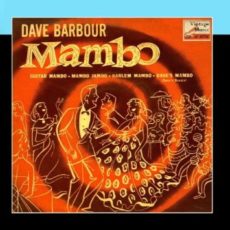
Dave Barbour was born May 28, 1912 in Long Island, New York and started off as a banjoist with Adrian Rollini in 1933 and then Wingy Manone in 1934. He switched to guitar in the middle of the decade and began playing with Red Norvo in 1935-1936.
Through the rest of the decade and the Forties he found a sizable amount of work as a studio musician and played in ensembles with Teddy Wilson and Billie Holiday, Artie Shaw, Lennie Hayton, Charlie Barnet, Raymond Scott, Glenn Miller, Lou Holden, Woody Herman, André Previn and Benny Goodman.
While performing with Goodman’s ensemble, he fell in love with lead singer Peggy Lee, and they quit the group to marry and moved to Los Angeles, California where Johnny Mercer put them to work as a songwriting team, writing a number of Lee’s hits, such as Mañana (Is Soon Enough for Me) and It’s a Good Day. Unfortunately Dave’s alcoholic and domestic troubles with Lee eventually split apart their marriage.
His orchestra had the best-selling US version of the peppy song Mambo Jambo and though his remaining career was far less successful thanhis ex-wife’s, his songwriting royalties sustained him, as the tunes he co-wrote with Lee were covered by many hitmakers of the 1950s. He acted in the films The Secret Fury and Mr. Music, and occasionally performed, including with Benny Carter in 1962. Guitarist Dave Barbour passed away on December 11, 1965 of a hemorrhaged ulcer in Malibu Beach, California, aged 53.

Give A Gift Of Jazz – Share

More Posts: guitar
Daily Dose Of Jazz…
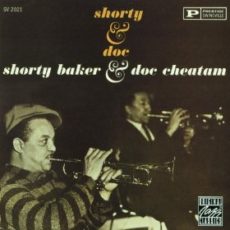
Shorty Baker was born Harold Baker on May 26, 1914 in St. Louis, Missouri and began playing drums, but switched to trumpet during his teens.
He started his career on riverboats with Fate Marable, then with Erskine Tate before playing with Don Redman in the mid-1930s. He went on to work with Teddy Wilson and Andy Kirk before joining Duke Ellington. Shorty married Kirk’s pianist Mary Lou Williams and though the two separated shortly thereafter, they never officially divorced.
Baker worked on and off in Duke Ellington’s Orchestra from 1942 to 1962 alongside Ray Nance, Clark Terry, Taft Jordan, Willie Cook and Cat Anderson among others. He also worked with Billy Strayhorn and Johnny Hodges’ group in the early Fifties during the period when Hodges was not a member of Ellington’s orchestra. During the latter years of his career he worked with Bud Freeman and Doc Cheatham.
Trumpeter Shorty Baker passed away on November 8, 1966 in New York City.
Sponsored By

www.whatissuitetabu.com
More Posts: trumpet
Daily Dose Of Jazz…
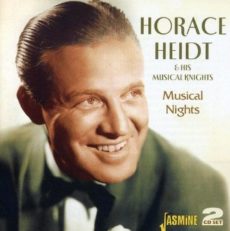
Horace Heidt was born on May 21, 1901 in Alameda, California, He went on to attend the University of California Berkeley as a guard on the football team. But a broken back dashed those dreams and he turned his attention to music, forming The Californians with some classmates.
From 1932 to 1953, he became one of the more popular radio bandleaders beginning on NBC’s Blue Network with Shell Oil’s Ship of Joy and Answers by the Dancers and Horace Heidt’s Alemite Brigadiers. He broadcasted from CBS from 1937-1939.
Horace would employ singer Matt Dennis and singing comedian Art Carney. His recordings were highly successful with Gone With The Wind and Ti-Pi-Tin going to No. 1 and The Man With The Mandolin hitting No. 2 on the charts. His 1941 song, The Hut-Sut Song is heard in the movie A Christmas Story.
He returned to NBC to perform on Pot o’ Gold radio show from 1939-194, portraying himself in the film of the same name starring James Stewart and Paulette Goddard. From 1940 to 1944 he did Tums Treasure Chest, followed by 1943–45 shows on the Blue Network. Lucky Strike sponsored The American Way on CBS in 1953.
On December 7, 1947, NBC launched The Horace Heidt Youth Opportunity Program and accordionist Dick Cortino the first winner of the $5,000 prize, soon had his own show. Heidt’s talent search catapulted a number of performers such as Carney, Frankie Carle, the King Sisters, Alvino Rey, Gordon McRae, Frank DeVol, Johnny Standley and Al Hirt. When the program expanded from radio to television in 1950, it was one of the first talent shows.
Pianist and bandleader Horace Heidt passed away on December 1, 1986 in Los Angeles, California. For his contribution to radio and television he has two stars on the Hollywood Walk of Fame and a Golden Palm Star on the Palm Springs Walk of Stars.
Uplift Someone’s World
More Posts: piano
Daily Dose Of Jazz…
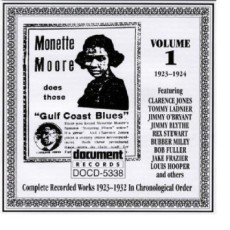
Monette Moore was born May 19, 1902 in Gainesville, Texas but was raised in Kansas City, Missouri. She taught herself piano in her teens and worked as a theater pianist in Kansas City in the early Twenties. In 1923–24 she recorded for Paramount Records in New York City and Chicago, in addition working Dallas and Oklahoma City and eventually settling in New York City.
Monette played with Charlie Johnson’s ensemble at Smalls Paradise and recorded with him in 1927–28. Her output from 1923–27 amounts to 44 tunes, some recorded under the name Susie Smith. Her sidemen included Tommy Ladnier, Jimmy O’Bryan, Jimmy Blythe, Bob Fuller, Rex Stewart, Bubber Miley, Lou Hooper and Elmer Snowden.
In the 1930s, Moore recorded with Fats Waller, filled in for Ethel Waters as an understudy, and in 1937 sang with Zinky Cohn in Chicago. She would perform at her own club, Monette’s Place, in New York City in 1933. Around 1940 she sang in New York with Sidney Bechet and Sammy Price, then moved to Los Angeles in 1942, performing often in nightclubs. She appeared in James P. Johnson’s revue Sugar Hill in 1949 and in numerous films in minor roles.
Monette recorded again from 1945-47, performed with the Young Men of New Orleans at Disneyland in 1961–62. Vocalist and pianist Monette Moore passed away of a heart attack on October 21, 1962 in Garden Grove, California.
More Posts: vocal
Daily Dose Of Jazz…
Woody Herman was born Woodrow Charles Thomas Herman on May 16, 1913 in Milwaukee, Wisconsin. His father had a deep love for show business and this influenced him at an early age. As a child he worked as a Vaudeville singer and tap-dancer, then started to play the clarinet and saxophone by age 12.
1936 saw him joining the Tom Gerun band and his first recorded vocals were Lonesome Me and My Heart’s at Ease. He also performed with the Harry Sosnick Orchestra, Gus Arnheim and Isham Jones, the latter writing numerous popular songes including It Had To Be You. When Jones retired Woody acquired the orchestra, which became known for its orchestrations of the blues. They first recorded for the Decca label as a cover band, eventually getting their first hit with Woodchopper’s Ball in 1939.He went on to have hits with The Golden Wedding and Blue Prelude.
As bebop was gradually replacing swing Herman commissioned Dizzy Gillespie as an arranger and he provided him three arrangements of Woody‘n You, Swing Shift and Down Under in 1942, heralding a change in the music. By 1945 Herman was with Columbia Records, recording the First Herd, the very successful Laura, the theme song to the 1944 movie of the same name. That group became famous for its progressive jazz that was heavily influenced by Duke Ellington and Count Basie. By the end of 1946 the big band era was over and he disbanded his only financially profitable group.
In 1947, Herman organized the Second Herd that remained together until 1987. This band was also known as The Four Brothers Band derived from the song and featured three tenor and one baritone saxophone of Zoot Sims, Serge Chaloff, Herbie Steward and Stan Getz. In the band was also Al Cohn, Gene Ammons, Lou Levy, Oscar Pettiford, Terry Gibbs and Shelly Manne and they had hits with Early Autumn and The Goof and I.
Herman would go on to perform in movies with Billie Holiday and Louis Armstrong, record for RCA, Capitol, MGM and Verve record labels, put together his Third Herd and variations of the New Thundering Herd and by the Seventies was touring and working more in jazz education by offering workshops and taking on younger sidemen.
The 1980s saw Herman’s return to straight-ahead jazz, dropping some of the newer rock and fusion approaches he had used the previous decade. He continued to perform with his health in decline, chiefly to pay back taxes that were owed because of his business manager’s bookkeeping in the 1960s. Herman owed the IRS millions of dollars and was in danger of eviction from his home. He eventually passed leadership duties to reed section leader Frank Tiberi.
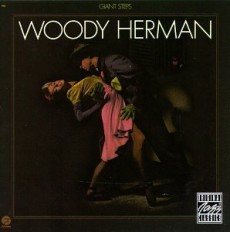
Clarinetist, alto and soprano saxophonist, singer and big band leader Woody Herman was awarded two Grammys for Best Big Band Jazz Album for Encore and Giant Steps, The Grammy Lifetime Achievement Award, had won Down Beat, Esquire and Metronome polls. He was the feature of a documentary film titled Woody Herman: Blue Flame- Portrait of a Jazz Legend, and was a featured half-time performer at Super Bowl VII. He passed away on October 29, 1987.
Dose A Day-Blues Away