

Daily Dose Of Jazz…
Al McKibbon was born January 1, 1919 in Chicago, Illinois but grew up in Detroit, Michigan from the age of two. Attending Cass Tech, the high school that gave the world jazz greats Gerald Wilson, J.C. Heard, Wardell Grey and other, Al focused his training on the bass, which at the time, the bass was coming into its own as a jazz instrument and replacing the tuba.
In 1947, after working with Lucky Millinder, Tab Smith, J.C. Heard, Coleman Hawkins, and as a singer with the Ted Bruckners band, replaced Ray Brown in Dizzy Gillespie’s band. He joined Miles Davis’ nonet in the Fifties recording with him as well as Earl Hines, Count Basie, Johnny Hodges, Thelonious Monk, George Shearing, and Cal Tjader, with whom McKibbon is credited with interesting Cal in Latin music while a member of Tjader’s group.
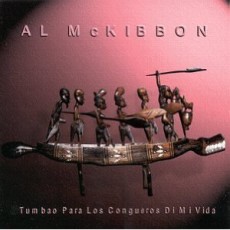
McKibbon, always highly regarded among his peers, was the chosen bassist for the “Giants of Jazz”, and continued to perform until 2004. In 1999, at age 80, he recorded his first album as a leader “Tumbao Para Los Congueros Di Mi Vida” and garnered a Grammy nomination for Best Latin Jazz Performance.
Al McKibbon, double bassist, singer and self taught dancer, who played a Jacob Steiner bass made in 1650, best known for his work in bop, hard bop, and Latin jazz, passed away on July 29, 2005.
More Posts: bass
Daily Dose Of Jazz…
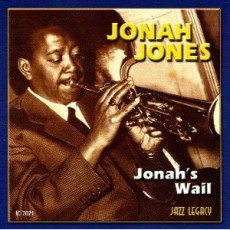
Jonah Jones was born Robert Elliott Jones in Louisville, Kentucky on December 31, 1909. He started playing alto sax at the age of 12 in the Booker T. Washington Community Center band in Louisville before quickly transitioning to trumpet where he excelled immediately. Jones began his career in the 1920s playing on a riverboat named “Island Queen” which plied between Kentucky and Ohio.
By 1928 he joined with Horace Henderson, later worked with Jimmie Lunceford, had an early and successful collaboration with Stuff Smith from 1932-1936, and by the Forties he was working in big bands like Benny Carter’s and Fletcher Henderson. He would spend most of the decade with Cab Calloway’s band that later became a combo.
Starting in the 1950s he had his own quartet and began concentrating on a formula that gained him wider appeal for a decade. The quartet consisted of George “River Rider” Rhodes on piano, John “Broken Down” Browne on bass and “Hard Nuts “Harold Austin on drums. The most mentioned accomplishment of this style is perhaps their version of “On The Street Where You Live”. This effort succeeded and he began to be known to a wider audience. This led to his quartet performing on “An Evening With Fred Astaire” in 1958 and winning a Grammy Award for Best Jazz Performance by a group in 1960.
Jonah went on to become a sensation in France, returned to more “core” jazz work with Earl Hines, played in the pit orchestra for the stage play Porgy and Bess starring Cab Calloway, was inducted into the Big Band and Jazz Hall of Fame in 1999. Trumpeter Jonah Jones passed away on April 29, 2000.
Daily Dose Of Jazz…
Snub Mosley was born Lawrence Leo Mosley on December 29, 1905 in Little Rock, Arkansas. Playing trombone in high school after graduation he joined Alphonse Trent’s territory band from 1926 to 1933. Following this he played with the Jeter-Pillars Orchestra in 1934, Claude Hopkins from 1934-35, was band mates with Fats Waller and Louis Armstrong with the Luis Russell Orchestra 1936-37. In addition, he led his own groups before settling in New York City.
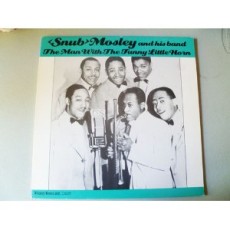
Though Mosley spent most of his career on trombone, he also invented an instrument called the slide saxophone, which had both the slide portion of a trombone and a saxophone mouthpiece. The instrument is prominently featured in his 1940 recording The Man With The Funny Little Horn. From 1940 to 1978 he recorded for Decca, Sonora, Penguin, Columbia and Pizza record labels.
Trombonist Snub Mosley passed away quietly on July 21, 1981 at his home at 555 Edgecombe Avenue in Harlem, New York City.
More Posts: slide saxophone,trombone
Daily Dose Of Jazz…
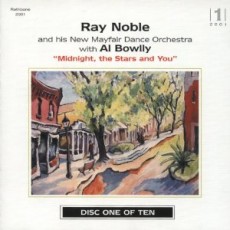
Raymond Stanley Noble was born on December 17, 1903 in Brighton, England and studied music at the Royal Academy. He became the leader of the HMV Records studio band, known as the New Mayfair Dance Orchestra that featured popular vocalist Al Bowlly and many musicians of the top hotel bands.
The Bowlly/Noble recordings achieved popularity in the United States, however, union bans prevented Noble from bringing British musicians to America so he arranged for Glenn Miller to recruit American musicians. Bowlly returned to England but Noble continued to lead bands in America, moving into an acting career portraying a stereotypical upper-class English idiot in films like Top Hat and Slumming On Park Avenue. He also played the “dense” character in love with Gracie Allen, or with his orchestra in an Edgar Bergen vehicle. Noble also provided music for many radio shows of the times like The Charlie McCarthy Show. His last major success as a bandleader came with Buddy Clark in the late 1940s.
Ray Noble arranged hits in the 1930s such as “Easy to Love”, “Mad About the Boy”, “Paris in the Spring”, wrote both lyrics and music for now jazz standards “Love Is The Sweetest Thing”, “Cherokee”, “The Touch of Your Lips”, “I Hadn’t Anyone Till You” and “The Very Thought Of You” and co-wrote “Goodnight, Sweetheart” and “You’re So Desirable”, recorded by Billie Holiday, Teddy Wilson and in 1990 by Robert Palmer.
Ray Noble, bandleader, composer, arranger, pianist, singer and actor passed away on April 3, 1978 at the age of 74.
More Posts: arranger,bandleader,composer
Daily Dose Of Jazz…
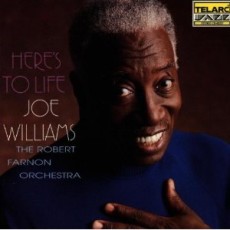
Joe Williams was born Joseph Goreed on December 12, 1918 in Cordele, Georgia but was raised in Chicago from the age of four by his mother, grandmother and aunt. As a child he was greatly influenced by the rebellious sound of jazz from Louis Armstrong, Duke Ellington, Ethel Waters, Cab Calloway, Big Joe Turner and many others of the 1920’s he would hear on the radio. By his early teens, he had already taught himself to play piano and had formed his own gospel vocal quartet, known as “The Jubilee Boys”, that sang at church functions.
During his mid-teens Williams began performing as a vocalist, singing solo at formal events with local bands. The most that he ever took home was five dollars a night, but that was enough to convince his family that he could make a living with his voice. So, at 16, he dropped out of school, created his stage name to “Williams” and began earnestly marketing himself to Chicago clubs and bands. His first job was singing with the band at Kitty Davis’s club during the evening for tips that would sometimes amount to $20.
Williams first real break came in 1938 when clarinetist Jimmy Noone invited him to sing with his band. Less than a year later, the young singer was earning a reputation at Chicago dance halls and on a national radio station that broadcast his voice across the nation. Soon he was touring the Midwest by 1939 and accompanying Louis Armstrong and Fats Waller, a year later toured with Coleman Hawkins. In 1942 Lionel Hampton hired Joe to fill-in for the regular vocalist for the orchestra, the Tic Toc Club in Boston and cross-country tours. By the time the relationship ended Williams was in great demand. Through the 40s he toured and made his first recording with Andy Kirk, which led to working with Red Saunders and recording for Okeh and Blue Lake Records.
He went on to sing with the Count Basie Orchestra from ’54 to 61 with his first recording “Count Basie Swings, Joe Williams Sings” that hit #2 on the charts and sparked another LP, he won Down Beat magazine’s New Star Award and international critic’s Best New Male Singer and reader’s poll Best Male Band Singer. Through the end of the 50s the band was consistently touring Europe.
By the Sixties he was working a solo career with top-flight jazz musicians like Harry “Sweets” Edison, Clark Terry, George Shearing and Cannonball Adderley. He did all the variety shows from The Tonight Show to Joey Bishop, Merv Griffin, Steve Allen and Mike Douglas. He gained further notoriety as the father-in-law on The Cosby Show.
Baritone Joe Williams continued to perform regularly at jazz festivals in the U.S. and aboard, as well as on the nightclub circuit. He received a star on the Hollywood Walk Of Fame in 1983 next to Count Basie, sang Ellington’s Come Sunday at Basie’s funeral, performed the title track All of Me in the Steve Martin/Lily Tomlin vehicle, won two Grammy Awards and enjoyed a successful career, working regularly until his death of natural causes at age 80. He collapsed on the street a few blocks from his home on March 29, 1999 in Las Vegas, Nevada.
More Posts: vocal