

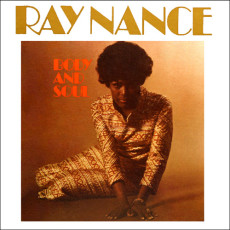
Daily Dose Of Jazz…
Ray Willis Nance was born on December 10, 1913 in Chicago, Illinois and as a child he studied piano, took violin lessons and was self-taught on trumpet. He led small groups from 1932-1937, then spent periods with the orchestras of Earl Hines and Horace Henderson through to 1940, however, he is best known for his long association with Duke Ellington through most of the 1940s and 1950s, after he was hired to replace Cootie Williams.
Shortly after joining the band, Nance was given the trumpet solo on the first recorded version of “Take The “A” Train” which became the Ellington theme, a major hit and jazz standard. Nance’s “A Train” solo is one of the most copied and admired trumpet solos in jazz history that even Williams upon his return to the some twenty years later would play Nance’s solo almost exactly as the original.
Ray was often featured on violin and was the only violin soloist ever featured in Ellington’s orchestra. He is also one of the well-known vocalists from the Ellington orchestra, having sung arguably the definitive version of “It Don’t Mean A Thing (If It Ain’t Got That Swing). It was Nance’s contribution to take the previously instrumental horn riff into the lead vocal, which constitute the now infamous, “Doo wha, doo wha, doo wha, doo wha, yeah!” The multi-talented trumpeter, violinist, vocalist and dancer earned him the nickname “Floorshow”.
He left the Ellington band in 1963 after having switched to and playing cornet alongside his predecessor Cootie Williams for a year. Over the course of his career he recorded a few albums as a leader and with Earl Hines, Rosemary Clooney and others. Ray Nance passed away on January 28, 1976 in New York City.
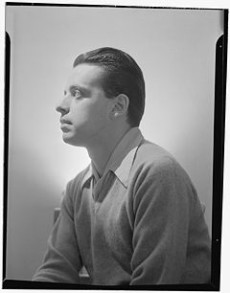
Daily Dose Of Jazz…
Nesuhi Ertegun was born November 26, 1917 in Istanbul, Turkey, moving to Washington, DC when his father was appointed Ambassador to the United States in 1935. From an early age, Nesuhi’s primary musical interest was jazz, having attended concerts in Europe. While at the Turkish Embassy he also promoted jazz concerts during 1941-44.
After his father’s death in 1944, Ertegun stayed in the U.S., moved to California, got married and established the Crescent record label. He purchased Jazz Man Records and issued traditional jazz recordings producing classic Kid Ory revival recordings plus sessions with Pete Daily and Turk Murphy. He went on to work with Contemporary Records and Imperial Records developing their jazz catalog for the later.
In 1955, he was preparing to work for Imperial Records to develop their jazz record line and develop a catalog of LPs. However, his younger brother Ahmet Ertegun and Jerry Wexler persuaded him to become a partner in Atlantic Records over the jazz and LP department.
As a producer he worked with John Coltrane, Charles Mingus, Ornette Coleman, the Modern Jazz Quartet, Ray Charles, Chris Connor, the Drifters, Bobby Darin, Roberta Flack and numerous others while being first recruiting songwriters and producers Leiber and Stoller. He went on to establish WEA International venturing into Latin-American rockers and other world music groups and remained at the helm until his retirement in 1987.
Nesuhi Ertegun, writer, editor, producer, educator, art collector and soccer promoter died on July 15, 1989, at the age of 71, due to complications following cancer surgery. He was posthumously inducted into the Rock and Roll Hall of Fame, awarded the Grammy Trustees Award for lifetime achievement, the National Soccer Hall of Fame and had the Nesuhi Ertegun Jazz Hall of Fame at Jazz at Lincoln Center dedicated to him.

Daily Dose Of Jazz…
Teddy Wilson was born Theodore Shaw Wilson in Austin, Texas on November 24, 1912. By his teenage years he was enamored with the music of Bix Beiderbecke and King Oliver and decided to make a living playing jazz. He studied piano and violin at Tuskegee Institute where his father was head of the English Department and his mother was chief librarian. A year later he joined Speed Webb’s band as one of seven arrangers, re-orchestrating in close harmony the songs of Beiderbecke and Hodges. He went on to join Louis Armstrong, understudying Earl Hines in his Grand Terrace Café Orchestra, and Benny Carter’s Chocolate Dandies.
By 1935 Teddy joined Benny Goodman trio with Gene Krupa becoming the first black musician to perform in public with a previously all-white jazz group. With the help of jazz producer John Hammond, Wilson got a contract with Brunswick Records in 1935 and started recording hot swing arrangements of popular songs of the day with the growing jukebox trade in mind. He recorded fifty hit records with various singers including Lena Horne, Helen Ward and Ella Fitzgerald while also participating in sessions with Lester Young, Roy Eldridge, Charlie Shavers, Red Norvo, Buck Clayton and Ben Webster.
Wilson formed his own short-lived big band in 1939 and then led a sextet at Café Society from 1940 to 1944. In the 1950s he taught at the Julliard School, appeared as himself in the motion picture The Benny Goodman Story, and during the next two decades lived quietly in suburban New Jersey. Pianist and arranger Teddy Wilson passed away on July 31, 1986 in New Britain, Connecticut at age 73.
More Posts: piano
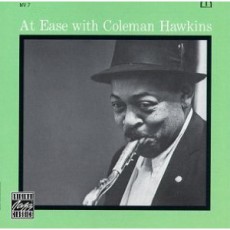
Daily Dose Of Jazz…
Coleman Randolph Hawkins was born on November 21, 1904 in St. Joseph, Missouri and named after his mother’s maiden name. He started out playing piano and cello prior to playing saxophone at age nine. By the time he turned 14, he was playing around eastern Kansas while attending Topeka High School and simultaneously studying harmony and composition for two years at Washburn College.
In 1921 Hawkins joined Mamie Smith’s Jazz Hounds, toured through 1923 and settled in New York City. Hawkins joined Fletcher Henderson’s Orchestra doubling on clarinet and bass saxophone and becoming a star soloist. He recorded with band mates Louis Armstrong and Henry “Red” Allen, a number of solo recordings with either piano or a pick-up band of Henderson musicians. In late 1934, he played with Jack Hylton’s band in London, toured Europe as a soloist until 1939 and worked with Django Reinhardt and Benny Carter in 1937 Paris.
Returning to the States he worked Kelly’s Stables, recorded two choruses of Body and Soul, his landmark recording of the Swing Era. Recorded as an afterthought at the session, it is notable in that Coleman ignores almost all of the melody, only the first four bars are stated in a recognizable fashion. In its exploration of harmonic structure it is considered by many to be the next evolutionary step in jazz recording from where Louis Armstrong’s “West End Blues” in 1928 left off.
Over the course of his long and prolific career Hawkins had an unsuccessful attempt at a big band, led a combo at Kelly’s Stables, played with Thelonious Monk, Oscar Pettiford, Miles Davis, Oscar Peterson, Herb Ellis, Ray Brown, Ben Webster, Max Roach, Howard McGhee, Sonny Rollins, John Coltrane, Roy Eldridge, J.J. Johnson, Fats Navarro and Duke Ellington among others, recorded a session with Dizzy Gillespie that is considered the first bebop recording and toured with Jazz at the Philharmonic. After 1948 Hawkins divided his time between New York and Europe, making numerous freelance recordings. In the 1960s, he appeared regularly at the Village Vanguard.
Tenor saxophonist Coleman Hawkins directly influenced many future bebop musicians such as Sonny Rollins and John Coltrane. In his later years he stopped recording, began drinking heavily and died of pneumonia on May 19, 1969 in New York.
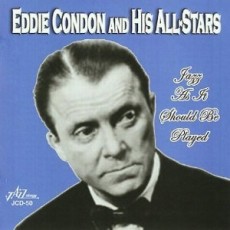
Daily Dose Of Jazz…
Albert Edwin Condon was born November 16, 1905 in Goodland, Indiana and started playing music on the ukulele before switching to guitar. By the time he was sixteen he was in Chicago playing professionally with Bix Beiderbecke, Jack Teagarden and Frank Teschmacher.
In 1928 Condon moved to New York City frequently arranging jazz sessions for various labels, sometimes playing with the artists he brought like Louis Armstrong and Fats Waller. He organized racially integrated recording sessions – when these were still rare – with Waller, Armstrong and Henry “Red” Allen. He played with the Red Nichols band, later forming a long association with Milt Gabler’s Commodore Records in 1938.
From the late 1930s on Eddie was a regular at Nick’s in Manhattan with Pee Wee Russell, Wild Bill Davison and Bobby Hackett. He went on to appear in a short film with Hackett, produced a series of jazz broadcasts from Town Hall during the last years of WWII that gave him national popularity.
From 1945 through 1967 he ran his own New York jazz club, Eddie Condon’s. In the 50s he recorded a sequence of classic albums for Columbia Records, toured Britain, Australia, Japan, the U. S. and performed at jazz festivals throughout the world until 1971. Two years later, Eddie Condon, jazz banjoist, guitarist, bandleader and arranger passed away on August 4, 1973 in New York City.
More Posts: arranger,bandleader,banjo,guitar