

Daily Dose Of Jazz…
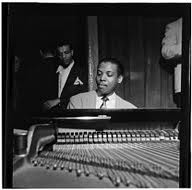
Kenny Kersey was born on April 3, 1916 in Harrow, Ontario into a musical family and studied piano and trumpet while attending the Detroit Institute of Musical Arts. In 1936, Kersey moved to New York City where he played with Lucky Millinder, Billy Hicks, Frankie Newton, Billie Holiday, Roy Eldridge, Red Allen and Cootie Williams.
In 1942 he replaced Mary Lou Williams as Andy Kirk’s pianist and Kirk recorded his composition “Boogie Woogie Cocktail”. He joined the Army from 1943 to 1945, where he occasionally played trumpet in military bands, then played from 1946 to 1949 with the Jazz at the Philharmonic touring ensembles. He continued to play with noted musicians through the 1950s, including Eldridge and Allen again, as well as Buck Clayton, Edmond Hall, Sol Yaged, and Charlie Shavers.
Kersey retired from music late in the 1950s after being diagnosed with a bone ailment. He recorded twelve tunes as a bandleader – four for Savoy in 1946, two for Clef in 1949, two for Circle in 1950, and four for Foxy in 1951 which featured Hot Lips Page and Paul Quinichette and as sidemen. Kenny Kersey passed away on April 1, 1983 in New York City.
More Posts: piano
Daily Dose Of Jazz….
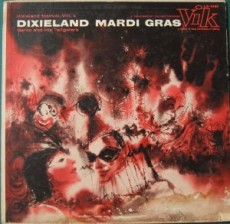
Santo Pecoraro was born on March 31, 1902 in New Orleans, Louisiana but was better known as Santo Pecora. The jazz trombonist distinguished his name due to a cousin, a drummer with the same name, though the two sometimes performed together in ensembles.
Santo began his musical endeavors playing the French horn but settled on the trombone while still a teenager. He played in orchestras accompanying silent films as well as in big bands led by Johnny De Droit and Leon Roppolo. He toured with Bee Palmer, a singer in the early 20’s, and then joined the New Orleans Rhythm Kings by the middle of the decade.
Towards the end of the twenties he moved to Chicago, playing both jazz bands and theatre palaces. He became a big band sideman in the thirties, toured with Sharkey Bonano and played with Wingy Manone in California.
Returning to New Orleans in the 40’s, he gigged on the riverboats and in nightclubs while continuing to work with Bonano. He longtime association with Dixieland and the New Orleans music scene established him as a staple well into the Sixties. Santo Pecora passed away on May 29, 1984 in his beloved Crescent City.

More Posts: trombone

Daily Dose Of Jazz…
Pearl Mae Bailey, born March 29, 1918 in Southampton County, Virginia was raised in the Newport News, Virginia. She began singing at the age of three, making her stage debut at 15 when prompted by her brother Bill she entered an amateur contest winning first prize at Philadelphia’s Pearl Theatre. She went on to do the same at The Apollo, which cemented her decision to pursue an entertainment career.
Singing and dancing in Philly’s black nightclubs and other east coast cities in the thirties, by WWII she was touring the country with the USO and then settling in New York. Her success as a solo nightclub performer brought her work with Noble Sissle, Cootie Williams, Cab Calloway and Duke Ellington.
In 1946 she made her debut on Broadway in St. Louis Woman, which was later followed by House Of Flowers. Broadway led to the silver screen and in 1954 she took the role of Frankie in Carmen Jones, Maria in Porgy and Bess in ’59, both starring Dorothy Dandridge and Aunt Hagar in the film version of St. Louis Blues. In between demanding stage and screen commitments she continued to tour and record.
Returning to Broadway with Cab Calloway in David Merrick’s 1967 production of Hello Dolly won her a Tony award a year later. Throughout the next two decades she would sing the national anthem at the World Series, have her own television show, continue to perform on Broadway, be the voice for several animated film characters, earn a B.A. in theology from Georgetown University, become a spokesperson for Duncan Hines, win a Daytime Emmy, be appointed Ambassador of Love by President Nixon, be awarded the Bronze Medallion from New York City and a Presidential Medal of Freedom.
Pearl Bailey, an uninhibited vaudevillian, singer and actress passed away on August 17, 1990 in Philadelphia of arteriosclerotic coronary artery disease. The sultry voice was best known for her signature songs “Takes Two To Tango”, “Baby It’s Cold Outside” and “Won’t You Come Home Bill Bailey”.

More Posts: vocal
Daily Dose Of Jazz…
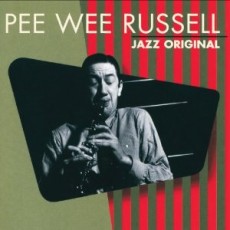
Charles Ellsworth Russell, much better known by his nickname Pee Wee Russell was born on March 27, 1906 in Maplewood, Missouri but grew up in Muskogee, Oklahoma. He began music studying the violin, followed by the piano and then drums. While none of these satisfied his musical acumen he became attracted to the clarinet when his father snuck him into an Elks Club dance and he witnessed the five-piece band. He bought an Albert-system instrument and took lessons from Charlie Merrill, a clarinetist in the pit band at the Broadway Theatre.
His family moved to St. Louis in 1920 and while in school at the Western Military Academy, Pee Wee played with various dance and jazz bands. By 1922 he was traveling and performing professionally with tent shows and riverboats but two years later settled in Chicago playing with notables as Bix Beiderbecke and Frankie Trumbauer.
Over the next two decades Russell built a career with his distinctive style that was somewhat unorthodox to his contemporaries and often was accused of playing out of tune. Yet he played with the likes of Coleman Hawkins, Louis Prima, Red Nichols, Art Hodes freelanced recording sessions and took up residence at “Nick’s” in Greenwich Village.
By 1940 Pee Wee’s health began to deteriorate exacerbated by his bout with alcoholism. In and out of hospitals and a breakdown was coupled with had periods when he could not play. In his latter years he played jazz festivals and international tours organized by George Wein including Newport in 1963 with Thelonious Monk. Playing Richard Nixon’s inaugural was his last gig with George Wein.
Clarinetist Pee Wee Russell died in an Alexandria, Virginia hospital just three weeks later on February 15, 1969. His greatly imaginative improvisations remain inspiration to clarinetists and in 1987 he was inducted into the Big Band and Jazz Hall of Fame.

More Posts: clarinet

Daily Dose Of Jazz…
Johnny Guarnieri, born March 23, 1917 in New York City was a virtuoso jazz and stride pianist best known for his stints with the big bands of Benny Goodman and Artie Shaw in the 1940s. Guarnieri is also noted for his embellishment and juxtaposition of jazz with classical piano, such as Scarlatti and Beethoven.
Throughout the 1940s Guarnieri was a busy sideman, recording with artists such as Charlie Christian, Cozy Cole, Ike Quebec, Charlie Kennedy, Hank D’Amico and Ben Webster. He also led his own group called the “Johnny Guarnieri Swing Men” and recorded with them on the Savoy label, a group that included Lester Young, Hank D’Amico, Billy Butterfield and Cozy Cole. He also led a trio in the 1940s composed of himself, Slam Stewart and Sammy Weiss.
In 1949 Guarnieri recorded an album with June Christy and recorded with numerous other artists over his career. In his later years he shifted more toward jazz education. In commemoration of his reputation as a teacher, Guarnieri’s students financed a label for him called “Taz Jazz Records” and in the ‘70s he recorded numerous albums on his new label, and until 1982 worked the “Tail of the Cock” nightclub in Studio City, California.
Pianist Johnny Guarnieri died doing what he loved to do, play jazz, onstage during a performance with Dick Sudhalter on January 7, 1985.
More Posts: piano