

Daily Dose Of Jazz…
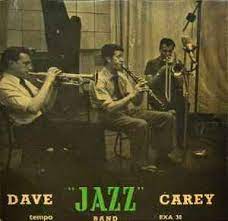
David Arthur Carey was born November 8, 1914 in Coulsdon, Surrey, England. His father was a pianist. In the early Thirties he had his own band that performed in the Croydon borough of London. After the start of World War II he opened a music shop in Streatham before being drafted into military service. In 1946 he opened The Swing Shop in Streatham, where he sold musical instruments and records and which he expanded into a mail order business.
He also played in dance and jazz bands in 1947 with Rex Stewart, who was visiting England, with whom he also recorded in London in September 1949, and in 1948 with Graeme Bell’s Australian Jazz Band. In the same year, Carey took part in recordings by Humphrey Lyttelton for Wilco, in 1950 with the boogie-woogie pianist Roy Vaughan. He was in Lyttleton’s band for a year in 1948 until he was replaced by Bernard Saward. The mid-1950s Dave led his own traditional jazz formations and recorded a number of records for Tempo Records and Decca Records.
Carey performed at the Royal Festival Hall in 1957 and contributed to pianist Pat Hawes’ recordings for Tempo. He worked as a music historian, collaborating with Albert McCarthy and the six-volume work Jazz Directory spanning 1949 to 1952. In the Sixties he led his own band in the 1960s.
According to his colleague Pat Hawes, his drumming was influenced by Baby Dodds, but also by drummers of the swing era such as Gene Krupa, Cozy Cole and George Wettling.
Drummer, bandleader and jazz researcher Dave Carey, who also plays vibraphone and washboard, transitioned on July 18 , 1999 in Croydon.

More Posts: bandleader,drums,history,instrumental,jazz,music,researcher,vibraphone
Daily Dose Of Jazz…
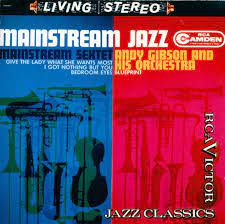
Albert “Andy” Gibson was born on November 6, 1913 in Zanesville, Ohio. He played violin early on before settling on trumpet. He played professionally in many orchestras and though he did not solo, he worked more often as an arranger.
During the 1930s his associations include Lew Redman, Zack Whyte, McKinney’s Cotton Pickers, Blanche Calloway, Willie Bryant, and Lucky Millinder. He quit playing in 1937 to arrange and compose full-time, working with Duke Ellington, Count Basie, Cab Calloway, Charlie Barnet, and Harry James. in the United States Army he led a big band while serving from 1942-45.
After his discharge, he continued working with Barnet but turned his focus primarily on R&B music. He was musical director for King Records from 1955–60 and recorded four songs as a leader in 1959 which were released by RCA Camden. He composed I Left My Baby popularized by Count Basie, The Great Lie, and The Hucklebuck.
Trumpeter, arranger, and composer Andy Gibson transitioned from a heart attack on February 11, 1961 in Cincinnati, Ohio.
More Posts: arranger,bandleader,composer,history,instrumental,jazz,music,trumpet
Daily Dose Of Jazz…
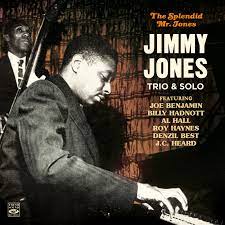
Joseph Rupert Benjamin was born on November 4, 1919 in Atlantic City, New Jersey. He played with many jazz musicians in a variety of idioms. Early in his career he played in the big bands of Artie Shaw, Fletcher Henderson, Sy Oliver, and Duke Ellington.
He went on to work with Hank Garland, Marian McPartland, Louis Armstrong, Jo Jones, Gary Burton, Roy Haynes, Art Taylor, and Brother Jack McDuff.
Never leading a recording session, Joe recorded three dozen albums as a sideman with Bob Brookmeyer, Kenny Burrell, Dave Brubeck, Harry Edison, Duke Ellington, Dizzy Gillespie, Barry Harris, Roy Haynes, Johnny Hodges, Budd Johnson, Roland Kirk, Gary McFarland, Carmen McRae, Gerry Mulligan, Jerome Richardson, Al Sears, Joya Sherrill, Rex Stewart, Sonny Stitt, Buddy Tate, Clark Terry, The Three Playmates, Sarah Vaughan, Mal Waldron and Kai Winding.
Double bassist Joe Benjamin transitioned on January 26, 1974.
More Posts: bass,history,instrumental,jazz,music
Daily Dose Of Jazz…
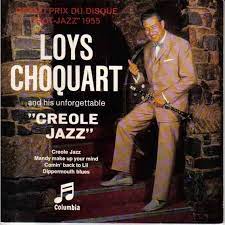
Loys Choquart was born on October 11, 1920 in Geneva, Switzerland. Leading his own ensemble by age 17, and at 19 had a position at Radio Geneva, remaining a broadcaster with the station for decades.
He first recorded with his ensemble the New Rhythm Kings in 1942, then with a new ensemble, the Dixie Dandies, in 1943 which included Henri Chaix and Wallace Bishop as sidemen.
According to jazz historian Rainer E. Lotz, by the end of World War II “he was considered the best Swiss saxophone and clarinet soloist”, playing in both Dixieland and swing idioms. His Creole Jazz ensemble won the Prix Jazz Hot in 1955 on the basis of recordings made in 1952.
He also led a larger ensemble with an orchestra, which included pianist and vibraphonist André Zumbach. During his later life he toured extensively throughout western Europe and owned a club in Geneva called La Tour. Unfortunately there are no recordings of his playing online.
Reedist, bandleader and broadcaster Loys Choquart transitioned on December 10, 1989 in Puplinge, Switzerland.

More Posts: bandleader,broadcaster,history,instrumental,jazz,music,reeds

Daily Dose Of Jazz…
George Horace Webb was born on October 8, 1917 in London, United Kingdom to a former music hall artiste. He grew up with a love of early jazz recordings, principally those made by the New Orleans musicians. A keen jazz enthusiast, he was a self-taught amateur pianist.
Working as a machine gun fitter in the Vickers-Armstrong factory at Crayford, he organized lunchtime entertainment at the factory, assembling scratch bands from among the workers. With his band, George Webb’s Dixielanders, he played regularly and famously at The Red Barn public house at Barnehurst, Kent, beginning in the early 1940s. They made several recordings and BBC radio broadcasts but by 1948 they had disbanded.
Webb was then part of Humphrey Lyttelton’s band from 1948 to 1951. After a short-term reformation of the Dixielanders in 1952, he concentrated on running a jazz club. In the mid-Sixties he was a musician agent and manager. Early in the following decade, he returned to more frequent playing and toured Europe as a soloist. Another version of the Dixielanders operated for a year and then ran a pub for 12 years.
A move back to Kent had him guest performing in various bands into the 2000s with Humphrey Lyttelton, Wally Fawkes and Eddie Harvey. In his playing he tried to re-create the style of such bands as King Oliver’s.
Pianist George Webb, who is considered by many as the father of the traditional jazz movement in Britain, transitioned on March 10, 2010.

More Posts: bandleader,history,instrumental,jazz,music,piano