

Daily Dose Of Jazz…
Michel Maurice Armand Warlop came into the world in Douai, France on January 23, 1911. A child prodigy, he won every award and prize that existed for the violin in France before attaining the age of 18. he started his musical studies with his mother, a music professor, and entered the Conservatory of Douai, the second oldest in France, at age six.
There he studied with Victor Gallois who had won the Prize of Rome for composition in 1905. At age seven, he played his first public concert accompanied by his mother on the piano and by age eight in 1919 he played his first concert in Paris, to benefit victims of WW1. He transferred to the Conservatory of Lille around the age of 10 and started his studies on the university level at the Conservatory of Paris at age 13.
By mid-1939 Warlop began working permanently with the Raymond Legrand Orchestra, then got called up for military service in September 1939 and left Paris. Soon after hostilities started between Germany and France and he became a German prisoner of war but later released because of his tuberculosis. He returned to France late in February 1941.
Back in Paris, he took up his old chair in Legrand’s orchestra, recorded with the Jazz Dixit and his own string septet Septuor a Cordes from time to time. Both of these units were made up of other musicians in the Legrand organization. Warlop wrote and arranged almost all of the Septour’s music which was in a style that blended a classical string setting with Warlop’s jazz abilities. By 1942 he recorded his own Swing Concerto, however, Disques Swing did not issue it and it sat in the vaults until it was finally released on a CD in 1989.
After the war many French musicians, singers and film stars were accused of supporting the enemy for appearing on German-controlled radio, playing for German troops or touring in Germany. Many were banned from working for various periods of time. Warlop had to sit out for two months and Legrand for one year. He never played again in Paris or recorded after this incident in 1945.
His tuberculosis had finally caught up with him along with his heavy consumption of alcohol and cocaine and violinist Michel Warlop, who preferred to tour as a jazz soloist and in small groups in the south of France, passed away at 36 on March 6, 1947 in Bagnères-de-Luchon, France. His last engagement was with Jimmy Réna’s small group at the Grand Hotel Superbagnières above Luchon, France in the Pyrenees Mountains near the border with Spain.

More Posts: bandleader,history,instrumental,jazz,violin
Daily Dose Of Jazz…
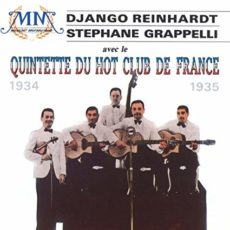
Charles Delaunay was born on January 18, 1911 in Vineuil-Saint-Firmin, Oise, the son of painters Robert Delaunay and Sonia Delaunay. As one of the founders of the Hot Club de France, together with Hugues Panassié, he initiated the Quintette du Hot Club de France with Django Reinhardt and Stephane Grappelli. He also organized concerts, for example with Benny Carter.
In 1935, again with Panassié, he founded Le Jazz Hot, one of the oldest jazz magazines. In 1937, he started Disques Swing, “Swing Records”, the first record label dedicated exclusively to jazz. During World War II Delaunay was a member of the Resistance while continuing to lead the Hot Club. 1948 was when he founded the record label Disques Vogue.
He authored the famous Hot Discography with five editions in England, France and the U.S., the first jazz discography and was also an artist. Author, jazz expert, co-founder and long-term leader of the Hot Club de France, Charles Delaunay passed away in Paris of Parkinson’s disease on February 16, 1988.
More Posts: artist,author,bandleader,history,instrumental,jazz,music,publisher

Daily Dose Of Jazz…
Sidney “Big Sid” Catlett, born January 17, 1910 in Evansville, Indiana, received at an early age instruction in the rudiments of piano and drums under the tutelage of a music teacher hired by his mother. When he and his family relocated to Chicago, Illinois he got his first drum kit, and immersed himself in the diverse styles and techniques of Zutty Singleton, Warren “Baby” Dodds, and Jimmy Bertrand, among others.
By 1928, Sid was playing with violinist and clarinet player Darnell Howard, before joining pianist Sammy Stewart’s Orchestra in New York City and performing at the Savoy Ballroom. After performing for several lesser established musical acts, he began recording and performing with multiple musicians including Benny Carter, McKinney’s Cotton Pickers, Fletcher Henderson, and Don Redman throughout the 1930s.
Between 1938 and 1942, he was Louis Armstrong’s drummer of choice as he was regularly featured in Armstrong’s big band, while also periodically joining Benny Goodman’s group. Following a brief stint in collaboration with Duke Ellington in 1945, Catlett led some of his own bands through the remainder of the 1940s while staying involved in Armstrong’s All-Stars between 1947 and 1949.
Catlett was one of the few drummers to successively transition into bebop, appearing on Dizzy Gillespie’s progressive recordings in 1945. In 1950 he performed with Hoagy Carmichael at the Copley Plaza Hotel. In early 1951, he began to suffer from pneumonia. On March 25, 1951 drummer Sid Catlett passed away at the age of 41 after suffering a heart attack while visiting friends backstage at a Hot Lips Page benefit concert in Chicago, Illinois. In 1996, he was inducted into the Big Band and Jazz Hall of Fame.
More Posts: bandleader,drums,history,instrumental,jazz,music
Daily Dose Of Jazz…
Steve Jordan was born on January 15, 1919 in New York City and studied with Allan Reuss early in life while Reuss was Benny Goodman’s guitarist. He worked in the Will Bradley Orchestra from 1939 to 1941, then moved to Artie Shaw’s band until 1942. The same year he worked briefly with Teddy Powell before he enlisted in the U.S. Navy.
Following his discharge from the service he played with Bob Chester, Freddie Slack, Glen Gray and the Casa Loma Orchestra, Stan Kenton, Jimmy Dorsey, and Boyd Raeburn.
He became a studio musician for NBC and worked often as a freelance sideman after the big band era was over. He worked with Gene Krupa, Mel Powell, Vic Dickenson, Charles Thompson, Buck Clayton, Ruby Braff, Benny Goodman, Wild Bill Davison, Clancy Hayes, Buddy Tate, Helen Ward, and Ed Polcer. He held a regular gig in Washington, D.C. with Tommy Gwaltney from 1965 to 1972, and was offered the opportunity to succeed Freddie Green in the Count Basie Orchestra but turned it down.
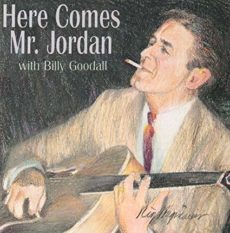
Jordan recorded two sessions as a leader, Here Comes Mr. Jordan and Fat Cat’s Jazz, the latter appearing to be out of print. He published a memoir titled Rhythm Man in 1991. Guitarist Steve Jordan passed away on September 13, 1993 at the age of 74 in Alexandria, Virginia.
More Posts: bandleader,guitar,history,instrumental,jazz,music
Daily Dose Of Jazz…
Putney Dandridge was born Louis Dandridge on January 13, 1902 in Richmond, Virginia, and began performing in 1918 as a pianist in a revue titled The Drake and Walker Show. 1930 saw him working as an accompanist for tap dancer Bill “Bojangles” Robinson, including appearances in the musical Brown Buddies. In 1931, he appeared in the cast of the musical revue Heatin’ Up Harlem, starring Adelaide Hall at the Lafayette Theatre in Harlem. In the 1932 American film, Harlem Is Heaven, Dandridge, on the piano and reciting lyrics in a speak set, accompanies Robinson as the dancer sings “Is You Is Or Is You Ain’t“.
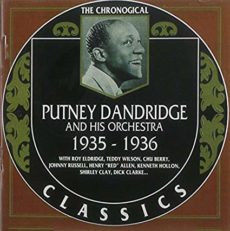
After touring in Illinois and the Great Lakes region, Putney settled in Cleveland, Ohio, forming a band with guitarist Lonnie Johnson. This period lasted until 1934 when he attempted to perform as a solo act. He took his show to New York City, beginning a series of long residences at the Hickory House on 52nd Street and other local clubs. From 1935 to 1936, he recorded numerous sides under his own name, many of which highlighted some major jazz talents of the period, including Roy Eldridge, Teddy Wilson, Henry “Red” Allen, Buster Bailey, John Kirby, Chu Berry, Cozy Cole and more.
Appearing to vanish from the music scene in the late thirties, it has been speculated that he may have been forced to retire due to ill health. Pianist Putney Dandridge passed away on February 15, 1946 in Wall Township, New Jersey at the age of 44.
More Posts: piano