

Daily Dose Of Jazz…
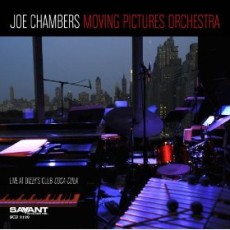
Joe Chambers was born June 25, 1942 in Stoneacre, Virginia into a musical family. He grew up listening to the rock and roll of Louis Jordan and Slim Gaillard along with classical composers like Vivaldi and Beethoven. At the tender age of four he was playing pots and pans, setting them up like a kit. More taken with Lester Young and Lionel Hampton, nonetheless, he soon joined a band that played the R&B hits and at thirteen hearing the esoteric sounds of Miles Davis, he was hooked.
Chambers earned an undergrad degree from the Philadelphia Conservatory and by the time he was twenty cut his first session on Freddie Hubbard’s Breaking Point. That single date led to road work with Harold Land, Sonny Rollins, Herbie Hancock, Eric Dolphy and Dizzy Gillespie.
As a member of the ‘60s Blue Note fraternity, Joe stands amongst some of the greatest jazz musicians of the 20th century. His intense drumming and trademark blend of cymbal-driven forward motion, deeply rhythmic continuity and explosive creativity has graced numerous landmark recordings like Hutcherson’s “Components”, Shorter’s “Schizophrenia” and “Etcetera”, and Tyner’s “Tender Moments”.
Joe Chambers is more than a drummer adding vibraphonist, pianist, composer and educator to his resume. He has eight albums as a leader, has scored several Spike Lee films, taught at the New School for Jazz and Contemporary Music in NYC and leads the Outlaw Band at the school; and he is the Thomas S. Kenan Distinguished Professor of Jazz in the University of North Carolina Wilmington’s Department of Music.
More Posts: drums,vibraphone
From Broadway To 52nd Street
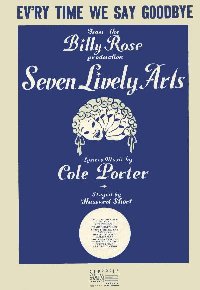
Seven Lively Arts opened at the Ziegfeld Theatre on December 7, 1944 and the curtain rose for 183 performances. Billy Rose produced the show, hiring Cole Porter to compose the music that spawned the jazz standard Ev’ry Time We Say Goodbye.
The Story: The musical featured eleven sketches such as Local Boy Makes Good, Pas de Deux and Heaven On Angel Street. The short-list of actors included Beatrice Lillie, Bert Lahr, Alicia Markova and Doc Rockwell. They are augmented with the talents of jazz notables Teddy Wilson, Red Norvo and Benny Goodman.
Broadway History: By the Mid 40s most theaters on Broadway that had been a good investment and a symbol of vivacity and mirth from the turn of the century were now considered uneconomical. Increasing real estate values was forcing the theaters into obsolescence, turning them into film house to accommodate the takeover by movies. A second threat during this period in the competition for audience was the emergence of television, which was providing free entertainment. The result of these two industries was a shocking 80% unemployment rate for Broadway actors in 1948, and for the first time in its history, Broadway had to call a general emergency meeting for all unions and theater people.
Sponsored By

www.whatissuitetabu.com

Daily Dose Of Jazz…
Eumir Deodato was born Eumir Deodato de Almeida on June 22, 1943 in Rio de Janiero of Italian and Portuguese parents. He began his musical training at twelve on the accordion but rapidly learned instrumental and orchestral skills that gave him his first recording session at 17.
Originally working as pianist and arranger in the Rio bossa nova scene, he rapidly outgrew this and, along with many other Brazilian musicians during the military dictatorshipin their country, moved to New York and began working with composer Luis Bonfa and later with producer Creed Taylor as an arranger. Additionally, he became keyboardist in Taylor’s expanding group of CTI backing artists.
His first U.S. album “Prelude” released in 1973 for CTI was a big band Latin jazz project that immediately attracted a wide audience. His funky version of Also Sprach Zarathustra won him the 1974 Grammy for Best Pop Instrumental Performance and hitting #2 on the charts.
Deodato has been in demand as a producer and arranger since the 1960s. In all, he has worked on more than 500 albums, fifteen of which have reached platinum. His skills as an arranger provided entree to the American recording industry, writing charts for Wes Montgomery, Astrud Gilberto, Frank Sinatra, Bjork, k.d. lang and Kool and the Gang among others.
He has scored several films over his career and recorded a live album in Rio in 2007. He continues to produce and arrange.
More Posts: piano
Daily Dose Of Jazz…
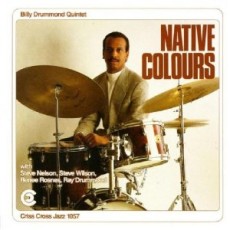
Jazz drummer Billy Drummond was born Willis Robert Drummond, Jr. on June 19, 1959 in Newport News, Virginia. From an early age he learned jazz from his father, who was also a drummer and a jazz enthusiast and whose record collection included many recordings of Miles Davis, Art Blakey, Max Roach, Buddy Rich and Elvin Jones, among others.
Billy played in bands from age eight and studied at Shenandoah Conservatory. At the behest of Al Foster he moved to New York in 1986 and shortly thereafter joined the Blue Note band, Out of the Blue (OTB) with whom he recorded their last CD. He subsequently joined the Horace Silver sextet and toured extensively.
Drummond has played and recorded with Nat Adderley, Ralph Moore, Buster Williams, Charles Tolliver, Lew Tabackin and Toshiko Akiyoshi, Hank Jones, James Moody, Sonny Rollins, Andy LaVerne, Lee Konitz, Larry Willis, Toots Thielemans and Freddie Hubbard among others greats.
Billy’s influences include a long list besides Tony Williams, Max Roach, Philly Joe Jones, Al Foster, Jack DeJohnette and Billy Hart. His discography includes three albums as a leader, another five as a co-leader, fifteen as a band member with Carla Bley and Steve Kuhn, and sixty-six as a sideman.
He is currently a long-time member of Carla Bley’s Lost Chords Quartet, leads the New York-based band “Freedom of Ideas” in addition to touring, and is Professor of Jazz Drums at the Juilliard School of Music and New York University in New York.
More Posts: drums
From Broadway To 52nd Street
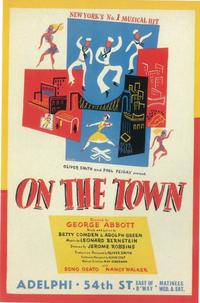
On The Town opened at the Adelphi Theatre on December 28, 1944 and ran for 463 performances. Leonard Bernstein composed the music and Betty Comden and Adolph Green wrote the lyrics. The musical starred Betty Comden, Nancy Walker, Adolph Green, John Battles, S. Ono Osata and Chris Alexander.
The Story: Three sailors – romantic Gaby, down-to-earth Chip and clownish Ozzie are on shore leave in New York City. During a subway ride, Gaby falls in love with a picture of Miss Turnstiles. This event leads the guys on an adventure to find her. Roaming around the city as far as the museum of Natural History and Coney Island, the other two also find love. Nancy Walker plays the cab driver. From this play New York, New York and Some Other Time became jazz standards.
Jazz History: American involvement in World War II, which began on December 11th, 1941 marked a decline in the importance of big bands in popular music. Many musicians were sent to fight in the war, and those who remained were restricted by high taxes on gasoline. By the time the ban on recording was lifted, big bands had practically been forgotten, or had begun to be thought of as peripheral in relation to vocal stars such as Frank Sinatra.
The fall of the Big Band began on August 1, 1942 when the American Federation of Musicians initiated a strike against all major recording companies because of a disagreement over royalty payments. No union musician could record. The effects of the strike include the shrouding of the developments of bebop in mystery. There are few documents that can provide evidence of what the early forms of the music sounded like.
Sponsored By
www.whatissuitetabu.com