

Hollywood On 52nd Street
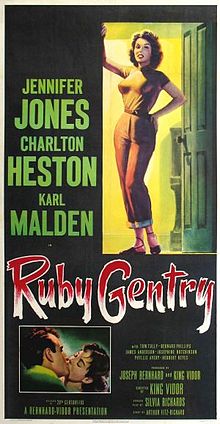
The song Ruby was composed by Heinz Eric Roemheld as the theme for the 1952 film Ruby Gentry. It subsequently became a jazz and pop standard, both as an instrumental and with lyrics by Mitchell Parish. The film was directed by King Vidor and starred Jennifer Jones as Ruby Corey/Gentry, Charlton Heston played Boake Tackman and Karl Malden held down the role of Jim Gentry. At the time of the film’s release the theme enjoyed much popularity in an orchestration by Les Baxter with harmonica solo by Danny Welton.
The Story: Ruby, a poor backwoods girl living in the small North Carolina town of Braddock, is still in love with Boake Tackman. During high school, Ruby had rebuffed his aggressive advances, and was taken in for a couple of years by kind wealthy businessman and his wife, who protected her and taught her the skills a lady would need. She moves back home when her father needed her help. Boake’s family used to be wealthy, but after generations of profligacy all he has left is the land he has had drained and farmed. He starts a relationship with her but plans to marry a local woman with a rich family. When Ruby hears the news, she marries her former benefactor, Mr. Jim Gentry, whose invalid wife recently died, despite not loving him.
Her background keeps her from being accepted by most of Jim’s peers, most of whom decline to attend their after-wedding party. Insecure, Jim becomes jealous of her relationship with Boake, has a fight, calls her a tramp and she leaves in tears. Apologies ensue and while sailing she admits her lack of loving him, while a loose rope results in Jim being knocked overboard by the boom, leaving Ruby widowed and distraught. Now she becomes the local gold-digger and murderess, the town rebuffs her and she gets harassing phone calls.
Retaliating, Ruby uses Jim’s money to begin a campaign against everyone who slighted her, calling in debts to close down people’s businesses as well as the newspaper that slandered her. Still holding a soft spot for Boake she returns his promissory note but again he rebuffs her kindness as a way to buy him and her out of the swamp. Once again, woman scorned and she floods Boake land, ruins his crop and once calm, apologizes. However, her estranged brother Jewel begins shooting at them, killing Boake and in turn Ruby kills her brother and then laments her decisions that have caused so much pain. Now alone, Ruby becomes the skipper of a fishing boat, forever looked down upon by the townspeople.
Sponsored By

www.whatissuitetabu.com

#preserving genius
Daily Dose Of Jazz…
Bob Maize was born on January 15, 1945 in San Diego, California. He played piano from age seven and switched to bass at 13 and began playing professionally. After moving to San Francisco, California in 1963, he worked in the house bands of many jazz clubs in the city, including Soulville and Bop City.
He played with Sonny Stitt, Philly Joe Jones, Vince Guaraldi, Mose Allison, Herb Ellis, Monty Alexander, Anita O’Day, Emily Remler, and Jon Hendricks. He also did a stint in a rock band as a bass guitarist.
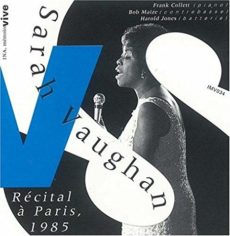
A move to Los Angeles, California in the 1970s saw him working with Scott Hamilton, Dave McKenna, and Tal Farlow. Following this, Maize worked with Horace Silver in 1983-84, recorded with Eiji Kitamura on the Concord label, for whom he recorded regularly as a sideman, and toured Japan with Sarah Vaughan in 1985. He continued to play as a sideman in West Coast clubs into the new millennium.
Double bassist Bob Maize, never led a recording session and passed away on November 20, 2004 in Los Angeles.

Give A Gift Of Jazz – Share
#preserving genius
More Posts: bass
Daily Dose Of Jazz…
George Duke was born on January 12, 1946 in San Rafael, California and raised in Marin City. It was at the young age of 4 that he first became interested in the piano when his mother took him to see Duke Ellington in concert. He began his formal piano studies at the age of 7, at his local Baptist church. Attending Tamalpais High School in Mill Valley, he went on to earn a bachelor’s degree in trombone and composition with a minor in contrabass from the San Francisco Conservatory in 1967.
Initially he played with friends from garages to local clubs, George quickly eased his way into session work, before getting his master’s degree in composition from San Francisco State University. Although starting out playing classical music, his musician cousin Charles Burrell convinced him to switch to jazz and improvise what he wanted to do.
1967 saw Duke venturing into jazz fusion, playing and recording with violinist Jean-Luc Ponty, as well as performing with the Don Ellis Orchestra, and Cannonball Adderley’s band, and recorded with Frank Zappa and The Mothers of Invention on a number of albums through the 1970s. He also played with Ruth Underwood, Tom Fowler, Bruce Fowler from Zappa’s Overnite Sensation band that he was a part of, along with Johnny “Guitar” Watson and jazz guitarist Lee Ritenour. Lynn Davis and Sheila E recorded with him on his late-1970s solo albums Don’t Let Go and Master of the Game.
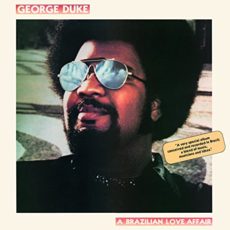
During the 1980s he collaborated with bassist Stanley Clarke and produced the Clarke/Duke Project that released three albums, he served as a record producer and composer on two instrumental tracks on the Miles Davis albums Tutu and Amandla, worked with a number of Brazilian musicians, including singer Milton Nascimento, percussionist Airto Moreira and singer Flora Purim, and in the 1992 film Leap of Faith featured gospel songs and choir produced by him and choir master Edwin Hawkins.
Duke was musical director for the Nelson Mandela tribute concert at Wembley Stadium in London, temporarily replaced Marcus Miller as musical director of NBC’s late-night music performance program Sunday Night during its first season, and was a judge for the second annual Independent Music Awards to support independent artists’ careers. He worked with Jill Scott on her third studio album, The Real Thing: Words and Sounds Vol. 3; and put together a trio with David Sanborn and Marcus Miller for a tour across the United States.
His educator side had him teaching a course on Jazz And American Culture at Merritt College in Oakland, California. He was nominated for a Grammy as Best Contemporary Jazz Performance for After Hours in 1999, was inducted into The SoulMusic Hall Of Fame in 2012, and was honored with a tribute album My Old Friend: Celebrating George Duke, produced by long-time friend and collaborator Al Jarreau, that received a NAACP Image Award for Outstanding Jazz Album in 2015.
As leader he recorded some four dozen albums and as sideman he worked with such artists as Third World, The Keynotes, Gene Ammons, Billy Cobham, Eddie Henderson, Alphonse Mouzon, Michael Jackson, Deniece Williams, Miles Davis, Dianne Reeves, John Scofield, Chanté Moore, Joe Sample, Phil Collins, Regina Belle, Teena Marie, Joe Williams, Gerald Wilson and Larisa Dolina among many others.
Keyboard pioneer, vocalist guitarist, trombonist, producer and composer George Duke passed away on August 5, 2013 in Los Angeles, California from chronic lymphocytic leukemia. He was 67. His songs have been sampled by Daft Punk, Kanye West and Ice Cube among numerous others.
Dose A Day-Blues Away
#preserving genius
More Posts: bass guitar,flute,keytar,piano,saxophone,synthesizer,trombone,vocal
Daily Dose Of Jazz…
William Parker was born January 10, 1952 in the Bronx, New York. He was not formally trained as a classical player, though he did study with Jimmy Garrison, Richard Davis, and Wilbur Ware and learned the tradition and is one of few jazz bassists who frequently plays arco.
Active on the free jazz scene since the early Seventies, Parker first came to public attention with pianist Cecil Taylor. The 1990s saw Parker’s prominence and public profile grow as an influential bassist in the New York City experimental jazz scene.
He has long been a member of saxophonist David S. Ware’s quartet, in Peter Brötzmann’s groups and has also played with various other groups that included Paul Murphy. He is a member of the cooperative Other Dimensions In Music and together with his wife, Patricia Nicholson Parker, organizes the annual Vision Festival in New York City.
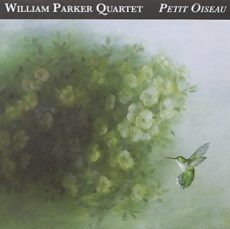
His Sound Unity album has been listed in the Top 10o and his Double Sunrise over Neptune made the Top 10 album pick list by Amazon, and his Petit Oiseau has been chosen as one of the best jazz disks of 2008 by The Wall Street Journal, the BBC’s Radio Three, The Village Voice and PopMatters.
In 2006, Parker was awarded the Resounding Vision Award from Nameless Sound. His first book, Who Owns Music?, assembles his political thoughts, poems, and musicological essays In June 2011, while his second book, Conversations, is a collection of interviews with notable free jazz musicians and forward thinkers, mainly from the African-American community.
Free jazz bassist William Parker continues to record and perform regularly at music festivals around the world.
Take A Dose On The Road
#preserving genius
More Posts: bass
Daily Dose Of Jazz…
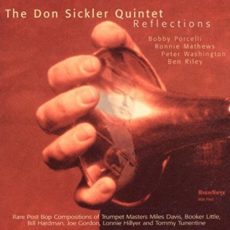
Don Sickler was born on January 6, 1944 in Spokane, Washington and with his mother’s guidance, an accomplished teacher, started learning accordion and piano at the age of four. At five he wrote his first composition that his parents published in their Sickler Accordion Course books. Taking up the trumpet at age ten, two years later he formed his first jazz combo and by 1957 was leading a nonet, playing for school and college dances. He went on to matriculate through Gonzaga University and the Manhattan School of Music in 1970 with a Master’s Degree in Trumpet Performance.
In New York he played commercially, subbed in Broadway show bands, played in rehearsal bands and jazz lofts though he turned towards music publishing. Don began working at E.B. Marks Music as music editor to managing editor, then moved to production manager of United Artists Publishing’s print division. Though they controlled the music catalogues of Blue NOte and Pacific Records that shaped much of his early life, he became disillusioned by the lack of corporate priority given to jazz. So he left and established his own publishing companies: Second Floor Music and 28th Street Music, which have published the works of over 350 jazz composers including Hank Mobley, Kenny Dorham, Bobby Timmons, Gigi Gryce, James Williams, Bobby Watson and a list too long to name.
After a seven-year hiatus Sickler resumed his playing career by collaborating with Philly Joe Jones that lasted for five years. This association afforded him opportunities to play with Art Blakey, Billy Higgins, Roy Haynes, Ben Riley and Charli Persip and other great players on every instrument. By 1982 he and Philly Joe created Dameronia, an all-star tribute band to Tadd Dameron, releasing two critically acclaimed albums and he transcribed all arrangements.
He would go on to release albums as a leader with Jimmy Heath, Cedar Walton, Ron Carter, Billy Higgins, Roy Hargrove, Mulgrew Miller, Bobby Watson, Ralph Moore, Wallace Roney, Clark Terry, Grover Washington, Joe Henderson, and Renee Rosnes. As a sideman he has worked with Herbie Hancock, Frank Wess, Wayne Shorter, Christian McBride, Larry Coryell Freddie Redd and Superblue.
Trumpeter, arranger, producer, publisher, music director and educator Don Sickler has won five Grammy Awards beginning with Joe Henderson’s Lush Life in 1992 and has been nominated several times that include J. J. Johnson’s The Brass Orchestra. His tribute album Monk on Monk was DownBeat Magazine’s 1998 Album of the Year. He is currently the musical director for the annual Thelonious Monk International Jazz Instrumental Competition for the Thelonious Monk Institute, conducts workshops, master classes and teaches trumpet, jazz arranging and composition at Columbia University.
Sponsored By

#preserving genius
More Posts: trumpet