

The Quarantined Jazz Voyager
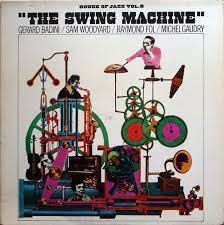
Closing out the final week of the month is The Swing Machine. It’s another offering from the continent that this Jazz Voyager has discovered not in his collection but one that requires sharing.The title really says it all so aptly named by tenor saxophonist Gérard Badini in preparation for a good time!
The album was recorded May 30, 1975 at the Hoche Studio in Paris, France and was produced by Jacques Lubin. The recording engineer was Gerhard Lehner, the liner notes were written by Alexandre Rado, and the photography by Christian Rose.
Tracks | 44:48- It Don’t Mean A Thing (Duke Ellington, Irving Mills) ~
- Let’s Do It (Cole Porter) ~
- Sam Woodyard Is Back In Town (Gérard Badini) ~
- Cute (Neal Hefti)
- Asphodèle (Raymon Fol) ~
- Stomp, Lok And Listen ( Duke Ellington) ~
- Michel Gaudry ~ Double Bass
- Drums – Sam Woodyard ~ Drums
- Raymond Fol ~ Piano, Celesta
- Gérard Badini ~ Tenor Saxophone

More Posts: adventure,album,club,genius,jazz,museum,music,preserving,restaurant,saxophone,travel

Daily Dose Of Jazz…
Julia Feldman was born on June 22, 1979 in Samara, Soviet Union to Israeli parents and into a family with a large musical background; her father wa ajeweler who played jazz piano, and a grandfather who was an accomplished conductor and a leader of the city philharmonic orchestra. Classically trained by studying the piano from the age of 5 until the family’s immigration to Israel in 1990 where she continued her piano studies along with jazz improvisation at the High School Of Arts in Jerusalem.
Becoming interested in jazz singing in the last year of her high school studies Feldman began studying voice technique and jazz improvisation along with intensive studies of jazz with the saxophonist Arnie Lawrence at the International Music Center of Jerusalem. While there she studied and performed with known American jazz musicians, such as Evelyn Blakey, Larry Goldings, Armen Donelian, Bob Meyer, Sheila Jordan, Judi Silvano and composer Allen Gershwin, performing the latter’s Walk In The Wilderness.
The late Nineties had her continuing her education and performing with a host of musicians. She has put together her self-titled ensemble and quartet with the former releasing a tribute album in 2006 Words Are Worlds inspired and featuring many standards by Billie Holiday. Other projects she has worked on as a vocalist have delved her into progressive rock Musicca Ficta, vocalist in Radical Shlomo, as pianist, vocalist, co-composer and co-lyricist in Ayulyul and collaboration with ethno-core Jerusalem band Shoom.
Vocalist, composer and educator Julia Feldman, whose singing combines elements of multiple jazz genres, free improvisation and modern classical music, continues to explore, perform and record.

More Posts: bandleader,composer,educator,history,instrumental,jazz,music,vocal
Requisites
Eastern Rebellion ~ Cedar Walton, George Coleman, Sam Jones, Billy Higgins | By Eddie Carter
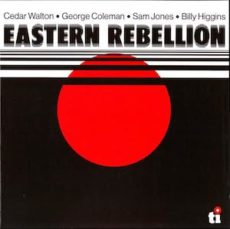
This morning’s subject submitted for your examination was released in 1976 by a quartet who had been playing together for a year before recording their first collaborative album. Eastern Rebellion (Timeless Records SJP 101) is the record that launched the Netherlands label, and also marked the first-time pianist Cedar Walton doubled as a producer. The group is a first-rate ensemble featuring George Coleman on tenor sax, Sam Jones on bass, and Billy Higgins on drums. 2021 marked the 45th Anniversary of its debut, so to commemorate this event, Music on Vinyl launched the Timeless Jazz 45th Anniversary Series. My copy used in this report is their 2022 European Stereo Audiophile reissue (Music on Vinyl MOVLP2950).
The album opener, Bolivia by Cedar Walton begins with the trio’s infectious introduction that gets the listener’s foot moving immediately, setting up the quartet’s spirited theme with Coleman leading the charge. George is up first, taking no prisoners with a heated performance. Cedar tackles the second interpretation exuberantly. Sam keeps it going with a joyful finale preceding the quartet’s conclusion. Naima by John Coltrane starts with a sparkling example of sensitivity and delicacy by Walton that shifts upward for Coleman’s melody. The saxophonist leads off with a radiantly beautiful presentation, followed by Walton who answers with a tenderly passionate interpretation leading to the group’s gorgeous finale.
5/4 Thing by George Coleman starts Side Two with the tenor’s warm introduction that softly evolves to the quartet’s collective melody. George takes the lead and dazzles on the opening statement, then Cedar excels with meticulous strokes on the second solo. Billy wraps up everything in splendid style before Coleman takes the group gently out. Bittersweet by Sam Jones offers everyone solo space and is anything but. Jones begins this cheery, uptempo tune with an enthusiastic exercise. Coleman keeps the tension up with an energetic reading that bounces off the rhythm section effectively. Walton gets a good thing going in the next performance and Higgins provides a perfect summation culminating with the theme’s reprise and an abrupt stop.
Cedar Walton’s Mode For Joe is dedicated to Joe Henderson and was the title tune of the saxophonist’s 1966 album which Cedar played on as well. The quartet begins the melody, then Cedar shines like a beacon on the opening statement. Billy gives a delightful solo next, followed by George who moves with agility. Jones’ bass is the exclamation point before the quartet’s lively exit. Elvin Campbell was the recording engineer for Eastern Rebellion. This audiophile reissue was pressed on 180-gram silver vinyl and is incredibly quiet until the music begins. It’s also an excellent-sounding album that fills your listening room with superb definition. If you’re in the mood for swinging jazz and tight musicianship, I invite you to check out Eastern Rebellion, the next time you go vinyl shopping. It’s an engaging set by Cedar Walton, George Coleman, Sam Jones, and Billy Higgins that’s worth every penny for a spot in your library!
~ Mode For Joe (Blue Note BLP 4227/BST 84227) – Source: Discogs.com © 2022 by Edward Thomas Carter
More Posts: choice,classic,collectible,collector,history,instrumental,jazz,music,piano
The Quarantined Jazz Voyager
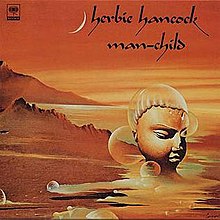
This week the ever vigilant Jazz Voyager is watching this new version of the virus creeping back to once again exploit humanity’s complacency relative to the collective health. People are still dying, maybe not at the rate over the past two years but dying. So in the spirit of staying healthy, I am selecting a classic funk~fusion album from the shelves and placing it on the turntable to take a renewed listen. This week it is the album Man-Child by Herbie Hankcock.
It is the fifteenth studio album by the jazz pianist. Recorded between 1974 and 1975, it was released on August 22, 1975 by Columbia Records, it was the final studio album to feature The Headhunters. The album was produced by David Rubinson and Hancock, and was recorded at Wally Heider Studios and Funky Features in San Francisco, California as well as Village Recorders and Crystal Studios in Los Angeles, California.
Departing from the music of his early career, Herbie gives us one of his most funk-influenced albums. Utilizing more funk based rhythms around the hi-hat, and snare drum, the tracks are characterized by short, repeated riffs by both the rhythm section, horns accompaniment, and bass lines. With less improvisation, more repetition of riffs along with brief solos, he re-introduces the electric guitar to this new sound.
The core group of The Headhunters was Paul Jackson, Bill Summers, Harvey Mason, Bennie Maupin, and Mike Clark (who replaced Harvey Mason post-1974). Hancock had toured and recorded with them for the previous three years. This was their final album as a group.
Tracks | 45:17- Hang Up your Hang Ups (Hancock, Melvin Ragin, Paul Jackson) ~ 7:29
- Sun Touch ~ 5:12
- The Traitor (Hancock, Ragin, Louis Johnson, Wayne Shorter) ~ 9:38
- Bubbles (Hancock, Ragin) ~ 9:03
- Steppin’ In It ~ 8:42
- Heartbeat (Hancock, Ragin, Jackson) ~ 5.16
- Herbie Hancock ~ piano, keyboards
- Bud Brisbois ~ trumpet
- Jay DaVersa ~ trumpet
- Garnett Brown ~ trombone
- Dick Hyde ~ trombone, tuba
- Wayne Shorter ~ alto and soprano saxophones
- Bennie Maupin ~ soprano and tenor saxophones, bass clarinet, alto and bass flutes, saxello, percussion
- Jim Horn ~ flute, saxophone
- Ernie Watts ~ flute, saxophone
- Dewayne McKnight, David T. Walker ~ guitar
- Wah Wah Watson ~ synthesizer, voice bag, guitar
- Henry E. Davis ~ bass guitar
- Paul Jackson ~ bass guitar
- Louis Johnson ~ bass guitar
- Mike Clark ~ drums
- James Gadson ~ drums
- Harvey Mason ~ drums
- Stevie Wonder ~ harmonica
- Bill Summers ~ percussion
More Posts: adventure,album,club,genius,jazz,museum,music,piano,preserving,restaurant,travel
Requisites
The Great Jazz Trio At The Village Vanguard | By Eddie Carter
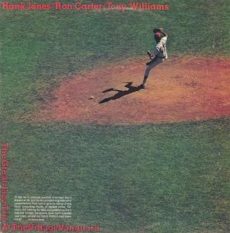
This morning’s subject submitted for your consideration is a recent addition to the library by one of the quintessential small groups in jazz. The Great Jazz Trio At The Village Vanguard (East Wind EW-8053) is the first of three live albums by Hank Jones on piano, Ron Carter on bass, and Tony Williams on drums recorded over two nights at the venue in 1977. My copy used in this report is the 1978 US Stereo release (Inner City Records IC 6013).
Side One starts the set with a speedy rendition of Moose The Mooche by Charlie Parker. The trio takes off on a lively opening chorus, succeeded by Hank who accelerates quickly on the first solo. Tony takes over for the closing statement with a fierce attack of intense heat preceding the trio’s swift climax.
Up next is Naima, John Coltrane’s beautiful ballad named for his first wife. The trio’s rendition begins with a delicately graceful piano introduction segueing into a breathtaking collective theme. Jones opens the first solo luxuriously, gaining momentum into an enticing ending. Carter displays his abundant skills on a delightful finale complemented by Williams’ gentle brushwork leading to a warm, expressive exit.
Side Two gets underway with a pretty tune by Claus Ogerman, Favors. The ensemble begins with an easygoing midtempo opening chorus. Hank is up first and lets his ideas unfold at a leisurely pace. Ron follows with a relaxing message on the second solo, then Hank and Tony share a carefree conversation leading to the ensemble’s theme reprise and soft close.
The set closes with a blues by Ron Carter, 12 + 12. After the ensemble’s happy melody, Jones kicks off the solos with an utterly joyful performance. Carter also says plenty on an impressively buoyant statement, followed by Williams who speaks last in an exchange with Jones into the theme’s reprise and Tony’s introductions of the group. The album was produced by Kiyoshi Itoh and Yasohachi Itoh. Co-Producer David Baker also was the recording engineer. He’s done a phenomenal job because the sound quality is splendid with an exquisite soundstage placing the listener’s sweet spot in the crowd as the trio’s performing. The only issue is a small typo appearing on the back cover and the Side Two record label of both the Japanese and US releases, Claus Ogerman’s name is mispronounced.
Hank Jones was regarded by critics and fans alike as one of the most gifted musicians in jazz with an extensive discography and a career lasting sixty-six years including thirty-six as a member of The Great Jazz Trio. He passed away on May 16, 2010, at age ninety-one. Ron Carter is a living legend and the most recorded jazz bassist in history. He also plays the cello, is still performing and recording, and just celebrated his eighty-fifth birthday. Tony Williams was one of the best drummers in jazz and for five years provided the power behind The Miles Davis Quintet. He passed away at age fifty-one on February 23, 1997; but leaves a lasting legacy of music as a leader and sideman. If you enjoy live jazz and are a fan of these great musicians, I invite you to check out The Great Jazz Trio At The Village Vanguard. It’s a terrific jazz album with superb performances that is sure to please novice and seasoned jazz fans alike!
~ The Great Jazz Trio At The Village Vanguard, Volume 2 (East Wind EW-8055), ~ The Great Jazz Trio At The Village Vanguard Again (East Wind UCCJ-4001) – Source: Discogs.com ~ Naima – Source: JazzStandards.com ~ Moose The Mooche – Source: Wikipedia.org © 2022 by Edward Thomas Carter
More Posts: bass,choice,classic,collectible,collector,drums,history,instrumental,jazz,music,piano