

Three Wishes
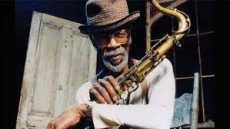
Joe Henderson and the Baroness was having a conversation when she inquired what his three wishes would be if granting them was possible and he replied:
- “I wish there would be one that would cover all three. I mean, something very crazy and earthy. I’ve got it! That love would be paramount to everything – possibly except food. That’s it! That’s the only way I can get it together, Nica: love, love, love!”
*Excerpt from Three Wishes: An Intimate Look at Jazz Greats ~ Compiled and Photographed by Pannonica de Koenigswarter

More Posts: baroness,history,instrumental,jazz,music,pannonica,saxophone,three,wishes
Daily Dose Of Jazz…
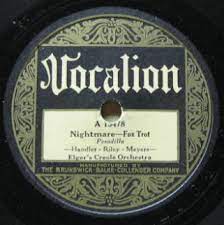
Charles Anthony Elgar was born on June 13, 1879 in New Orleans, Louisiana on June 13, 1879. From age 5 he played violin and also played trumpet. He studied music in Wisconsin and Illinois.
Elgar played in Chicago, Illinois from 1903 with the Bloom Theater Philharmonic Orchestra, but returned to his hometown late in the decade of the 1900s. He remained there until about 1913 when he returned to Chicago, putting together a band the same year. His band played at the Navy Pier Ballroom, Hattie Harmon’s Dreamland Ballroom from 1917 until 1922 and opened the old Savoy Ballroom in 1928.
With his band Charles toured in the revue Plantation Days and traveled to London, England though he did not accompany it on this trip. However, he did play with Will Marion Cook’s Orchestra in Europe. He went on to lead bands in Milwaukee, Wisconsin from 1925 to 1928, making several recordings with Elgars Creole Orchestra that he led at the Wisconsin Roof Gardens in Milwaukee and again in Chicago, 1926-30.
His sidemen included Manuel Perez, Lorenzo Tio, Louis Cottrell, Jr, Barney Bigard, Darnell Howard, and Omer Simeon. He made four recordings as leader of the Creole Orchestra. He concentrated on teaching in the 1930s, and worked as a union official later in his life. He was a founder and charter member of the local branch of the American Federation of Musicians, AFL-CIO, Local 2018.
Violinist, teacher and jazz bandleader Charles Elgar transitioned in August 1973 in Chicago.

More Posts: bandleader,educator,history,instrumental,jazz,music,violin
Daily Dose Of Jazz…
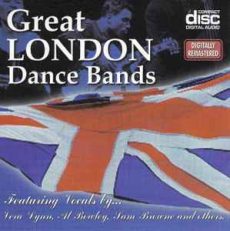
Don Barrigo was born on June 12, 1906 in London, England. A competent tenor saxophonist, he was active in his hometown and New York City, New York in the 1920s and 30s.
Among the artists with whom Don played and sometimes recorded were Joe Venuti and Eddie Lang. In the UK he played with Nat Gonella, Harry and Sid Roy, Billy Mayerl, Al Bowlly, Percival Mackey, Bert Bowen, Howard Jacobs and the Freddy Schweitzer Band. In the States he played with Don Parker and Louis Armstrong, and in France with Serge Glykson.
By 1940 he was a member of Maurice Winnick’s dance band alongside fellow sideman Ted Heath. Tenor saxophonist Don Barrigo transitioned on May 4, 1977.
More Posts: history,instrumental,jazz,music,saxophone
Requisites
Steppin’ Out ~ Harold Vick | By Eddie Carter
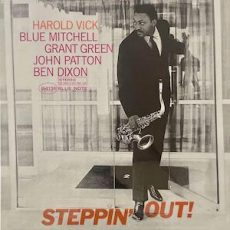
One of the joys of jazz collecting is seeing favorite LPs surface again in the wild and as audiophile albums. This morning’s discussion is a welcome reissue by Harold Vick. Steppin’ Out (Blue Note BLP 4138/BST 84138) was the tenor saxophonist’s debut album and the only one he made for the label as a leader. It was recorded in 1963 and released the same year. For his first effort, Harold’s joined by Blue Mitchell on trumpet, John Patton on organ, Grant Green on guitar, and Ben Dixon on drums. I first heard him on Oh Baby! Patton’s 1965 release with the same lineup. My copy is the 2022 Blue Note Tone Poet Series Stereo audiophile reissue sharing the original catalog number.
Our Miss Brooks is the first of five originals by the leader. It starts with the quintet’s finger-snapping, toe-tapping melody. Harold serves up the first slice of this soulful song; next, the group makes a short bridge into Grant’s tasteful reading. The second bridge leads to John mining a vein of bluesy riches in the finale ahead of the ensemble’s close. Trimmed In Blue steps up the pace for the quintet’s theme. Vick starts the solos with a spirited interpretation, then Mitchell comes behind him to give an exuberant reading. Green replies with a sparkling statement, followed by Patton’s zesty bounce leading to the theme’s reprise.
Laura, by David Raskin and Johnny Mercer, became a jazz standard as the title tune of the 1944 film noir. Blue sits out for the quartet’s hauntingly dreamlike melody. Harold makes a profound impression in the song’s only solo with nostalgic romanticism over the rhythm section’s subtle support into a gorgeous ending. Dotty’s Dream opens Side Two with the quintet in a swinging groove from the opening chorus. Vick gets down to business first, then Mitchell enters for a lively romp. Green responds with a vibrant reading, and Patton’s closing remarks are fueled with comments from both horns into the climax.
The quintet takes a relaxing trip to Vicksville next. The ensemble’s easy-swinging theme starts this comfortable ride into Blue’s smooth-sailing opening statement. Grant builds a perfect solo from simple ideas next. Harold strolls into an exquisite interpretation; then, John concludes with a carefree comment before the closing chorus fades out. The title tune, Steppin’ Out, moves the beat upward for the ensemble’s invigorating melody. Vick lets the listener know they’re in for a treat on the opening statement; then Green follows with an excellent solo. Mitchell comes in for a cheerful reading next, and Patton winds up the session in a festive finale preceding the theme’s return.
Alfred Lion produced the initial session of Steppin’ Out. Rudy Van Gelder was the recording engineer behind the dials. Joe Harley supervised the audiophile reissue, and Kevin Gray mastered it at Cohearent Audio. The front and rear covers are high gloss and gorgeous, with session gatefold photos worthy of hanging in your listening room. The record is pressed on 180-gram audiophile vinyl. The sound quality is quite good despite a bit of harmonic distortion from John Patton’s organ microphone placement as he’s supporting the other musicians. It’s particularly noticeable on Vicksville and Steppin’ Out.
Don’t let that dissuade you from checking out this album on your next vinyl treasure hunt. Steppin’ Out is a solid debut and a great introduction to this underrated, talented tenor saxophonist with wonderful performances by Grant Green, Blue Mitchell, John Patton, and Ben Dixon, keeping the beat efficiently! If you enjoy soulful jazz from the tenor sax with a double dose of the Blues and Hard-Bop, I offer for your consideration, Steppin’ Out by Harold Vick. It’s just right for an evening listening session with your favorite drink in hand!
~ Oh Baby! (Blue Note BLP 4192/BST 84192) – Source: Discogs.com ~ Laura – Source: JazzStandards.com © 2023 by Edward Thomas Carter
More Posts: choice,classic,collectible,collector,history,instrumental,jazz,music,saxophone
Daily Dose Of Jazz…
Joseph “Kaiser” Marshall was born on June 11, 1902 in Savannah, Georgia and was raised in Boston, Massachusetts. There he studied under George L. Stone, and played with Charlie Dixon before moving to New York City, New York in the early 1920s. After playing with violinist Shrimp Jones, he joined Fletcher Henderson’s band at the Club Alabam, remaining in Henderson’s retinue from 1922 until 1929.
He played with many noted jazz artists in the 1930s and 1940s, including Duke Ellington, Cab Calloway, Art Hodes, Wild Bill Davison, Sidney Bechet, Bunk Johnson, and Mezz Mezzrow. He also recorded with Louis Armstrong in the late 1920s, being the drummer on Armstrong’s 1929 recording of Knockin’ a Jug.
Between 1928-1930, he recorded with Benny Carter, Fats Waller and Coleman Hawkins in McKinney’s Cotton Pickers. Shortly after Kaiser recorded with the Four Bales of Hay, featuring Wingy Manone, Dickie Wells, Artie Shaw, Bud Freeman, Frank Victor, John Kirby and either Teddy Wilson or Jelly Roll Morton.
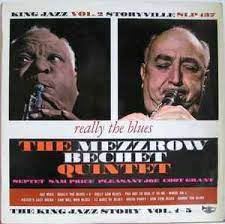
He went on to record as a member of the Mezzrow-Bechet Quintet featuring Sidney Bechet, Mezzrow, Fitz Weston, and Pops Foster. Drummer Kaiser Marshall transitioned on January 2, 1948 in New York City, New York.
More Posts: drums,history,instrumental,jazz,music