

Requisites
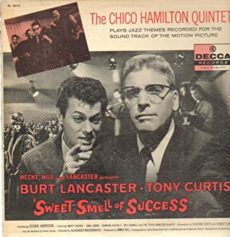
With Sweet Smell Of Success drummer Chico Hamilton got his first brush (no pun intended) with Hollywood in 1957. Riding high on the popularity of his adventurous quintet of the time – reed/flutist Paul Horn, bassist Carson Smith, cellist Fred Katz, guitarist John Pisano, he and the band were cast in the film after being watched around the country for six months to insure they were drug free, on the heels of Gerry Mulligan’s recent release from jail on similar charges.
This gritty black-and-white film about a ruthless Walter Winchell-style, New York City tabloid-gossip columnist, J.J. Hunsecker, played by a dour Burt Lancaster, who wields his power like a club from Club 21. The plot of this sharp-edged media satire thickens when J.J.’s younger sister, played by Susan Harrison, begins dating the clean-cut young jazz guitarist in the Chico Hamilton Quintet, Steve Dallas, played by Martin Milner. Tony Curtis turns in a brilliant performance as the unctuous Broadway press agent Sidney Falco, who would sell his own mother to get an item in J.J.’s column. It’s your basic “guitarist finds girl, guitarist loses girl, guitarist loses gig but ends up with girl” story.
The music composed by Elmer Bernstein, Fred Katz and Chico Hamilton and performed by Elmer Bernstein Orchestra and the Chico Hamilton Quintet. The personnel in the group are Chico Hamilton – drums, Paul Horn – tenor saxophone, alto saxophone, flute, clarinet, Fred Katz – cello, John Pisano – guitar and Carson Smith on bass. They appear on the soundtrack on compositions by Hamilton and Katz: Hot Dogs and Juice (Goodbye Baby), Hunsecker Operates (Goodbye Baby), Goodbye Baby Blues and Love Scene (Susan – The Sage).
The group also performed Jazz Themes composed by Hamilton and Katz: Goodbye Baby, Cheek to Chico, Susan (The Sage), Sidney’s Theme, Jam, Night Beat and Concerto of Jazz Themes from the Soundtrack of “Sweet Smell of Success.

More Posts: collectible,drums
Daily Dose Of Jazz…
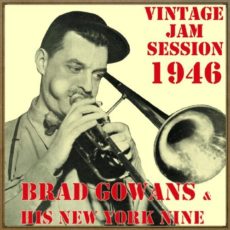
Brad Gowans was born Arthur Bradford Gowans on December 3, 1903 in Billerica, Massachusetts. His earliest work was on the Dixieland jazz scene, playing with the Rhapsody Makers Band, Tommy DeRosa’s New Orleans Jazz Band, and Perley Breed. In 1926 he played cornet with Joe Venuti, and worked later in the decade with Red Nichols, Jimmy Durante, Mal Hallett and Bert Lown. Leaving music for several years during the Great Depression, he returned to play with Bobby Hackett in 1936, then Frank Ward, Wingy Manone, Joe Marsala, and Bud Freeman’s Summa Cum Laude Band by 1940.
Moving to New York City early in the 1940s, Brad played regularly at Nick’s in Greenwich Village and worked with Ray McKinley and Art Hodes. As a clarinetist, he played in the reconstituted Original Dixieland Jazz Band’s 1940s recordings. He stopped playing again briefly in the mid-1940s, then returned to play with Max Kaminsky, Jimmy Dorsey, and Nappy Lamare.
Aside from his playing, Gowans also arranged pieces for Bud Freeman and Lee Wiley, and invented the valide trombone, a hybrid slide-valve trombone which never caught on. He recorded a few times as a leader in 1926, 1927, and 1934, and recorded Brad Gowans and His New York Nine for Victor Records in 1946.
He went on to freelance on the West Coast and collapsed on stage in 1954 while playing with Eddie Skrivanek. Trombonist and reedist Brad Gowans passed eight months later on September 8, 1954 in Los Angeles, California.

Daily Dose Of Jazz…
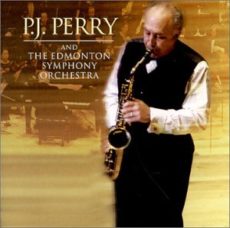
P. J. Perry CM was born Paul John Guloien to saxophonist Paul Guloien, who performed under the name Paul Perry and Margaret Yeo, on December 2, 1941 in Calgary, Alberta, Canada. Early in life they moved around Canada between Medicine Hat, Regina, Sylvan Lake and Vancouver. He learned to play the clarinet and piano before becoming a saxophonist for his father’s band when he was 14.
Spending most of his time in Canada, as a young man, Perry played at Sylvan Lake and in various Vancouver night clubs. Her recorded and released his debut album My Ideal on the Unity label in 1989, following with his sophomore project Worth Waiting For on Jazz Alliance. He has gone on to record for Unity/Page, Cellar Live, Royalty record labels, and for Justin Time Records he has twice recorded with the Edmonton Symphony Orchestra.
He has received several accolades and honors among others, two Juno awards, an honorary doctorate of law from the University of Alberta and is a member of the Order of Canada. Alto saxophonist P. J. Perry continues to perform, record and tour.
More Posts: saxophone
Daily Dose Of Jazz…
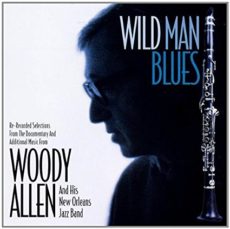
Heywood Allen was born Allan Stewart Konigsberg on December 1, 1935 in Brooklyn, New York. He began playing the clarinet as a child and took his stage name from clarinetist Woody Herman. He has performed publicly at least since the late 1960s, notably with the Preservation Hall Jazz Band on the soundtrack of Sleeper. One of his earliest televised performances was on The Dick Cavett Show on October 20, 1971.
Woody Allen and his New Orleans Jazz Band have been playing each Monday evening since 2011 at Manhattan’s Carlyle Hotel, specializing in classic New Orleans jazz from the early twentieth century. He plays songs by Sidney Bechet, George Lewis, Johnny Dodds, Jimmie Noone and Louis Armstrong.
The documentary film Wild Man Blues directed by Barbara Kopple documents a 1996 European tour by Allen and his band, as well as his relationship with Previn. The band has released two CDs: The Bunk Project in 1993 and the soundtrack of Wild Man Blues in 1997. Allen and his band played the Montreal International Jazz Festival on two consecutive nights in June 2008. At 81, clarinetist Woody Allen continues to perform with his band when not writing scripts or directing and acting in films.

More Posts: clarinet
Daily Dose Of Jazz…
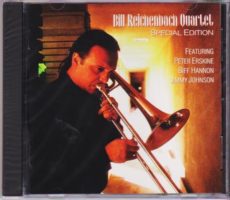
William Frank Reichenbach Jr. was born November 30, 1949 in Takoma Park, Maryland, the son of Bill Reichenbach, drummer for Charlie Byrd. He began playing in high school bands in the Washington, D.C. area, sat in with his father’s group, and played with Milt Jackson, Zoot Sims, and others.
Reichenbach went on to study at the Eastman School of Music and after graduating joined the Buddy Rich band. He would also work in the Toshiko Akiyoshi – Lew Tabackin Big Band in Los Angeles, California during the mid to late Seventies. After that move to the West Coast, he became known for music for television and film.
Not limiting himself to jazz, Bill played trombone on The Wiz and, with the Seawind Horns including Jerry Hey on Michael Jackson’s albums Off the Wall, Thriller, and HIStory. He was also the composer for Cartoon All-Stars to the Rescue.
Trombonist and composer Bill Reichenbach is best known in jazz circles as a session musician for television, films, cartoons, and commercials. He recorded a solo album, Special Edition, where he is featured on tenor as well as bass trombone. He continues to compose, record and perform.
More Posts: trombone