

Daily Dose Of Jazz…
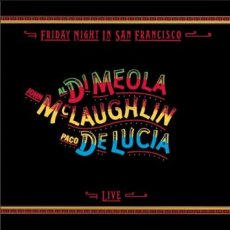
Paco de Lucía was born Francisco Sánchez Gómez in Algeciras, Cadiz, Spain on December 21, 1947. His father introduced him to the guitar at a very young age and was extremely strict in his upbringing, forcing him to practice up to 12 hours a day, every day. Combined with natural talent, he soon excelled and in 1958, at age 11, he made his first public appearance on Radio Algeciras. A year later he was awarded a special prize in the Jerez flamenco competition.
At age 14 Paco was touring with the flamenco troupe of dancer Jose Greco and in 1964 he recorded the first of three albums with guitarist Ricardo Modrego. From 1968 to 1977 he would record 10 albums with flamenco singer Camaron de la Isla.
In 1979, de Lucía along with John McLaughlin and Larry Coryell formed The Guitar Trio, briefly toured Europe and released Meeting of the Spirits, a video recorded at London’s Royal Albert Hall. Al Di Meola later replaced Coryell and since 1981 the trio has recorded three albums.
Over the course of his career, Paco De Lucia, considered one of the finest guitarist in the world, has appeared in the western film Hannie Caulder, recorded on the soundtrack of Don Juan DeMarco, led his own sextet with brothers Ramón and Pepe, continues to record jazz, classical and flamenco albums, has won the Prince of Austrias Award, and has been awarded doctorates from the University of Cadiz and Berklee College of Music. On February 25, 2014 he passed away of a heart attack at age 66 in Playa de Carmen, Mexico. He was posthumously award a Latin Grammy for Album of the Year for his album Canción Andaluza the same year.

Inspire A Young Mind
More Posts: guitar
Hollywood On 52nd Street
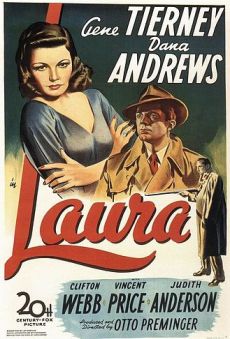
Laura is a jazz standard written for the 1944 American film noir produced and directed by Otto Preminger. The theme song was composed by Johnny Mercer nd David Raksin. The movie starred Gene Tierney, Dana Andrews and Clifton Webb with supporting cast comprised of Vincent Price, and Judith Anderson.
The Story: New York City police detective Mark McPherson (played by Andrews) is investigating the murder of beautiful and highly successful advertising executive, Laura Hunt (Tierney). A series of interviews leads McPherson to the people in Laura’s life – decadent newspaper columnist Waldo Lydecker (Webb), parasitic playboy fiancé, Shelby Carpenter (Price) and her aunt Ann Treadwell (Anderson) who has been carrying on with Carpenter and giving him money. Through the ensuing investigation McPherson falls in love with the dead woman’s image only to discover that she is alive and that another girl was murdered. He now only has to learn the identity of the murderer in order to save Laura.
Sponsored By

www.whatissuitetabu.com
Daily Dose Of Jazz…
George V. Johnson Jr. was born on December 20, 1950 in Washington, D.C. Self taught, he was first exposed to music by singing and participating regular with church and school choirs while listening and emulating records played by his parents. He attended Prince George’s Community College then went on to matriculate through Howard University School of Fine Arts.
A composer, George writes lyrics about complex things: personal experiences, love, history, family, home, heaven and jazz. Phrases turn, emotions connect and melodies soar with his natural gift of writing lyrics and poetry. Meeting pianist John Malachi was fortuitous as he helped shape and guide Johnson’s career over the next 15 years.
He met a major influence, Eddie Jefferson, and performed or recorded with Lou Donaldson and James Moody, has performed at numerous jazz festivals and tributes, played various nightclubs and toured Europe. He has penned lyrics to more than 40 Hank Mobley compositions as part of the Second Floor Music project that has single handedly kept vocalese alive.
Over a 35 year career, vocalist, lyricist, actor, playwright, producer, promoter, composer George Johnson has played with legendary jazz musicians and vocalists such as Lou Donaldson, Dr. Lonnie Smith, Shirley Horn, Dizzy Gillespie, John Hicks, Billy Higgins, Rufus Reid, Max Roach, Philly Joe Jones, Tony Williams, Kurt Lightsey and the list continues. He continues to perform, and record.
Give A Gift Of Jazz – Share
More Posts: vocal
Daily Dose Of Jazz…
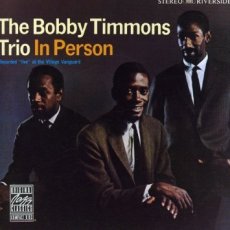
Bobby Timmons was born Robert Henry Timmons on December 19, 1935 in Philadelphia, Pennsylvania. Studying piano from the age of six by the age of 19 he was moving to New York, playing with the likes of Kenny Dorham’s Jazz Prophets, Chet Baker, Sonny Stitt and Maynard Ferguson. He became a member of Art Blakey’s Jazz Messengers from 58-59 touring Europe and became well known for his composition “Moanin”.
He joined Cannonball Adderley for a year, recorded two soul-jazz compositions that became hits “This Here” and “Dat Dere” and rejoined Blakey for a brief stint in the Sixties. Over the course of his career he recorded some 16 albums for Riverside, Milestone and Prestige record labels and recorded another twenty-three as a sideman with Art Blakey, Hank Mobley, Lee Morgan, Donald Byrd, Curtis Fuller, Nat Adderley, Kenny Burrell and the Young Lions.
However sophisticated and versatile a pianist he proved to be, Timmons’ success of his compositions, which have become jazz standards, could not compensate for his artistic frustrations and his battle with alcoholism. Pianist and composer Bobby Timmons passed away from cirrhosis at the age of 38 on March 1, 1974.
Jazz Is Global – Share
More Posts: piano,vibraphone
Daily Dose Of Jazz…
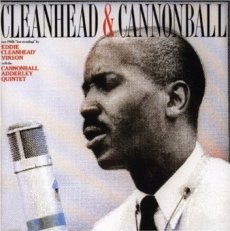
Eddie “Cleanhead” Vinson was born on December 18, 1917 in Houston, Texas and took up the alto saxophone in his youth. By the late 30s he joined Milton Larkin’s Orchestra and at various times sat next to Arnett Cobb, Illinois Jacquet, Cedric Haywood and Wild Bill Davis.
Exiting Larkin’s employment in 1941, Vinson picked up a few vocal tricks while touring with bluesman Big Bill Broonzy, moved to New York City joining and recording with Cootie Williams, and then struck out on his own in 1945, Eddie formed his own large band that performed, recorded and toured over the next ten years.
He signed with Mercury Records, and enjoying a double-sided hit in 1947 with his R&B chart-topper “Old Maid Boogie”, and the song that would prove to be his signature number, “Kidney Stew Blues”.
Vinson leaned towards jazz during the early 50s when his band included John Coltrane. In the early 1960s he moved to Los Angeles working with Johnny Otis and by the late 60s he was touring in a strict jazz capacity with Jay McShann and his career took an upswing. A 1970 appearance at the Monterey Jazz Festival with Otis spurred a bit of a comeback for Vinson and throughout the decade worked high-profile blues and jazz sessions for Count Basie, Johnny Otis, Roomful of Blues, Arnett Cobb and Buddy Tate.
During this period he also composed steadily, including “Tune Up” and “Four”, both of which have been incorrectly attributed to Miles Davis. Vinson recorded extensively during his fifty-odd year career and performed regularly in Europe and the United States.
Jump blues, R&B, jazz and bebop alto saxophonist Eddie “Cleanhead” Vinson, whose nickname came from a hair straightening incident in which the lye destroyed his hair, passed away on July 2, 1988 from a heart attack whilst undergoing chemotherapy in Los Angles, California.
Put A Dose In Your Pocket