

Daily Dose Of Jazz…
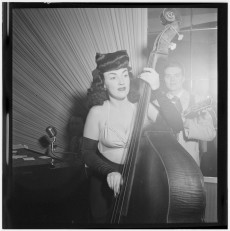
Bonnie Wetzel was born Bonnie Jean Addleman on May 15, 1926 in Vancouver, Washington. She learned violin as a child and was an autodidact on bass.
She played with Ada Leonard in an all-female ensemble and soon after worked in a trio with Marian Grange. Bonnie married trumpeter Ray Wetzel in 1949 and the pair worked in the Tommy Dorsey Orchestra in 1951.
Wetzel played in the Beryl Booker Trio with Elaine Leighton in 1953. They toured Europe in 1953-54 and recorded for Discovery Records. She also played with Herb Ellis, Charlie Shavers, Roy Eldridge and Don Byas. During the 1950s she freelanced in New York City. Double-bassist Bonnie Wetzel, who never led a recording session in her short career, passed away on February 12, 1965, at the age of 38.

Take A Dose On The Road

More Posts: bass
Daily Dose Of Jazz…
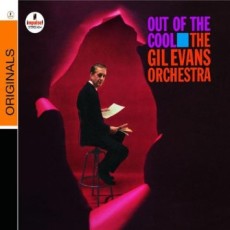
Gil Evans came into this world on May 13, 1912 in Toronto, Ontario, Canada as Ian Ernest Gilmore Green. His name was changed to his stepfather’s Evans early in his life. His family moved to Stockton, California where he spent most of his youth.
Between 1941 and 1948, Evans worked as an arranger for the Claude Thornhill Orchestra. His basement apartment behind a New York City Chinese laundry became a meeting place for musicians looking to develop new musical styles outside of the dominant bebop style of the day that included the leading bebop performer Charlie Parker, Gerry Mulligan and John Carisi.
In 1948, Gil collaborated with Miles Davis, Mulligan and others to create a nonet utilizing French horns and tubas keeping the big sound with less cost. The Davis-led group was booked for a week at the Royal Roost as an intermission group on the bill with the Count Basie Orchestra. Subsequently, Capitol Records recorded 12 numbers at three sessions in 1949 and 1950 that were reissued on the 1957 Miles Davis LP titled Birth Of The Cool. He was also instrumental in contributing behind the scenes to Davis’ classic quintet albums of the 1960s.
From 1957 onwards Evans recorded albums under his own name. He brought tubist Bill Barber, trumpeter Louis Mucci along with im and featured soloists Lee Konitz, Jimmy Cleveland, Steve Lacy, Johnny Coles and Cannonball Adderley. By 1965 he was arranging the big band tracks on Kenny Burrell’s Guitar Forms album.
Evans’ influence by Latin, Brazilian and Spanish composers Manuel de Falla and Joaquin Rodrigo as well as German expat Kurt Weill led him to create arrangements that included two basses, using Richard Davis, Paul Chambers, Ron Carter, Ben Tucker and Milt Hinton on many of his recordings. He was prolific in his recording until he became discouraged by the commercial direction Verve Records was taking with his arrangements for Astrud Gilberto’s Look To The Rainbow, causing him to take a hiatus from music.
During this period he began listening to Jimi Hendrix at the suggestion of his wife. He became interested in scoring the music of the rock guitarist, put together another orchestra in the Seventies and began working with in the free jazz and jazz rock idioms. He eventually released an album of arrangements of Hendrix’s music with John Abercrombie and RyoKawasaki and his ensembles featured electric guitars and basses, like that of Jaco Pastorious, from that date forward.
He would go on to release Where Flamingos Fly in 1981 with Coles, Harry Lookofsky, Richard Davis and Jimmy Knepper, Howard Johnson, Don Preston and Billy Harper. He created his Monday Night Orchestra in 1983 that became a staple for five years at Sweet Basil Jazz Club in Greenwich Village. Members of the band were Lew Soloff, Hiram Bullock, David Sanborn, Mark Eagan and Tom “Bones” Malone and Gil Goldstein among others. He recorded a big band album of The Police songs with Sting collaborating with apprentice arranger Maria Schneider.
Gil won two Grammy awards, has four films to his credit and was inducted into the Down Beat Jazz Hall of Fame in 1986. He ha a catalogue of eighteen studio albums, 16 live albums, arranged fifteen albums for Miles Davis, Hal McKusick, Helen Merrill, Johnny Mathis, Macy Lutes, Don Elliott, Astrud Gilberto and Kenny Burrell.
Pianist, composer, arranger and bandleader Gil Evans, who played an important part in the development of cool, modal, free and fusion styles of jazz, passed away of peritonitis in Cuernavaca, Mexico at the age of 75 on March 20, 1988.
Put A Dose In Your Pocket
More Posts: piano
Daily Dose Of Jazz…
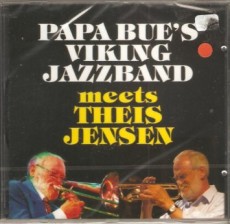
Papa Bue Jensen was born Arne Bue Jensen on May 8, 1930 in Copenhagen, Denmark, At an early age, he became fascinated with jazz, prompted by records from his brother with Harry James, Arte Shaw, Tommy Dorsey, Glenn Miller, Bert Ambrose, Bunk John and George Lewis in the stack.
After World War II, Jensen became a sailor for a few years, visiting ports all around the world, where he had an opportunity to listen to enjoy their music venues. It was around this time that he started to play jazz. He borrowed money to by a slide trombone, was taught the seven basic positions of the slide by a Royal Danish Orchestra musician, and the rest he taught himself. Soon he was playing with other young jazz musicians, performing in clubs and bars around Copenhagen.
He played in the Royal Jazzman band, that later became the Bohana Jazz Band, Henrik Johansen’s Jazz Band and recorded as a sideman with the Saint Peter Street Stompers in the 1950s. Papa Bue also worked with the Bonanza Jazz Band, Chris Barber, Adrian Bentzon and Johansen. During this period of his career he was immersed in the Nyhavn music scene jamming with other young jazz musicians. In 1956 he founded and led the New Orleans Jazz Band, and was given the nickname Papa Bue as he was the on father in the group.
In late 1957, after an article by Shel Silverstein was published in which he referred to them as the Danish Vikings, Jensen renamed the ensemble the Viking Jazz Band. They released their first album in 1958 and their sophomore project Schlafe Mein Prinzchen released in 1960, sold over one million copies, garnering them gold status.
Though bebop was in at the time he remained in the Dixieland style, but was influenced by early swing and is considered one of the most significant proponents of his genre. The group remained active into the 1990s, recording and/or performing with George Lewis, Champion Jack Dupree, Art Hodes, Wild Bill Davison, Wingy Manone, Edmond Hall, Albert Nicholas, Earl Hines, Stuff Smith and Ben Webster.
Papa Bue’s Viking Jazz Band recorded Bent Fabricius-Bjerre’s theme music for the Olsen Gang series, and was awarded the Golden Keys To The City in 1969 after performing at the 1969 New Orleans Jazz Festival. In 1989 he was awarded the Ben Webster Prize of Honor.
Trombonist Papa Bue Jensen, who released a large number of albums on Storyville, timeless and Music Mecca record labels though few are in print, passed away on November 2, 2011, at the age of 81.
Dose A Day-Blues Away
More Posts: trombone
Daily Dose Of Jazz…
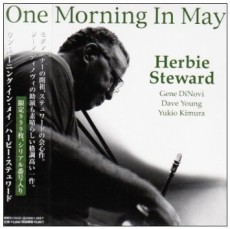
Herbie Steward was born Herbert Bickford Steward on May 7, 1926 in Los Angeles, California. He was widely known for being one of the tenor saxophones in the Four Brothers, alongside Stan Getz, Zoot Sims and Serge Chaloff in Woody Herman’s Second Herd.
Having a nice tone, Steward interacted well and was an above-average soloist. He also played alto saxophone, soprano saxophone and clarinet and was active from the 1940s to the Sixties and played in the swing and big band jazz genres. During his active years he recorded or performed with Earle Spencer, Smith Dobson, Tecumseh “Tee” Carson, Eddie Duran, John Mosher, Eddie Moore, Gene DiNovi, Sir Charles Thompson, David Young, Yukio Kimura, Kohnosuke Saijoh, Al Cohn, Stan Kenton, Chaloff and Sims.
Tenor saxophonist Herbie Steward, who has only a few albums as a leader in print at present, passed away on August 9, 2003 in Clearlake, California.
Take A Dose On The Road
More Posts: saxophone
Daily Dose Of Jazz…
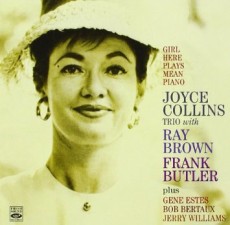
Joyce Collins was born on May 5, 1930 in Battle Mountain, Nevada. She began playing piano professionally at the age of 15 while still attending Reno High School. While studying music and teaching at San Francisco State College she played in groups and solo at various jazz clubs, eventually touring with the Frankie Carle band.
By the late 1950s, Collins settled in Los Angeles, California, working there Reno and in Las Vegas she became the first woman to conduct one of the resort’s show bands. During this period she worked in film and television studios, spending 10 years in the band on the Mary Tyler Moore and Bob Newhart shows.
In 1975, she recorded with Bill Henderson garner Grammy nominations for their Street Of Dreams and Tribute To Johnny Mercer albums. Joyce continued to work in films, coached the Bridges brothers for their roles in The Fabulous Baker Boys. She appeared twice on Marian McPartland’s Piano Jazz radio show.
She performed mostly in solo, duo and trio work but occasionally sat in with big bands, such as that led by Bill Berry. She has recorded with Paul Horn and under her own name releasing her debut album in 1961, followed by her sophomore release Moment To Moment, after a long gap. She was an accomplished composer, arranger and singer with a delicate understanding of the lyricist’s intentions.
As an educator, in 1975 she taught jazz piano at the Dick Grove Music School. She wrote and arranged extensively, including a program, performed live and on radio, tracing the involvement of women in jazz as composers and lyricists. Pianist, singer and educator Joyce Collins passed away on January 3, 2010.
Put A Dose In Your Pocket