

Daily Dose Of Jazz…
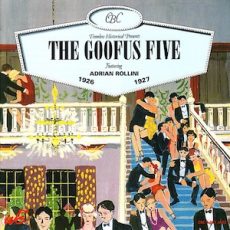
Adrian Francis Rollini was born June 28, 1903 in New York City, New York of French and Swiss extraction. Growing up in Larchmont, New York, he showed musical ability early on and began to take piano lessons at the age of two. Considered a child prodigy, he played a fifteen-minute recital at the Waldorf Astoria Hotel at the age of four. By age 14 he was leading his group composed of neighborhood boys, in which he doubled on piano and xylophone.
Leaving high school in his third year he cut piano rolls for the Aeolian company on their Mel-O-Dee label and the Republic brand in Philadelphia, Pennsyolvania. At 16 he joined Arthur Hand’s California Ramblers and being equally skilled at piano, drums, xylophone, and bass saxophone, gained him Hand’s respect. Hand transferred the band to Rollini when he retired from the music field.
During the 1920s not only was he a member of the California Ramblers with Red Nichols, Jimmy and Tommy Dorsey, he also held membership in The Little Ramblers, The Goofus Five, and The Golden Gate Orchestra. During this time, he managed to lay down hundreds of sessions with Annette Hanshaw, Cliff Edwards, Joe Venuti, Miff Mole, Red Nichols, Bix Beiderbecke, Roger Wolfe Kahn, and Frank Trumbauer.
The 1930s saw him forming the Adrian Rollini Orchestra which recorded on Perfect, Vocalion, Melotone, Banner, and Romeo labels, where he played both bass saxophone and vibraphone. During the early swing era, starting in 1935, he managed Adrian’s Tap Room, owned the Whitby Grill, and opened White Way Musical Products, a store for the sale and repair of musical instruments.
Gradually shifting from the bass saxophone to the vibraphone after popularity of the hot jazz era of the 1920s waned. He went on to play hotels, arranging and writing songs behind the scenes. After an exhaustive career, he made his last recording with his trio in the early 1950s. He relocated to Florida, opened the Eden Roc Hotel in 1955, ran the Driftwood Inn at Tavernier Key and his Driftwood offered deep-sea fishing charters.
Bass saxophonist, pianist, and vibraphonist Adrian Rollini, died under unsolved circumstances on May 15, 1956 at the age of 52 in Homestead, Florida.

More Posts: bandleader,history,instrumental,jazz,music,piano,saxophone,vibraphone
Daily Dose Of Jazz…
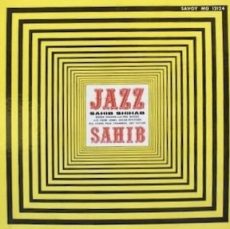
Sahib Shihab was born Edmund Gregory on June 23, 1925 in Savannah, Georgia. Schooled in New York from age 3, he first played alto saxophone professionally for Luther Henderson at 13. He studied at the Boston Conservatory, and played in and around New York with Art Blakey, Gigi Gryce, Benny Golson, Thelonious Monk, Oscar Pettiford, Dizzy Gillespie. He toured with the bands of Fletcher Henderson, Buddy Johnson, Roy Eldridge, Andy Kirk, Duke Ellington, Count Basie and the original 17 Messengers of Blakey.
During the late 1940s, Shihab played with Thelonious Monk, and on July 23, 1951 he recorded with Monk that was later issued on the album Genius of Modern Music: Volume 2. During the decade he recorded with Art Blakey, Kenny Dorham and Benny Golson. The invitation to play with Dizzy Gillespie’s big band saw his switch to baritone saxophone.
Between 1952 to 1955 he toured with Illinois Jacquet in Europe, as well as with Coleman Hawkins and Sarah Vaughn and toured with Dakota Stanton from 1956 to 1958. He was one of the musicians who showed up for the Art Kane photograph A Great Day In Harlem. Closing out the Fifteies he toured Europe with Quincy Jones, and subsequently settled in Scandinavia in 1960, married and raising a family. Shihab, disillusioned with racial politics in the United States, decided around this time to move to Europe.
As an educator he worked for Copenhagen Polytechnic and wrote scores for television, cinema and theatre. He composed and arranged for Swedish and Danish radio orchestras. He went on to perform with bassist Niels-Henning Ørsted Pedersen and together with pianist Kenny Drew, he ran a publishing firm and record company. Through the Sixties he joined the Kenny Clarke/Francy Boland Big Band and remained a member of the band during its 12 years existence.
Returning to the United States in 1973 he toured with Quincy Jones and The Brothers Johnson. He returned to Copenhagen, Denmark three years later, where he produced albums for Metronome Records, along with Kenny Drew. The album is titled Brief Encounter, and features the voices of Debby Cameron and Richard Boone. At decade’s end he started a record company with Kenny Drew called Matrix and spent his remaining years between New York and Copenhagen, performed in partnership with Art Farmer and led his own jazz combo called Dues.
Hard bop baritone, alto, and soprano saxophonist and flautist, composer, arranger, producer and educator Sahib Shihab, who beginning of 1986 was a visiting artist at Rutgers University, died from cancer on October 24, 1989, in Nashville, Tennessee at age 64.
More Posts: arranger,bandleader,composer,educator,flute,history,instrumental,jazz,music,producer,saxophone
Daily Dose Of Jazz…
John Hollenbeck was born June 19, 1968 in Binghamton, New York and earned degrees in percussion and jazz composition from the Eastman School of Music. He moved to New York City in the early 1990s. He has worked with Bob Brookmeyer, Fred Hersch, Tony Malaby, the Vanguard Jazz Orchestra, Kenny Wheeler, Pablo Ziegler, and Meredith Monk.
In 1998, he composed The Shape of Spirit, a piece for wind ensemble on Mons Records. The following year he composed Processional and Desiderata for wind ensemble and orator. This composition, written for and featuring the voice and trombone of Bob Brookmeyer, was released on Challenge Records in 2001.
Hollenbeck went on to receive several commissions from the Bamberg Choir and the Windsbacher Knabenchor in Germany, Bang on a Can, the People’s Commissioning Fund, the IAJE Gil Evans Fellowship, and in addition he composed and performed the percussion score to the following Meredith Monk works: Magic Frequencies, Mercy and The Impermanence Project.
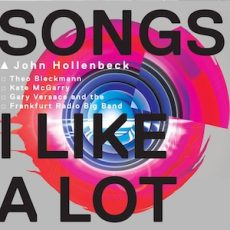
His 2000 debut release Static Still with Theo Bleckmanne began his recording as a leader and in 2001 his sophomore project No Images landed on Gary Giddins’ Village Voice Top Ten list. He has gone on to record nine more albums to date as a leader and nine albums with the Claudia Quintet.
Drummer John Hollenbeck, who was an eleven year professor of jazz drums and improvisation at the Jazz Institute Berlin and in 2015 joined the faculty of Schulich School of Music, continues to perform.
More Posts: bandleader,drums,educator,history,instrumental,jazz,music
Daily Dose Of Jazz…
Joseph Christopher Columbus Morris was born on June 17, 1902 in Greeenville, North Carolina. He led his own band from the 1930s into the late 1940s, holding a residency at the Savoy Ballroom for a period. During the mid 1940s he began drumming behind Louis Jordan, remaining with him until 1952. In the mid-to-late 1950s, Columbo backed Wild Bill Davis’s organ combo, and he recorded with Duke Ellington in 1967.
He worked again as a leader in the 1970s, in addition to doing tours of Europe with Davis. While in France he played with Floyd Smith, Al Grey, Eddie “Cleanhead” Vinson, Buddy Tate, and Milt Buckner. He got his first professional gig playing with Fletcher Henderson in 1921. Between the 1920s and the 1960s, Columbo played at most of the city’s nightclubs, and led the Club Harlem Orchestra for 34 years until 1978, when the club shut its doors.
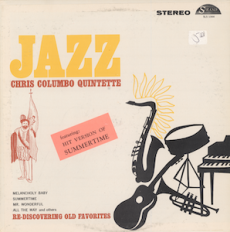
Columbo worked, recorded, and toured with prominent jazz artists including Dizzy Gillespie, Louis Armstrong and Ella Fitzgerald. He did an album on the Strand label called Jazz: Re-Discovering Old Favorites by the Chris Columbo Quintette featuring organist Johnny “Hammond” Smith. He appeared in the 1945 film It Happened In Harlem, based on the Harlem nightclub Smalls Paradise and the 1947 film Look Out Sister.
Prior to suffering a stroke in 1993 which partially paralyzed, Columbo was the oldest working musician in Atlantic City. Chris’ band went on to perform at practically every Atlantic City casino hotel. At the time of his stroke, he was playing regularly at the Showboat.
Drummer Chris Columbo, who was a father figure to Sonny Payne, who was also known as Crazy Chris Columbo and sometimes credited as Joe Morris on record, died on August 20, 2002 in New Jersey. He was 100 years old.
More Posts: bandleader,drums,history,instrumental,jazz,music
Daily Dose Of Jazz…
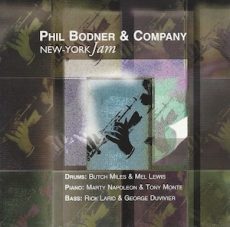
Philip L. Bodner was born in Waterbury, Connecticut on June 13, 1917 and worked as a studio musician in the 1940s and 1950s in New York City. He recorded with Benny Goodman and with Miles Davis and Gil Evans in 1958. The 1960s saw him playing with Oliver Nelson and J.J. Johnson.
During the Sixties he organized The Brass Ring, a group modeled after Herb Alpert and the Tijuana Brass. The group released nine albums between 1966 and 1972 and associations in the 1970s included Oscar Peterson, Yusef Lateef, Peanuts Hucko, Wild Bill Davison, and Ralph Sutton.
Bodner played the signature piccolo part on Van McCoy’s disco hit song The Hustle. During that period he also played with Ralph Sutton and Johnny Varro, worked with Mingus Epitaph, and arranged Louie Bellson’s tribute to Duke Ellington’s Black, Brown and Beige.
He worked in a swing style with Marty Napoleon, Mel Lewis, and George Duvivier in the 1980s and played with Maxine Sullivan and Barbara Carroll. Over the course of his career he recorded five albums as a leader, and eleven as a sideman with Coleman Hawkins, Cootie Williams, Miles Davis, Joe Wilder, Paul Desmond, Wes Montgomery, Cal Tjader, Mel Davis, George Benson, Freddie Hubbard, and Joey DeFrancesco.
Clarinetist and studio musician Phil Bodner, who also played flute, oboe, saxophone, and English horn, died in New York City on February 24, 2008, at age 90.