

Daily Dose Of Jazz…
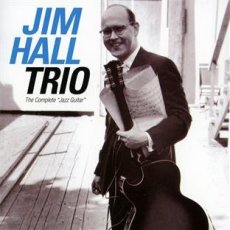
Jim Hall was born James Stanley Hall on December 4, 1930 in Buffalo, New York. Learning to play guitar as a child, he was educated at the Cleveland Institute of Music. After his matriculation he moved to Los Angeles, California and began to attract national then international attention in the late 50s. It was during this period that he further studied classical guitar with Vincente Gomez.
Hall would play with the Chico Hamilton Quintet and Jimmy Guiffre in the Fifties, Ella Fitzgerald in the early 60s, then played with Ben Webster, Hampton Hawes, Bob Brookmeyer, John Lewis, Zoot Sims, and Lee Konitz, among others. A move to New York led him to work with Sonny Rollins and Art Farmer and his live and recorded collaborations there with Bill Evans, Paul Desmond and Ron Carter have become legendary.
Formal recognition as a composer came in 1997, when Jim won the New York Jazz Critics Circle Award for Best Jazz Composer/Arranger. His pieces for string, brass, and vocal ensembles can be heard on his “Textures and By Arrangement” recordings. He has been commissioned to compose for guitar and orchestra, awarded an NEA Jazz Masters Fellowship, was one of the first musicians to join the fan-funded label ArtistShare.
Hall changed the way jazz guitar sounded, with his innovation, composition, and improvisation. Apart from Metheny, he influenced other contemporary artists such as Bill Frisell, Mick Goodrick, John Scofield, and John Abercrombie. He continued to perform, tour and record up until he passed away in his sleep on December 10, 2013 in his Manhattan apartment.

Jazz Is Global – Share
More Posts: guitar

Daily Dose Of Jazz…
Amina Figarova was born on December 2, 1966 in Baku, Azerbaijan and began studying music as a child. She started learning piano and expanded into composition and arrangement. Attending the Baku Conservatory as a youth, her immediate plans were to become a classical concert pianist.
A course in jazz performance at the Rotterdam Conservatory, however, led to Amina matriculating through Berklee College of Music. She recorded the first of her ten CDs in 1995 titled Attraction on the Media Music label then signed with Munich Records and has had a prolific and collaborative relationship releasing nine albums for the label.
Pianist Amina Figarova has toured extensively, developing a tight-knit ensemble that, despite inevitable personnel changes, has attained a distinctive and inimitable voice by concentrating on all-original repertoire for almost 18 years.
With a dozen albums under her belt the pianist continues to perform, record and tour with her husband, flautist Bart Platteau, who is a member of her international sextet.
Give The Gift Of Knowledge
More Posts: piano
Daily Dose Of Jazz…
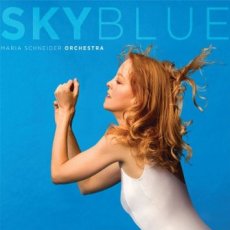
Maria Schneider was born on November 27, 1960 in Windom, Minnesota and started playing piano as a child. She studied music theory and composition at the University of Minnesota, followed by earning a Masters of Music from the Eastman School of Music and studying for one year at the University of Miami.
After Eastman she became an apprentice arranger under Gil Evans, collaborating with him for the next several years, producing arrangements commissioned by Sting and scoring the films “The Color of Money” and “Absolute Beginners”. Schneider went on to study with Bob Brookmeyer from 1986 to 1991, concurrently worked as a freelance arranger in New York.
She formed The Maria Schneider Jazz Orchestra in 1993, appearing weekly at Visiones in Greenwich Village for five years, then hit the festival circuit and toured Europe. In 2005, her album “Concert In The Garden” won a Grammy for “Best Large Ensemble Album” and was the first Grammy for a work sold entirely via the Internet. Her second Grammy came for Cerulean Skies from her 2007 Sky Blue project for Best Instrumental Composition.
Maria was one of the first artists to use ArtistShare to produce an album, and the composer, arranger and big-band leader has garnered recognition from the Jazz Journalist Association as Composer of the Year, Arranger of the Year and Large Jazz Ensemble of the Year.
Jazz Is Global – Share
Daily Dose Of Jazz…
Roland Guerin was born on November 15, 1968 into a musical family, first learning music from his bass playing mother. Her sage wisdom taught him that you can’t make it in music without a strong groove and feeling.
While studying marketing at Southern University in Baton Rouge he joined legendary jazz educator Alvin Batiste’s band, The Jazztronauts. Following this stint he toured the world with jazz guitarist Mark Whitfield and during this period he further explored the jazz genre in which he found success.
While exploring his spiritual side, Guerin created a new instrument – a hollow-bodied acoustic six string bass guitar that enabled him to write music for an entire spectrum of genres including pop, rock, R&B, classical, folk, and country.
Roland made his debut as a bandleader in 1998 with his acclaimed “The Winds of the New Land”, and then released four successful albums in the next decade. From 1994 to 2010 Roland was a member of the Marcus Roberts Trio, also regularly enhanced by symphony orchestras.
He would go on to perform with George Benson, Jimmy Scott, Frank Morgan, Vernel Fournier, Gerry Mulligan, Brian Blade, John Scofield, Herlin Riley and Dr. Michael White while recording with Ellis Marsalis, Marcus Roberts, and Allen Toussaint among others.
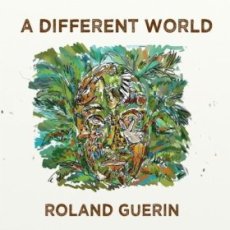
When he is not touring around the world, Roland is very active on the New Orleans music scene, and has released his last album “A Different World” in 2011.
Inspire A Young Mind
More Posts: bass,bass guitar
Daily Dose Of Jazz…
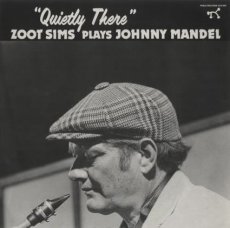
John Haley “Zoot” Sims was born on October 29, 1925 in Inglewood, California to vaudeville parents. Growing up in a performing family he learned to play both drums and clarinet at an early age along with steps taught him by his hoofer father.
Learning to play saxophone he followed in the footsteps of Lester Young, developing into an innovative saxophonist. Always fond of the higher register of the tenor sax, Sims was considered one of the strongest swingers in the field by his peers.
By the ‘50s and into the ‘60s Zoot had a long and successful partnership as co-leader of a quintet with tenor saxophonist Al Cohn, recording under the name of al & Zoot and a favorite at The Half Note club in New York. He added alto and soprano saxophones over the course of his career playing with renowned bands such as Benny Goodman, Artie Shaw, Stan Kenton and Buddy Rich. Zoot also play with Gerry Mulligan and later with Mulligan’s Concert Jazz Band.
During this period he recorded a series of albums for Norman Granz on his Pablo Records label and played on a few of Jack Kerouac’s recordings. However, it was early in his career that he acquired his nicknamed “Zoot” while working with the Kenny Baker band in California and was later appropriated for the sax-playing Muppet.
Zoot Sims, tenor and soprano saxophonist passed away in New York City on March 23, 1985.
Give The Gift Of Knowledge
More Posts: saxophone