

Daily Dose Of Jazz…
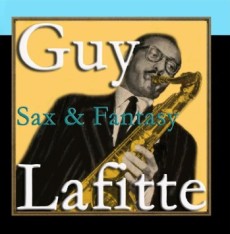
Guy Lafitte was born on January 12, 1927 in Saint-Gaudens, France. Most notable for his tenor saxophone work with Mezz Mezzrow from 1951–1952 and also toured with Big Bill Broonzy in 1951.
In 1954 Lafitte made Paris his home, and worked with Lionel Hampton Emmett Berry. He also collaborated on various other projects with musicians such as Wild Bill Davis and Bill Coleman.
Guy recorded six albums as a leader beginning with his debut in 1953 with All The Things You Are playing with Franck Pourcel, and continued on with Peanuts Holland, Raymond Fol, Jean-Claude Pelletier, Geo Daly, Andre Persiany, Paul Rovere, Teddy Martin, Hank Jones, George Duvivier, J.C. Heard, Clyde Lucas, Jacky Terrasson, Pierre Boussaguet and Al Lewitt.
He recorded another seven sessions as a sideman with Arnett Cobb, Bill Coleman, Sammy Price, Lucky Thompson, Buck Clayton, Charlie Singleton and Ben Webster. Tenor saxophonist Guy Lafitte passed away on June 10, 1998.

Dose A Day – Blues Away
More Posts: saxophone
Daily Dose Of Jazz…
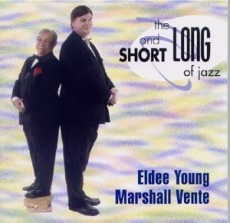
Eldee Young was born January 7, 1936 in Chicago, Illinois. He started playing upright bass at the age of 13, helped by his eldest brother who played guitar.
In 1955 Eldee joined the Ramsey Lewis Trio and after a decade together recording more than twenty albums, split along with band mate Isaac “Red” Holt to form the Young-Holt Trio. They would change their name to the Young-Holt Unlimited in 1968. After they dissolved six years and ten records later, he continued playing, mainly with small groups in Chicago.
He also played with pianist Jeremy Monteiro for more than 20 years, appeared on recording sessions with James Moody, Eden Atwood and Lorez Alexander, among others.
Double bassist and cellist Eldee Young, who performed mainly in the cool jazz, post bop and R&B mediums passed away of a heart attack in Bangkok, Thailand on February 12, 2007.
Give A Gift Of Jazz – Share
More Posts: bass
Daily Dose Of jazz…
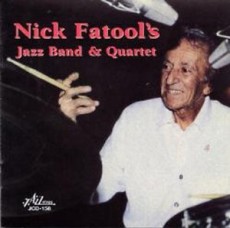
Nick Fatool was born on Jan. 2, 1915 in Milbury, Massachusetts and studied drums as a youth. He first played professionally in Providence, Rhode Island, followed with time in Joe Haymes’s band in 1937 and then Don Beston’s in Dallas soon after. By 1939 he was playing briefly with Bobby Hackett, and then took a chair with the Benny Goodman Orchestra.
Becoming one of the most visible drummers of the 1940s, Nick played with several bands led by Artie Shaw, Alvino Rey, Claude Thornhill, Les Brown and Jan Savitt. In 1943 he moved to Los Angeles, California and recorded profusely as a session musician. The short list of his credits includes Harry James, Errol Garner, Louis Armstrong, Jess Stacy, Tommy Dorsey, Matty Matlock, Glen Gray, Bob Crosby and the Crosby Bobcats.
From1944 to 1958 Fatool played on sessions for Capitol Records as a sideman for Johnny Mercer, Betty Hutton, Jo Stafford, Peggy Lee, Billy May, Nat “King” Cole, Wingy Manone, Dean Martin, Gordon MacRae, Red Nichols, Tennessee Ernie Ford, Ray Anthony, Jack Teagarden, The Andrews Sisters, Frank Sinatra, Andy Griffith, and Robert Mitchum to name a few during this period.
In the 1950s and 1960s Nick found much work on the Dixieland jazz revival circuit, playing with Pete Fountain from 1962-1965 and the Dukes of Dixieland. His only session as a bandleader was as the head of a septet in 1987, “Nick Fatool’s Jazz Band & Quartet” leading Eddie Miller, Johnny Mince, Ernie Carson and others. Drummer Nick Fatool passed away on September 26, 2000 in Los Angeles, California. He was 85.
Put A Dose In Your Pocket
More Posts: drums
Daily Dose Of Jazz…
John Kirby was born John Kirk in Winchester, Virginia on December 31, 1908. His mother gave him up for adoption and was raised by Reverend Washington and Nancy Johnson. He was a student at the Winchester Colored School and started trombone lessons around nine years old under the guidance of Professor Powell Gibson. As a kid and that he learned to play music just as it was written and his formal education ended around 1923.
Kirby arrived in Baltimore around 1927 and met trombonist Jimmy Harrison, saxophonist Coleman Hawkins and composer Duke Ellington. It was Harrison who persuaded him to switch from trombone to tuba. He played tuba with Bill Brown and His Brownies, pianist Charlie Sheets and then with John C. Smith’s Society Band. He joined Fletcher Henderson in 1929, recorded tuba on a number of sessions, but switched to double-bass when tuba fell out of favor as jazz bands’ primary bass instrument.
In the early 1930s, John took bass lessons from legendary bassists Pops Foster and Wellman Braud, left Henderson to play with Chick Webb, then joined Lucky Millinder and briefly led a quartet in 1935, but was more often than not a sideman in other groups. He performed behind Billie Holiday and Teddy Wilson on their first recording date.
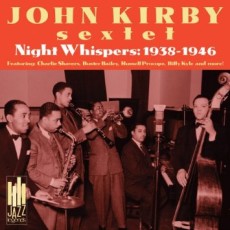
By 1936, Kirby was a successful sideman on the New York City jazz scene, secured a gig at the Onyx Club leading Charlie Shavers, Buster Bailey, Billy Kyle, Russell Procope and O’Neill Spencer, becoming one of the more significant small groups in the big band era. They recorded the Shaver’s classic Undecided, with Maxine Sullivan most often performing the vocal duties for the group.
Along with his orchestra, John had a 30-minute radio program, Flow Gently, Sweet Rhythm, also known as The John Kirby Show on CBS from April 1940 – January 1941. The program also featured Sullivan and the Golden Gate Quartet and they have been cited as the first black artists to host a jazz-oriented series.
He tended toward a lighter, classically influenced style of jazz often referred to as chamber jazz. He was very prolific and extremely popular from 1938-1941 but lost most of his group to World War II. Through the war years he was able to attract Dizzy Gillespie, Benny Carter, Ben Webster, Clyde Hart, Budd Johnson and Zutty Singleton to his small groups and club dates. As Kirby’s career declined, he drank heavily and was beset by diabetes.
After the war, Kirby got the surviving sextet members back together, with vocalist Sarah Vaughan but the reunion did not last. A concert at Carnegie Hall in December 1950, with Bailey plus drummer Sid Catlett, attracted only a small audience, crushing his spirit and badly damaging what little was left of his career. Double-bassist, trombonist and tubist John Kirby passed away on June 14, 1952 in Hollywood, California at age 43.
Give A Gift Of Jazz – Share
Daily Dose Of Jazz…
Ed Byrne was born on December 30, 1946 in Philadelphia, Pennsylvania and he worked for more than fifteen years on the New York City jazz scene as a soloist with Chet Baker, Joe Henderson, Herbie Hancock, Dizzy Gillespie, Maynard Ferguson, Billy Eckstine, Charles Mingus, Gerry Mulligan, Thad Jones/Mel Lewis, Archie Shepp, Mel Torme and the list continues. He also performed, composed, and arranged numerous recordings and toured the Americas, France, Germany and Sweden.
Ed was nominated Best Trombone Soloist by Latin New York magazine, as a leader was nominated for a Grammy Award for his Fenway Funk album, and won a Grammy for Eddie Palmieri’s Latin jazz album, Unfinished Masterpiece.
As an educator he hold a doctorate of Musical Arts in Jazz Studies from the New England Conservatory, has been on the faculties of Berklee College, Baruch College, University of the Arts, Greenfield Community College and the University of Rhode Island. Ed has published 42 texts on jazz improvisation and his Linear Jazz Improvisation Method, sold world-wide.
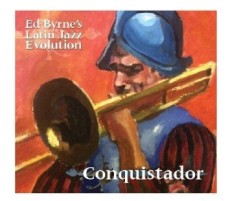
Trombonist, author, bandleader, composer, arranger and educator Ed Byrne is currently the leader of his Latin Jazz Evolution that released their first CD titled Conquistador, on Blue Truffle Records and continues to perform, record and tour.
Inspire A Young Mind
More Posts: trombone