

Daily Dose Of Jazz…
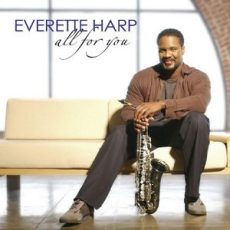
Everette Harp was born August 17, 1961 in Houston, Texas and was the youngest of eight children. His mother played the organ and gospel music was one of his earliest influences. He started playing jazz in middle school at Marshall Junior High under the tutelage of drummer Buddy Smith. He attended the High School for Performing and Visual Arts in Houston, then North Texas State University as a music major in the early 1980s.
He worked as an accountant for a short time, and played in local bands, most notably a jazz/funk group called The Franchise which released a 1987 album locally with the first recording of Harp’s There’s Still Hope. 1988 saw him moving to Los Angeles, California and touring briefly with Teena Marie, then Anita Baker.
Two years later George Duke signed him to a contract with Capitol Records to record with his group 101 North. Bruce Lundvall of Blue Note Records signed Harp to a solo contract before the group album was released. Harp’s album was produced by Duke and released by Blue Note in 1992.
Harp appeared at the Montreux Jazz Festival, would go on to appear on The Arsenio Hall Show, on Sax by the Fire, and perform on the theme songs for Entertainment Tonight and Soul Train and shared the stage with President Bill Clinton at the Arkansas Ball in 1992.
Harp has worked with Stanley Clarke, Natalie Cole, Neil Diamond, Aretha Franklin, Wayne Henderson, Al Jarreau, The Jazz Crusaders, Billy Joel, Chaka Khan, Kenny Loggins, Bobby Lyle, Peter Maffay, Marcus Miller, Chante Moore, Dianne Reeves, Eros Ramazzotti, Brenda Russell, Joe Sample, and Luther Vandross.
Saxophonist Everette Harp, who received his first nomination in 2015 for a Grammy Award for Best Contemporary Instrumental Album, continues to perform, compose and record.

More Posts: bandleader,composer,history,instrumental,jazz,music,saxophone
Daily Dose Of Jazz…
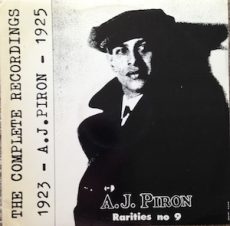
Armand John “A.J.” Piron was born on August 16, 1888 in New Orleans, Louisiana to Octave Louis Piron and Marie Jeanne Zeringue. At home he spoke English and French patois, and grew up steps from Claiborne Avenue, which at that time was a bustling, tree-lined center of commerce and community life. His father, a shoemaker, was also a musician and music teacher and played in the Philharmonic Orchestra. He taught his sons Milford, Albert, and Armand how to play.
At the age of seven Piron had an accident that damaged one of his legs. For the next five years while he recovered, he devoted himself to practicing the violin. This could be the reason he didn’t join the numerous New Orleans marching bands popular at that time. Instead became a dance and concert band musician and at age twelve he made his musical debut by joining a band his father led that included some of his students and his brothers.
In 1903 A.J. began playing in the Bloom Philharmonic. In 1908 he played for the Peerless Orchestra. Then in 1913 he played in the large, legendary orchestra organized by John P. Robichaux for the Carnival ball of the Elves of Oberon. That same year he played at the Rose Bud Theater on Dryades Street, sometimes with Papa Celestin’s Tuxedo band. He also played in the Olympia Band with Sydney Bechet, Kid Ory, Louis Keppard, and Clarence Williams, among others.
After touring briefly with W.C. Handy in 1917, Piron started an orchestra which included Lorenzo Tio, Steve Lewis, John Lindsay, and Peter Bocage. The theme song of the orchestra was The Purple Rose of Cairo, written by Piron and Steve Lewis. In 1923, Piron took his band to New York City.
Violinist A.J. Piron, who led dance bands during the 1910s through the 1930s, died on February 17, 1943 in New Orleans.
More Posts: bandleader,history,instrumental,jazz,music,violin
Daily Dose Of Jazz…
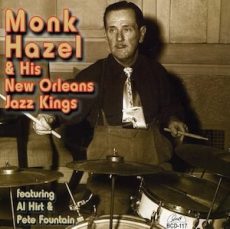
Monk Hazel was born Arthur Frank Hazel to a drummer father on August 15, 1903 in Harvey, Louisiana. Early on he played drums with Emmett Hardy, who gave him his first cornet, and then with Stalebread Lacombe. In the 1920s he worked with many bands including the Halfway House Orchestra led by Abbie Brunies, Tony Parenti with whom he recorded in 1928, and Johnny Wiggs.
From the late 1920s to the early 1930s, Hazel led his own Bienville Roof Orchestra which played atop the Bienville Hotel at Lee Circle, and made recordings in 1928 and then spent time in New York playing with Johnny Wiggs, Jack Pettis and with his own group from 1929 to 1931.
Hazel relocated to Hollywood in Los Angeles, California for a period working with Gene Austin but eventually returned to New Orleans, Louisiana performing with Joe Caprano in 1937 and the Lloyd Danton Quintet. He spent 1942-43 in the Army and then worked for a time outside of music.
During his final twenty years, Hazel was once again active in New Orleans, recording with his own band in 1945 and performing with Sharkey Bonano from 1949 to 1952, George Girard, Mike Lala, Santo Pecora and virtually every other important name in New Orleans jazz.
As a leader, Monk recorded four titles in 1928 for Brunswick Records and a full album for Southland Records in 1954; Pete Fountain and Al Hirt were among his sidemen on the latter recording.
Drummer and cornetist Monk Hazel, who occasionally took cornet and mellophone solos, died on March 5, 1968 in New Orleans.
More Posts: bandleader,cornet,drums,history,instrumental,jazz,music
Daily Dose Of Jazz…
Francis Henry “Jumbo Jack” Gardner was born in Joliet, Illinois on August 14, 1903. In the early-1920s he played locally in Denver, Colorado with Doc Becker’s Blue Devils, Boyd Senter’s band and others.
Moving to Chicago, Illinois in 1923, he led his own band in addition to playing with musicians like Wingy Manone, Jean Goldkette, and Gene Austin. He remained in the city through 1937, playing with Jimmy McPartland in 1936.
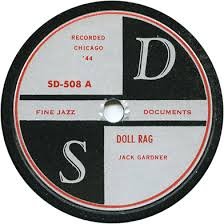
When he rellcated to New York City he began associations with Sandy Williams’s orchestra and Harry James, but returned to Chicago early in the 1940s, where he led his own group. In 1944, he recorded with Baby Dodds.
He spent much of his later life playing in Dallas, Texas, where he died in 1957. Gardner’s compositions include the song Bye, Bye, Pretty Baby, co-written with George Hamilton.
Pianist Jack Gardner died on November 26, 1957 in Dallas, Texas at the age of 54.
Daily Dose Of Jazz…
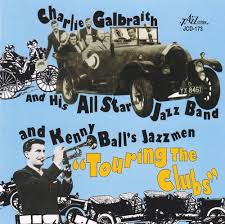
Charlie Galbraith was born August 13, 1920 in Lambeth, London, England. In the late 1940s he worked with the John Haim Jelly Roll Kings, Cy Laurie, Reg Rigden and Mike Daniels.
From 1949 to 1954 Charlie led his own group, Jazzmen and in late 1954 with Eric Silk, Bobby Mickleburg the following year, George Webb, Joe Daniels and Kenny Ball for two years beginning in 1957.
1960 saw Galbraith leading his own All Stars Jazz Band and in 1963 co-led with trumpeter Brian Jones. He later worked with Monty Sunshine and Joe Daniels through the end of the decade.
During the 1970s and Eighties he led his own band. Trombonist and singer Charlie Galbraith died January 16, 1997 in London, England.