

Daily Dose Of Jazz…
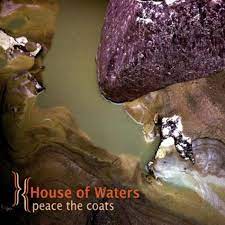
Moto Fukushima was born in Kobe, Japan on February 23, 1978 and received the Outstanding Performer Award before graduating Summa Cum Laude from Berklee College of Music. His musical style is a unique combination of Western classical music, Japanese traditional music, and African-inspired music of South America, which is evident in his jazz improvisation. His playing is characterized by a remarkable blend of finesse, subtlety, and power.
He is a co-leader of the Brooklyn-based power trio, House of Waters. The band has released two albums on the Grammy Award-winning group Snarky Puppy’s GroundUp label, with the first album reaching #2 on the iTunes World Music chart, and the second album hitting #4 on the iTunes Jazz chart.
His music has been featured in the Sports Emmy Award-winning piece on ESPN’s E60, and he won 3rd place in the International Songwriting Competition in 2014. He has also been the recipient of the ASCAP Plus Award.
Moto has collaborated with Mike Stern, Leni Stern, Karsh Kale, Dave Weckl, Dave Eggar, Big Apple Circus, Alex Skolnick, and Gil Goldstein. Six-string bass player, composer, and shamisen player Moto Fukushima, currently based in New York City, continues to perform and record.

More Posts: bass,composer,history,instrumental,jazz,music,shamisen
Daily Dose Of Jazz…
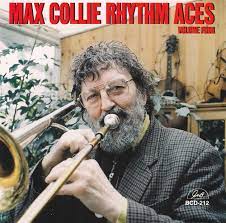
John Maxwell Collie was born on February 21, 1931 in Melbourne, Australia. In 1946 he first heard professional jazz listening to Graham Bell’s lunchtime concerts at The New Theatre Melbourne. By 17 he was playing with a local band and shortly after leading it.
When he received the invitation by cable to take the trombone chair in the Melbourne New Orleans Jazz Band that was on tour in Europe, Max accepted and in 1962 arrived in England. He toured Europe until the band went back to Australia a year later, however, he decided to stay and joined the London City Stompers, becoming leader after a year. In 1966 he formed Max Collie’s Rhythm Aces and that band, notwithstanding the collapse of the UK jazz scene flourished.
The group released their first record in 1971 and in 1975 they won the World Championship of Jazz in traditional jazz against fourteen competing North American jazz bands in Indianapolis, Indiana.
He would go on to tour Sweden, Denmark, Finland, Norway and Japan and create a theater show. This show, Max Collie’s New Orleans Mardi Gras, which included Ken Colyer and Cy Laurie, turned out to be the most successful jazz show in British jazz history. Trombonist Max Collie died on January 6, 2018, at the age of 86.
More Posts: bandleader,history,instrumental,jazz,music,trombone
Daily Dose Of Jazz…
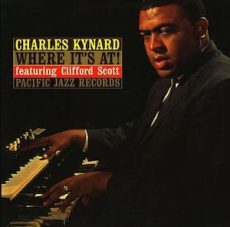
Charles Kynard was born in St. Louis, Missouri on February 20, 1933 and first played piano then switched to organ and led a trio in Kansas City. The trio included Tex Johnson on flute and saxophone, and Leroy Anderson on drums.
In 1963, he settled in Los Angeles, California and his band featured guitarists Cal Green and Ray Crawford, drummer Johnny Kirkwood. Between 1963 to 1973 Charles recorded ten albums as a leader, and ten albums as a sideman with Johnny Almond, Paul Jeffrey, Les McCann, Blue Mitchell, Howard Roberts, Clifford Scott, Sonny Stitt, and Tom Waits.
Organist Charles Kynard died on July 8, 1979.
More Posts: history,instrumental,jazz,music,organ
Daily Dose Of Jazz…
Judy Lewis was born on February 19, 1958 in Milwaukee, Wisconsin and from age seven she studied classical piano, subsequently winning competitions throughout the Midwest. Moving to New York City she continued with her studies at Columbia University, but gradually moved from music to study religion. At 20 she moved to Israel where she continued to perform while searching for spiritual meaning in her life.
Her success as a performer was overshadowed by her desire to concentrate on spiritual matters. In 1991 Lewis began playing the piano again and by 1995 she returned to a music career, in addition to teaching to support her family. Dissatisfied with the classical form, by the mid-90s she turned to jazz. The catalyst came in Los Angeles, California when she attended her first jazz concert and was soon practicing extensively the work of jazz pianists such as Chick Corea, Bill Evans, Tommy Flanagan, Red Garland and Keith Jarrett.
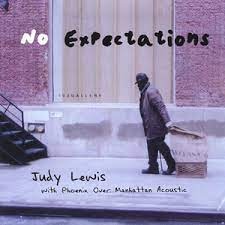
She began composing her own music, formed a group, the Back Alley Jazz Quintet, and made her jazz debut in 1996. By the following year, Judy had brought the group down to a trio. Her acclaim grew in Israel, then expanded to tours of Europe and the USA. In 2002 she released a solo set, Waiting On A New Day, and then in 2003 she formed the fusion band, Phoenix Over Manhattan which would evolve into an acoustic band, No Expectations that was greeted warmly by critics.
Energetic, enthusiastic and determined, her concept of jazz had a vibrancy that was welcomed by many for its contrast to the smooth jazz outpourings of the early century. Pianist Judy Lewis, who operates a recording company, Visionary Insomniac Records, continues to perform, compose and record.
More Posts: history,instrumental,jazz,music,piano
Daily Dose Of Jazz…
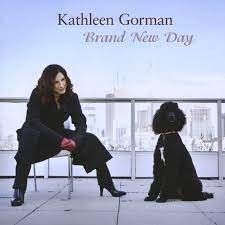
Kathleen Gorman was born on February 18, 1967 and grew up in Halifax, Nova Scotia in a musical family where creative expression was encouraged. Piano lessons started at age six, and years of classical studies gave her a solid musical foundation. She began performing and writing in her teens and after composing a theme for CTV for the Winter Olympics, she moved to Montreal, Canada to pursue jazz piano, arranging and composition studies. Completing a Bachelor of Fine Arts at Concordia University, Montreal she followed this by McGill for advanced study in composition and orchestration.
She continuously worked as a pianist/vocalist for several years in Montreal clubs before settling in Toronto, Canada where she began performing weekly, and set up a home studio, for recording projects and teaching. She is a Toronto based pianist/vocalist, as well as a composer/arranger and jazz educator, teaching jazz piano, theory and composition. She has trained with Jan Jarczyk, Jon Ballantyne, Hilario Duran, Sheila Jordan, Barry Harris, Kurt Elling, and Jeri Brown.
Pianist, vocalist and bandleader Kathleen Gorman continues to record, arrange, compose and educate, performing often in Toronto.
More Posts: arranger,composer,history,instrumental,jazz,music,piano,vocal