

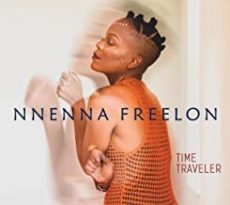
The Quarantined Jazz Voyager
In our ongoing practice of social distancing and wearing our masks, this week’s selection comes the very talented interpreter and vocalist Nnenna Freelon who has delivered her latest Time Traveler. The songs for the album were recorded over a span of two years on March 13~15, 2018, October 24, 2018, August 20, 2020 and September 3, 2020. It was released on May 21, 2021 on the Origin Records label.
The album was recorded at Manifold Records in Pittsboro, North Carolina, Overdub Lane, Durham, North Carolina and Tedesco Studios in Paramus, New Jersey. It was produced by Nnenna Freelon, with musical direction by Miki Hayama. The engineers were Jason Richmond (1~6, 8~11), Ian Schreier (1,3~5,7,9) Tom Tedesco (1~3,8) and John Plymale (2,8).
The cover design and layout was by John Bishop, photography by Chris Charles, clothing stylist ~ Katina Bryson, makeup ~ Sharon Davis, hairstylist ~ Anes El and henna and face artist Shemora Sheik made up the production team.
She draws from her life story the songs of her youth and has helped her navigate the process of loss and healing and steps through an imagined doorway where past, present and future collide. She reminds us of a time when grace and elegance were a standard and that is timeless. There is a reverence in the lyrics that was lost in my youth but has been captured with age.
Tracks | 55:03
- I Say A Little Prayer For You (Burt Bachrach/Hall David) ~ 5:07
- Marvin Medley: If This World Were Mine/Ain’t Nothing Like The Real Thing/Ain’t No Mountain High Enough ( Marvin Gaye, Ashford & Simpson) ~ 6:05
- Just You (Nnenna Freelon) ~ 5:32
- Betcha By Golly Wow (Thom Bell, Linda Creed) ~ 4:54
- Time In A Bottle (Jim Croce) ~ 6:59
- You Make Me Feel Brand New (Thom Bell, Linda Creed) ~ 5:06
- Moon River (Henry Mancini, Johnny Mercer) ~ 5:57
- Time After Time (Sammy Cahn, Jule Styne ~ 4:58
- Come Rain Or Come Shine (Harold Arlen, Johnny Mercer) ~ 5:55
- Time Traveler (Freelon,Curry,Robinson, Scott) ~ 4:30
- Nnenna Freelon ~ Vocals
- Miki Hayama ~ Piano 1,3,5,7,8 Rhodes 2,4,9 Synth 2,8
- Chuckey Robinson ~ Keyboards 10,11
- Brandon McCune ~ Hammond Organ 1,3
- Keith Ganz ~ Guitar 2~6,8~11
- Noah Jackson ~ Acoustic Bass 1,3~5,7,9
- Gerald Veasley ~ Electric Bass 2,8
- Lance Scott ~ Electric Bass 10,11
- E. J. Strickland ~ Drums 1,3~5,7,9
- Adonis Rose ~ Drums 2,8
- Jon Curry ~ Drums 10,11
- Beverly Botsford ~ Percussion 2,4,8
- Trineice Robinson-Martin ~ Background Vocal
- Kirk Whalum ~ Tenor Saxophone, Flute 4
- Shana Tucker ~ Cello 5

More Posts: adventure,album,club,genius,jazz,museum,music,preserving,restaurant,travel,vocal
Daily Dose Of Jazz…
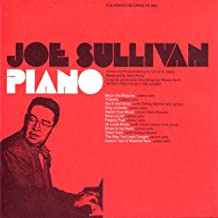
Joe Sullivan was born Michael Joseph O’Sullivan on November 4, 1906 in Chicago, Illinois. The ninth child of Irish immigrant parents, he studied classical piano for 12 years and by age 17, he began to play popular music in silent-movie theaters, on radio stations, and then with the dance orchestras, where he was exposed to jazz. Graduating from the Chicago Conservatory he was an important contributor to the Chicago jazz scene of the 1920s.
Sullivan’s recording career began towards the end of 1927, when he joined McKenzie and Condon’s Chicagoans. Other musicians in his circle included Jimmy McPartland, Frank Teschemacher, Bud Freeman, Jim Lanigan and Gene Krupa. In 1933, he joined Bing Crosby as his accompanist, recording and making many radio broadcasts.
Contracting tuberculosis in 1936, while convalescing at a sanitarium in Monrovia, California in 1937, Crosby organized and appeared in a five-hour benefit for him at the Pan-Pacific Auditorium in Los Angeles, California on May 23, 1937 in front of an audience of six thousand. The show was broadcast over two different radio stations, with fourteen bands attending and raised approximately $3,000 for Sullivan.
After suffering for two years with tuberculosis, Joe briefly re-joined Bing Crosby in 1938 and the Bob Crosby Orchestra in 1939. In 1940, when leading Joe Sullivan’s Cafe Society Orchestra, he had a minor hit with I’ve Got A Crush On You. By the 1950s, he was largely forgotten, playing solo in San Francisco, California, and marital difficulties and excessive drinking caused him to become increasingly unreliable and unable to keep a steady job.
In 1963, he met up with old colleagues Jack and Charlie Teagarden plus Pee Wee Russell when they performed at the Monterey Jazz Festival. Pianist Joe Sullivan passed away on October 13, 1971 in San Francisco at the age of 64.
More Posts: bandleader,history,instrumental,jazz,music,piano
Daily Dose Of Jazz…
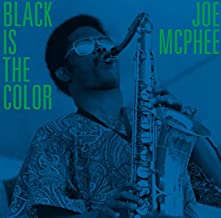
Joe McPhee was born November 3, 1939 in Miami, Florida and grew up in Poughkeepsie, New York. He began playing trumpet when he was eight, before learning other instruments. He played in various high school and then military bands before starting his recording career. His first recording came in 1967 when he appeared on the Clifford Thornton album titled Freedom and Unity.
McPhee taught himself saxophone at the age of 32 after experiencing the music of John Coltrane, Albert Ayler, and Ornette Coleman. During the late 1960s and early 1970s, he lectured on jazz music at Vassar College.
In 1975, Werner Uehlinger started the Swiss label Hathut Records with the specific intent of showcasing McPhee’s music. In the 1980s, he met Pauline Oliveros, began studying her musical theories, and worked with her Deep Listening Band.
Not having been signed with any major label in his native United States, Joe was better known throughout Europe until the 1990s. His 1996 album As Serious As Your Life, which takes its title from the jazz book by Val Wilmer, has been said to arguably be the finest of his solo recordings, according to the AllMusic review.
He has recorded or performed with Ken Vandermark, Peter Brötzmann, Evan Parker, Mats Gustafsson, Jeb Bishop, The Thing, Clifton Hyde, Jérôme Bourdellon, Raymond Boni, and Joe Giardullo. Since 1998, he, Dominic Duval, and Jay Rosen have performed and recorded as Trio X. In the 1990s Dominique Eade and McPhee had a jazz ensemble called Naima.
He has written reviews and commentary for Cadence magazine and was awarded the Resounding Vision Award by Nameless Sound. Multi-instrumentalist Joe McPhee, who plays tenor, alto, and soprano saxophone, trumpet, flugelhorn and valve trombone, is most notable for his free jazz work done from the late 1960s to the present day.
More Posts: bandleader,flugelhorn,history,instrumental,jazz,music,saxophone,trumpet,valve trombone

Daily Dose Of Jazz…
Arlene Bardelle was born on November 2, 1959 and Chicago, Illinois is her home. Growing up Judy Garland was an early influence and Ella Fitzgerald was a major influence on her singing. She also took cues from Sarah Vaughan, Carmen McRae and Irene Kral.
Having a longtime love affair with the grand old movies of the 30’s and 40’s, Arlene has accumulated a vast repertoire of the great American standard songbook as a result.
Bardelle has performed at the top Chicago venues with her band including the likes of pianists Tom Muellner, John Campbell, Jeremy Kahn and Dennis Luxion, bassist Kelly Sill, Jim Cox, Rob Amster, Larry Kohut, Joe Policastro and Larry Gray, drummers Tim Davis, Phil Gratteau, Bob Rummage and Rusty Jones and multi-instrumenatalist Ira Sullivan, saxophonists Eric Schneider and Ron Dewar, as well as trumpeter Art Davis.
Vocalist Arlene Bardelle released her last album Blue Gardenia in 2010 and she continues to perform and select the music she is passionate about.
More Posts: bandleader,history,instrumental,jazz,music,vocal
Daily Dose Of Jazz…
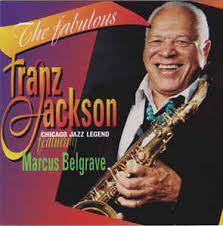
Born in Rock Island, Illinois on November 1, 1912 Franz Jackson got his first lessons on saxophone from Jerome Don Pasquall and later studied at the Chicago Musical College.
Early in his career, Jackson played with Albert Ammons’s band and for much of the 1930s he was based in Chicago, Illinois. He toured with Fletcher Henderson in 1938, then played with Roy Eldridge’s band in New York City. In 1940 he toured with Fats Waller and then went to work with Earl Hines.
Following small band work back in New York City, Franz joined Cootie Williams’s big band, played in Boston, Massachusetts with Frankie Newton, toured with Eldridge, and worked with Wilbur De Paris at Jimmy Ryan’s in the city.
Jackson formed his own band in Chicago in 1957, the Original Jass All Stars and with this group he made overseas tours, including playing in Vietnam. Moving to Dowagiac, Michigan in 1975, he formed another band, the Jazz Entertainers, in 1980.
Saxophonist and clarinetist Franz Jackson, who played in the Chicago jazz school, passed away on May 6, 2008 in Niles, Michigan. The Franz Jackson Collection at the Chicago Jazz Archive contains his papers and oral history material.
More Posts: bandleader,clarinet,history,instrumental,jazz,music,saxophone