

Daily Dose Of Jazz…
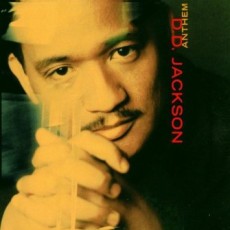
D.D. Jackson was born on January 25, 1967 in Ottawa, Canada. He started playing piano as a child, eventually graduating from the Manhattan School of Music. He would go on to become an alumnus of the Lehman Engel BMI Advanced Musical Theatre Workshop.
Jackson performs all over the world with his groups and has also appeared and recorded with some of the most distinguished names in jazz and beyond including: David Murray, Art Davis, Ray Drummond, James Spaulding, James Carter, Dewey Redman, Oliver Lake, Billy Bang, Regina Carter, Dafnis Preto, Cindy Blackman, Billy Hart, Andrew Cyrille, Mor Thiam, Mino Cinelu, Ahmir “Questlove” Thompson and others.
He is also an accomplished classical pianist, released a recording of Gershwin’s “Rhapsody in Blue”, he wrote a regular column “Living Jazz” for Downbeat magazine and the related “D.D. Jackson Living Jazz Podcast”.
Jackson is an alumnus of the Manhattan Producers Alliance, was a composers for The Wonder Pets and 3rd & Bird; scored the entire 26-episode season of The Ocean Room, won a Juno Award, is currently based in New York City teaching at Hunter College and the Harlem School of the Arts and has recorded twelve CDs as a leader and co-leader.

Jazz Is Global – Share
More Posts: piano
Daily Dose Of Jazz…
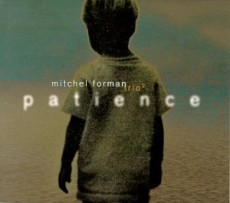
Mitchel Forman was born January 24, 1956 in Brooklyn, New York and began studying classical piano at the age of seven. At 17 he entered the Manhattan School of Music for three years of study and began working with bands in New York. Shortly after graduation he began touring and recording with Gerry Mulligan’s big band and quartet, followed by a stint with Stan Getz.
In 1980 Mitchel began a solo career with a piano performance at the Newport Jazz Festival and the subsequent recording became his first album, Live at Newport. He went on to work with Phil Woods, Carla Bley, Mel Torme and Astrud Gilberto; record for Soul Note Records and tour Europe regularly.
He joined guitarist John McLaughlin for a year and a half, recorded Mahavishnu and Adventures in Radioland. Then he joined Wayne Shorter and in between touring, contributed to and recorded Phantom Navigator.
In 1985, Forman began leading his own band and recorded his group debut for Magenta Records “Train of Thought”. At the same time he continued to work with other well-known jazz and music figures, including John Scofield, Mike Stern, Janis Siegel, Dave Samuels, Diane Schuur, Gary Burton, Pat Metheny, “Freddie Hubbard and numerous others.
Pianist Mitchel Forman continues to record and play under his own name and has recently started his own record label, Marsis Jazz. His move to California has him co-leading the band Metro with guitarist Chuck Loeb and performing around Los Angeles with his own bands.
Put A Dose In Your Pocket
More Posts: piano
Daily Dose Of Jazz…
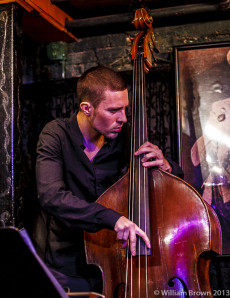
Aidan Carroll was born on January 21, 1984 in Oklahoma City, Oklahoma and grew up in the blues-infused city with his musical parents’ unwavering support. He studied music classical, rock and roll and R&B drumming avidly from a young age beginning with playing drums in his father’s band at age 10. After winning numerous awards on classical marimba and percussion, Carroll was drawn to the bass and to the world of jazz and improvisation.
In high school Aidan attended the Classen School of the Advanced Studies where he eventually switched from percussion major to bass major to play in jazz band and orchestra. He performed regularly with his school jazz band in big band and combo formats at local functions, and seasoned his experience with several awards at state competitions. Receiving a full jazz scholarship to the University of Central Oklahoma, he played in the top jazz big band all four years, as well as the orchestra and wind ensemble.
Prior to a move to New York City and matriculating through the City College of New York under the tutelage of John Patitucci, Aidan attended the Banff Creative Workshop and worked with the likes of Dave Douglas, Rez Abassi, Donny McCaslin and others.
A consummate sideman Carroll has recorded with Fred Hersch, Seamus Blake, Ralph Alessi, and toured with the Dan Tepfer Trio, Logan Richardson’s SHIFT, multilingual singer Marta Topferova, Zimbabwean singer Chiwoniso (R.I.P.), Sister Sparrow and the Dirty Birds, and Melody Gardot.
His debut album “Original Vision” is due out in March 2015. In the meantime he is touring with Grammy winner Lisa Fischer, when not regularly working with his New York peers playing in town with groups led by Sullivan Fortner, Chris Dingman, Julian Shore, John Raymond, Richie Barshay, Jason Palmer and others.
Dose A Day – Blues Away
More Posts: bass
Daily Dose Of Jazz…
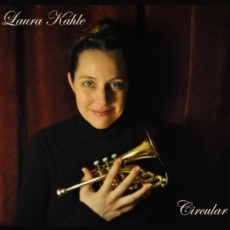
Laura Kahle was born on January 20, 1979 in Michigan but her family moved to Australia as a baby where she lived until 2004. She received her Bachelor of Music in jazz trumpet with the great John Hoffman and a Master of Music Studies in Composition @ the QLD Conservatorium of Music.
Moving to New York in 2004 she found herself working with the Danish Radio Big Band in Copenhagen, arranging the music of Jeff “Tain” Watts and Michael Brecker. She recorded “Downstream” was recorded in 2004 with a ten-piece ensemble from Brisbane, “West End Composers Collective”.
In 2006 she had two arrangements premiered by Wynton Marsalis and the Lincoln Center Jazz Orchestra featuring Jeff “Tain” Watts in Rose Hall, New York City. In 2007 she arranged the music of Gil Evans for the Branford Marsalis Septet, and performed in the Allen Room in New York City. By 2011 she recorded “Circular” and continues to perform and record.
Inspire A Young Mind
More Posts: trumpet
Daily Dose Of Jazz…
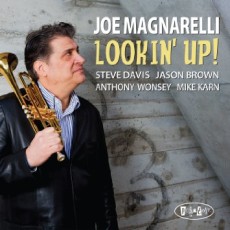
Joe Magnarelli was born in Syracuse, New York on January 19, 1960. He first started playing music at age 12 with guitar and trumpet lessons, but had a knack for picking out songs on the piano by ear. His early performance experience, from elementary through high school, came via playing the trumpet and guitar in church. Later, while attending Onondaga Community College in Syracuse, he was the pianist and choir director at the Central Baptist Church.
Mags, as he was known, went on to get his bachelor’s degree in liberal arts from the State University of New York in Fredonia in 1986, and that year, he moved to New York City to pursue a career in music. Becoming a regular on the New York and international jazz scene, by 1987 he was touring and recording with Lionel Hampton and Brother Jack McDuff, and was soon seen playing with Toshiko Akiyoshi, Glenn Miller Orchestra, Harry Connick Jr. and the Hard Bop Quintet.
In 1990, Joe was a semifinalist at the Thelonious Monk International Trumpet Competition in Washington, DC. He made his debut as a leader on the Cris Cross label in 1994 with “Why Not”. He followed that excellent album with three others on the label, “Always There”, “Mr. Mags” and “Hoop Dreams”. Joe currently has nine records out as a leader, and has played on numerous jazz labels as a sideman.In 2003-2006, Mags performed with the great Latin jazz conguero Ray Barretto’s New Sextet.
Joe recorded on Ray’s “Time Was, Time Is” (O+ Music), which was nominated for a Grammy. His list of sideman gigs is too long to list but a few are the Vanguard Orchestra, Jane Monheit, Jon Hendricks, Jimmy Cobb, Louis Hayes, Alvin Queen, Dado Maroni, Marty Sheller, Tom Harrell Big Band, The Carnegie Hall Orchestra, Don Sebesky, John Pizzarelli, Aretha Franklin, Rosemary Clooney, Joe Williams, Michael Feinstein, and the Lincoln Center Orchestra.
Trumpeter Joe Magnarelli is currently an adjunct professor of music at the Juilliard School of Music and Rutgers University, and he also conducts clinics and master classes around the world.
Give A Gift Of Jazz – Share
More Posts: trumpet