

Daily Dose Of Jazz…
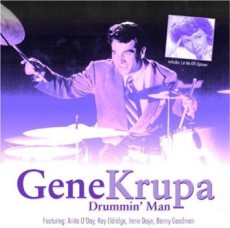
Gene Krupa was born Eugene Bertram Krupa on January 15, 1909 in Chicago, Illinois. Originally groomed for the priesthood by his parents, he He spent his grammar school days at various parochial schools and upon graduation, attended Saint Joseph’s College for a year, but later decided it was not his vocation. He studied with Sanford A Moeller and began playing drums professionally in the mid-1920s with bands in Wisconsin.
Gene broke into the Chicago scene in 1927, when he was picked by MCA to become a member of Thelma Terry and Her Playboys, the first notable American Jazz band to be led by a female musician. The Playboys were the house band at The Golden Pumpkin nightclub in Chicago and also toured extensively throughout the eastern and central United States.
Making his first recordings in 1927 with a band under the leadership of guitarist Eddie Condon and Red McKenzie, Krupa recorded others on the Chicago scene such as Bix Beiderbecke. His big influences during this time were Tubby Hall, Zutty Singleton and Baby Dodds.
By 1934 he joined Benny Goodman’s band, where his featured drum work made him a national celebrity. His tom-tom interludes on their hit “Sing, Sing, Sing” were the first extended drum solos to be recorded commercially. He made a cameo appearance in the 1941 film, Ball of Fire, in which he and his band performed an extended version of the hit Drum Drum Boogie, which he had composed with trumpeter Roy Eldridge. He also appeared in The Best Years Of Our Lives in 1946 during the waning years of the big band era.
1951 saw Gene leading a trio or quartet, appeared regularly with the Jazz At The Philharmonic band, never quite adjusted to be-bop, and by the end of the decade returned to Hollywood appearing in such films as The Glenn Miller Story, The Benny Goodman Story and had a biography starring Sal Mineo titled The Gene Krupa Story, featuring a cameo appearance by Red Nichols.
During the 1960s he played clubs in Washington, DC and New York but increasingly troubled by back pain, he retired in the late 1960s and opened a music school. He would give instruction to future KISS drummer Peter and Jerry Nolan of the New York Dolls. He occasionally played in public in the early 1970s until shortly before his death. Gene Krupa, big band drummer, band leader, actor and composer, known for his highly energetic and flamboyant style passed away on October 16, 1973.

Take A Dose On The Road
More Posts: drums
Daily Dose Of Jazz…
Ramiro Flores was born on January 12, 1977 in Buenos Aires, Argentina. He began his musical training through the alto saxophone at the age of 11 years. He studied composition at the UCA and saxophone at the National Conservatory, while both played in the band folklorist César Isella, in addition to various projects.
In 1998 he traveled to Boston to continue his studies at Berklee College of Music, where he studied with musicians such as Joe Lovano, George Garzone and Jerry Bergonzi among others. He graduated with a dual major in Film Scoring and Performance in 2002 before moving to New York and continued developing his musical career in this city.
During this period he collaborated with Pedro Giraudo, Mr. Live Big Band, Pablo Ablanedo, The Monkeys, Ryle’s Big Band, Jerry Bergonzi and Slide Hampton. For a period he worked as a show band musician for Carnival Cruise Lines, was a composer for American Music Co. and wrote a book of instruction flute, and recorded for Music Sales Corporation NYC. He began his development as a leader to form his own band and performing his own music in Boston and New York.
Returning to Argentina in 2005, he participated in the projects of the local jazz including Mariano Otero, Ligia Piro, Juan Cruz de Urquiza, Pepi Taveira and Javier Malosetti amongst numerous others. The following year he won “80mundos, and by 2007 he produced and recorded his first CD “Flowers”, for BAU records, in which he collaborated with the likes of Juan Quintero,
That same year in December he received the Clarín Award as the revelation of jazz, voted best soprano saxophonist in 2008 by the newspaper La Nación. Alto saxophonist Ramiro Flores released his sophomore project “Son Dos” and continues to perform.
Inspire A Young Mind
More Posts: saxophone
Daily Dose Of Jazz…
Neal Caine was born in St. Louis, Missouri on January 11, 1973. Growing up in University City he started out with the Suzuki Method on violin at age three. He heard a lot of Miles Davis and Dizzy Gillespie around the house as a child, inheriting his mother’s passion for jazz and learned music as a native language. He played bass at University City High School until graduating in 1991. He was immersed in the school’s jazz scene and its widely recognized jazz program alongside trumpeter Jeremy Davenport, pianist Peter Martin and saxophonist Todd Williams.
After high school, Caine still played jazz bass as a hobby and he moved to New Orleans he enrolled in Tulane University, majoring in political science and heading towards a law degree. But his love for jazz proved too strong to resist. Soon Caine was playing with the Ellis Marsalis and at gigs around the city with trumpeter Nicholas Payton, saxophonist Donald Harrison and trombonist Delfeayo Marsalis, touring Europe with the later, leaving college in his sophomore year.
A move to New York saw him joining Elvin Jones’ Jazz Machine for four years, followed by a year with Diana Krall and then on to spending the final year of her life with Betty Carter, known for her creativity and nurturing young musicians seeking solo careers. After her passing in 1998, Neal worked on establishing his name in New York and in 2000 Harry Connick Jr. called on him to tour Europe with his big band, which has become his regular gig for half a year.
He was also a frequent presence on the Smalls scene for many years, performing often with regulars Sherman Irby, Gregory Tardy, Charles Owens, Harry Whitaker, Zaid Nasser, Frank Hewitt, and others. These days, he has dual residency between New Orleans and New York City, and is active on both scenes. He’s on a long list of recordings by artists such as Wynton Marsalis, Nicholas Payton, John Hicks, Wess Anderson, Billy Hart, Oliver Lake, and Harry Connick Jr.
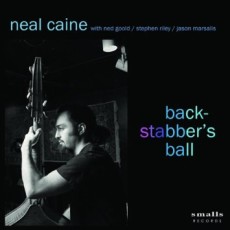
As a composer he has been influenced by the freedom and looseness of Wayne Shorter’s writings. With a long list of sideman gigs behind hem bassist Neal Caine has taken on the role of bandleader, putting a quintet together and releasing his debut recording “Backstabber’s Ball” on the Smalls Records label.
Give A Gift Of Jazz – Share
More Posts: bass
Daily Dose Of Jazz…
George Kahn was born on January 7, 1952 and grew up in New Rochelle, New York, studying classical music from the age of nine. He began composing while in high school and was always interested in improvisational music. As a Composition Major at Brandeis University, he studied the music of Charles Ives, John Cage and Karlheinz Stockhausen.
In his last years at Brandeis, being particularly affected by John Coltrane’s Kulu Se Mama, which opened his mind towards what was possible in music. After graduating, he lived on Cape Cod for a couple of years, did some gigs in Boston, toured the East Coast with a disco band and eventually moved to California in 1976.
Kahn worked in an improvising New Age group for a few years, studied arranging with Spud Murphy, and performed in a variety of settings. In the latter half of the 1990s he made his move, forming the Playing Music label and Sudhana Music Publishing. Since then he has released six CDs.
George performs frequently in the Los Angeles area, including an annual Jazz For The Homeless fundraiser for the charity PATH (People Assisting The Homeless) and benefits for public school music programs and looks forward to touring again in the near future.
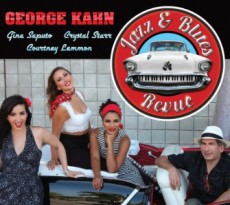
Consistently creative, pianist George Kahn has received critical acclaim for his 2008 “Cover Up!” and continues to perform, subsequently releasing “Jazz & Blues Revue”, an 8–piece band with three vocalists in 2014.
Take A Dose On The Road
More Posts: piano
Daily Dose Of Jazz…
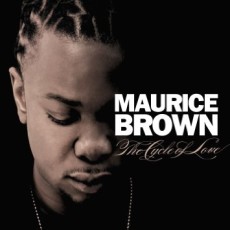
Maurice Brown was born on January 6, 1981 in Harvey, Illinois. Showing a remarkable affinity for the trumpet, he performed with Ramsey Lewis at Chicago’s Symphony Center while matriculating through Hillcrest High School. Following graduation, he received a full scholarship to attend Northern Illinois University, and later continued his studies at Southern University in Baton Rouge, Louisiana, where he worked with famed clarinetist Alvin Batiste.
Relocating to New Orleans shortly thereafter, Maurice began sitting in with numerous jazz veterans, including Clark Terry, Johnny Griffin, Ellis Marsalis and Lonnie Plaxico. He recorded as a sideman with Curtis Fuller, Fred Anderson, Roy Hargrove, Michelle Carr and Ernest Dawkins among others.
In 2001 Brown would win first place in the National Miles Davis Trumpet Competition and in 2003 he released his first album as a bandleader, heading his own quintet for Hip to Bop. The project showed an amazing affinity for bop-inflected jazz, along with a willingness to expand the genre’s lexicon through innovative techniques like playing trumpet solos through a wah-wah pedal.
Trumpeter Maurice Brown continues to live in New Orleans, playing both with his quintet and a hip-hop/funk combo called Soul’d U Out.
Dose A Day – Blues Away
More Posts: trumpet